


Reviewed by a Koukyuu Takkenshi (宅地建物取引士)
Fact-checked against current Japanese real-estate law, tax rules, and market data by a nationally licensed specialist who oversees luxury transactions across Minato, Shibuya, and Chiyoda. In Japan, a Takkenshi is legally required to sign off on every property transaction, and about 15% of candidates pass the exam each year.
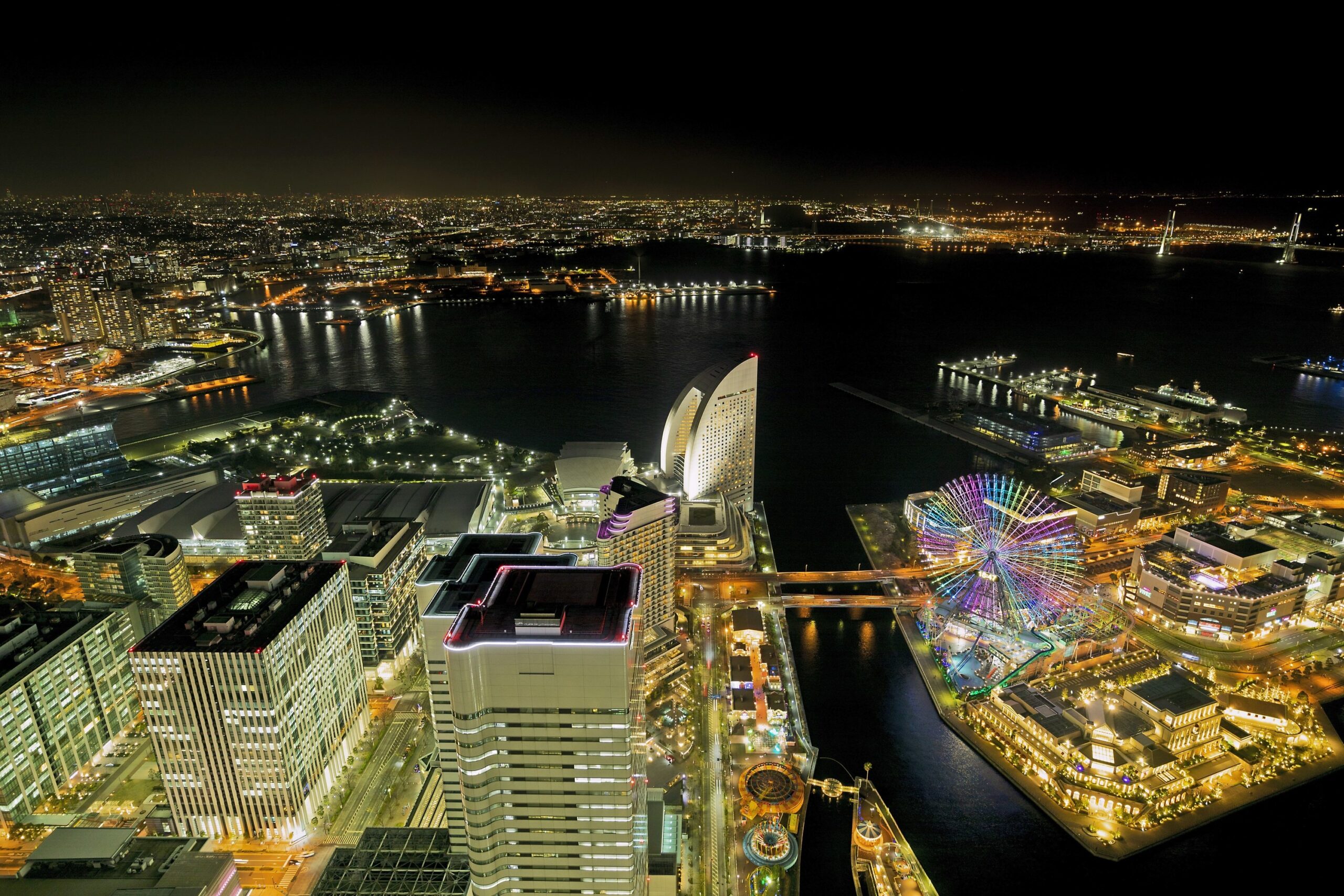
Minato Mirai’s inheritance tax route value reached ¥9.92 million per tsubo in January 2026, a second consecutive year of +9.1% growth that outpaced Yokohama City’s overall commercial land increase of +4.9%. For foreign investors acquiring bayfront tower mansions, this appreciation carries immediate cash-flow consequences. The same floor-to-ceiling glass and harbor views that command premium prices also trigger a little-discussed surcharge: Japan’s floor-level correction rate (階層別専有床面積補正率), which adds approximately 0.256% to the annual fixed asset tax burden for every floor above ground level.
The 2026 Land Price Surge and Its Tax Implications
The 2026 official land price survey (公示地価) recorded Minato Mirai at ¥2.2 million per square meter, representing +13.60% year-on-year growth, the steepest increase in the Greater Tokyo area outside the central 23 wards. Prime sites near Sakuragicho Station reached ¥3.75 million/m², while parcels adjacent to Yokohama Station touched ¥3.41 million/m². These figures mark a 4.8x recovery from the district’s 2005 post-bubble low of ¥460,000/m².
This appreciation flows directly into municipal tax assessments. Yokohama City reassesses land values every three years, with the 2024 reassessment governing tax bills from 2024 through 2026. Owners who purchased in 2022 or 2023 based on pre-surge valuations now face stepped-up assessments reflecting current market levels. The 2027 reassessment, due for announcement in early 2027, will capture any additional appreciation through December 2026.
For HNW investors, the relevant comparison is not merely against historical Minato Mirai prices but against alternative Tokyo bayfront positions. At ¥727,000/tsubo average, Minato Mirai now commands premiums approaching Tokyo’s outer wards and exceeds established commercial zones in Osaka. The district’s thermal infrastructure advantages, detailed in Yokohama’s thermal infrastructure and its ¥7.89 million tsubo premium, partially explain this compression, as corporate relocations from central Tokyo continue to absorb limited developable waterfront land.
How the Floor-Level Correction Rate Alters Tower Economics
Japan’s fixed asset tax system applies a structural bias against vertical living. For buildings exceeding 60 meters in height (approximately 20 floors) constructed or reassessed from 2018 onward, the National Tax Agency applies a floor-level correction rate that increments tax liability by roughly 0.256% per floor. A unit on the 40th floor therefore carries approximately 10% higher annual tax than an identically sized unit on the ground floor.
This mechanism, often termed the “tower mansion tax,” operates through the building portion of the fixed asset tax calculation. While land value is assessed uniformly across a condominium site, building value is allocated floor by floor. Higher floors receive upward adjustments based on market premiums for views, sunlight, and noise insulation, which the tax authority treats as enhanced asset value rather than mere preference.
The practical impact on Minato Mirai’s dominant 40-to-50-story luxury towers is substantial. A 100-square-meter unit on the 35th floor of a 2024-vintage tower carries an annual fixed asset tax and city planning tax combined burden of ¥450,000 to ¥600,000, assuming standard depreciation schedules. The identical floorplate on the 8th floor might generate ¥380,000 to ¥480,000. Over a ten-year hold, this differential compounds to ¥700,000 or more in additional tax outflow, exclusive of any appreciation-driven reassessment effects.
Investors evaluating Yokohama’s 2026 tax calendar and its reshaping of the Minato Mirai investment thesis must model these floor-specific burdens against rental yield differentials. Higher floors typically command 15-25% monthly rent premiums in Minato Mirai’s corporate tenant market, but the tax surcharge erodes this advantage by 3-5 percentage points annually.
The Five-Year Cliff: New Construction Relief and Its Expiration
New condominiums receive a 50% reduction on the building portion of fixed asset tax for five years from the date of acquisition, extendable to seven years for certified long-term quality housing (認定長期優良住宅). This relief creates a “cliff” effect: the sixth-year tax bill appears to double, though it merely represents the removal of the subsidy.
For foreign investors acquiring new towers in Minato Mirai’s 2020-2022 construction wave, 2025-2027 marks the cliff period. A unit purchased in 2020 with initial annual taxes of ¥220,000 may now face ¥440,000, before any floor-level or appreciation adjustments. Cash-flow projections drafted during acquisition often underestimated this transition, particularly for investors who assumed flat tax profiles.
The relief applies only to the building portion. Land tax, typically 60-70% of the total burden in Minato Mirai’s high-value sites, receives no reduction. The 2024 land reassessment therefore hit owners even during their relief period, with full effects visible in 2025 and 2026 bills.
Strategic implications depend on hold duration. Investors with sub-five-year horizons benefited from suppressed carrying costs. Those with ten-to-fifteen-year holds must normalize post-cliff tax levels into yield calculations. The most complex cases involve 2026 acquisitions of 2020-2021 vintage units: the purchaser inherits the remaining relief period, then faces immediate cliff exposure, while also absorbing the 2024 land reassessment at full value.
Payment Mechanics for Non-Resident Owners
Yokohama City issues fixed asset tax and city planning tax notices (納税通知書) annually in early April, with four installment dates: June, September, December, and February. Non-resident owners face three payment channels, each with distinct friction costs.
Automatic debit from a Japanese bank account remains the lowest-cost option, requiring only the initial setup and maintaining sufficient balances. Foreign investors without resident banking relationships must either establish accounts during acquisition structuring or accept higher-cost alternatives.
Credit card payment via the F-REGI municipal payment system incurs processing fees of approximately ¥70-80 per ¥10,000 of tax, translating to ¥3,500-4,800 in fees on a ¥500,000 annual bill. Smartphone payment options (Rakuten Pay, au PAY, FamiPay) offer point redemption opportunities, though municipal payment rules and point structures change frequently. Verification of current terms before each installment is prudent.
Critical compliance requirement: foreign owners must maintain current address registration with Yokohama City’s tax office. The municipal website provides dedicated guidance for overseas residents (国外にお住まいの方・長期間国外に滞在される方へ), including procedures for proxy payment and documentary requirements. Failure to update addresses risks missed notices, late penalties of 10-14.6% annualized, and potential enforcement actions including property liens.
For investors holding through corporate vehicles, the tax payment obligation falls on the registered owner. Structures involving Japanese operating companies with foreign parent ownership must ensure local subsidiary compliance, as Yokohama City does not recognize foreign parent guarantees for municipal tax purposes.
Combined Annual Burden: A 2026 Calculation Framework
Total property tax exposure in Minato Mirai combines three elements: land value assessment, building value assessment with floor-level adjustment, and the city planning tax surcharge.
Yokohama City applies a 1.4% fixed asset tax rate and 0.3% city planning tax rate to assessed values. Assessments typically run at 70% of market value for land and depreciated reconstruction cost for buildings, though the 2024 reassessment narrowed this gap for prime Minato Mirai sites.
A 2024 case study: 85-square-meter unit, 28th floor, tower completed 2021. Land share: ¥45 million assessed at 70% = ¥31.5 million. Building: ¥28 million replacement cost, 60% depreciated = ¥16.8 million. Floor-level correction: +7.2% adjustment. Combined assessment: ¡31.5m + (¥16.8m × 1.072) = ¥49.5 million. Tax at 1.7% combined rate: ¥841,500 annually. Post-relief cliff (from 2026): full ¥841,500 due, versus ¥420,750 during relief period.
Investors comparing Minato Mirai against Motomachi’s 4% land price gap and its different investment profile should model these complete tax stacks rather than headline price differentials. The ¥200,000-400,000 annual tax range for mid-range resale towers versus ¥400,000-600,000+ for premium high-floor new construction represents meaningful divergence in net operating income.
Inheritance Tax Route Value: The 2026 Benchmark
Separate from municipal property taxes, Japan’s inheritance tax route value (相続税路線価) establishes the valuation basis for estate and gift taxation. The 2026 route value for Minato Mirai commercial land of ¥9.92 million/tsubo, up from ¥9.02 million in 2025, affects foreign investors through Japan’s expansive inheritance tax jurisdiction.
Japan taxes worldwide assets of decedents domiciled in Japan, and Japan-situs assets of non-domiciled decedents, including real property. The route value, typically 80% of market value, determines the taxable base. A ¥500 million Minato Mirai tower unit might carry a ¥400 million route value assessment, potentially triggering Japanese inheritance tax exposure even for non-resident foreign owners.
The 2026 route value surge compounds this exposure for recent acquisitions. Investors who purchased at 2023-2024 prices now face estate tax assessments reflecting 2026 valuations, creating potential mismatches between acquisition cost basis and taxable value. Treaty relief may apply for certain nationalities, but structural planning before acquisition remains essential.
For investors with 永住権 (eijuuken, Japanese permanent residency), the domicile rules tighten further. Permanent residents are treated as domiciled in Japan for inheritance tax purposes regardless of actual residence patterns, subjecting global assets to Japanese estate taxation at progressive rates reaching 55% above ¥600 million.
Koukyuu is a private buyer’s advisory for distinguished Tokyo residences in Azabu (麻布), Hiroo (広尾), and Shirokane (白金), focused exclusively on transactions of ¥300 million and above. A licensed 宅建士 (takken-shi, Japan’s licensed real-estate transaction specialist) personally handles every stage of the engagement, from the first consultation to the signing. Begin a private conversation).