


Reviewed by a Koukyuu Takkenshi (宅地建物取引士)
Fact-checked against current Japanese real-estate law, tax rules, and market data by a nationally licensed specialist who oversees luxury transactions across Minato, Shibuya, and Chiyoda. In Japan, a Takkenshi is legally required to sign off on every property transaction, and about 15% of candidates pass the exam each year.
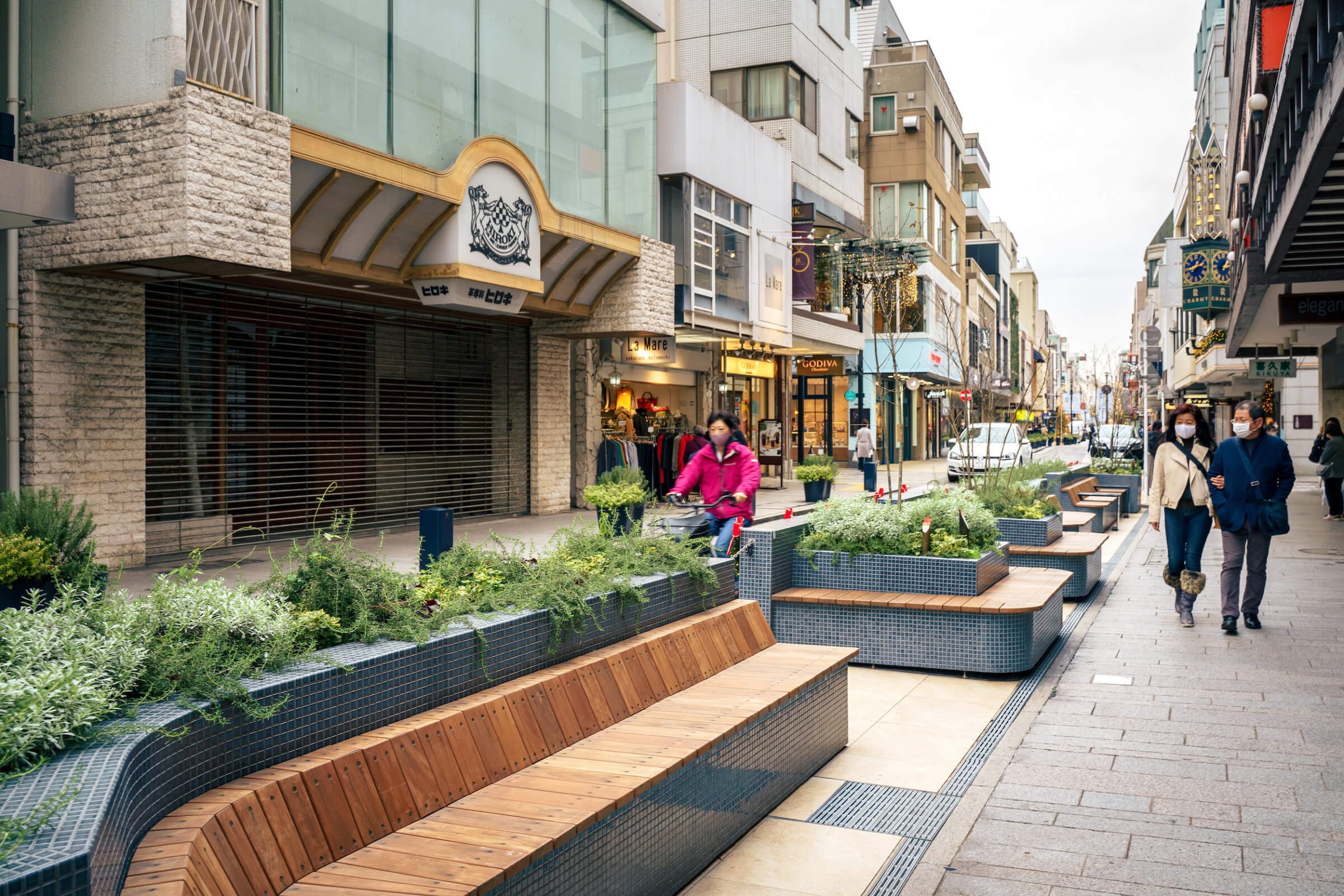
The Motomachi Charming Sale 2026 Spring concluded on March 1 after nine days of district-wide promotions, drawing foot traffic through a 600-meter retail corridor that has operated continuously since 1955. The event’s visual theme tied directly to GREEN×EXPO 2027, the International Horticultural Exhibition opening in Yokohama next April. This is not incidental decoration. The Motomachi shopping street cooperative holds trademark registration No. 3120211 on the “Charming Sale” brand, making it one of the few Japanese shopping districts with institutionalized retail management rather than ad hoc merchant coordination.
For property investors, the more significant signal sits beneath the flower arches. Official land price data for January 2026 places Motomachi’s average at ¥1,230,500 per square meter, up 4.34% year-on-year. That acceleration from 2025’s 3.77% growth rate is notable. What demands attention, however, is the spread. Minatomirai, twelve minutes north on the same Minatomirai Line, commands ¥2,200,000 per square meter, a 13.6% annual increase. Motomachi trails by 44% on price and roughly nine percentage points on growth velocity.
The Price Dispersion Within a Single Postal Code
Motomachi’s ¥1.23 million average conceals extremes that matter for acquisition strategy. Prime commercial frontage in Motomachi 3-chome, within 200 meters of Motomachi-Chukagai Station, trades at ¥2,010,000 per square meter, or ¥6.64 million per tsubo. Shift 400 meters northwest to Motomachi 1-chome’s Category 1 residential zone and land prices fall to ¥451,000 per square meter, ¥1.49 million per tsubo. That 4.5x intradistrict spread exceeds what most Tokyo wards show across their entire territory.
The zoning mechanics explain this. Motomachi carries three distinct designations: commercial zone (商業地域) along the shopping street core, Category 1 residential (第一種住居地域) in the interior blocks, and quasi-industrial pockets near the freight corridors. Building coverage ratios (建蔽率) range from 60% to 80%, floor-area ratios (容積率) from 200% to 500% depending on specific chome and frontage width. A 150-square-meter commercial plot with 400% FAR yields 600 square meters of buildable floor area. The same footprint in Category 1 residential with 200% FAR delivers half that volume.
Investors evaluating houses for sale in Yokohama Japan must parse these granular distinctions. The aggregate “Motomachi” label appearing in English-language property portals rarely distinguishes between a 4-story mixed-use building on the main shopping street and a 2-story wooden structure on a residential back lane. The price per square meter of built space can diverge by 300% or more.
Tax Obligations and Holding Costs in Yokohama Municipality
Yokohama’s property tax structure follows national standards with municipal variation. Fixed asset tax (固定資産税, kotei shisan-zei) applies at 1.4% of assessed value, assessed by the Kanagawa Prefecture valuation committee every three years. City planning tax (都市計画税, toshi keikaku-zei) adds 0.3% for properties within urbanization promotion areas. Motomachi falls entirely within this designation.
The combined 1.7% annual holding cost applies to land and building assessments separately. For a ¥300 million commercial property in Motomachi 3-chome, annual tax obligations approximate ¥5.1 million before income tax considerations. Depreciation schedules for reinforced concrete structures allow 47-year straight-line write-downs, or roughly 2.13% annually, partially offsetting taxable rental income.
Foreign investors should note that Yokohama City offers no foreign-specific tax incentives comparable to Osaka’s designated financial zone benefits or Fukuoka’s startup visa property programs. The 2026 tax environment is functionally identical for domestic and overseas owners, though repatriation of sale proceeds requires documentation of 源泉徴収 (gensen choshu, withholding tax) compliance. For non-resident sellers, 10.21% of gross sale price is withheld at 登記 (touki, legal title transfer), reconciled against actual capital gains liability in the following tax year.
Motomachi Versus Minatomirai: Two Yokohama Strategies
The 44% price gap between Motomachi and Minatomirai reflects fundamentally different risk-return profiles. Minatomirai’s 13.6% annual appreciation tracks the Yokohama Station district’s transformation into a secondary financial center, anchored by the 2020 relocation of Nissan Motor headquarters and sustained demand from Tokyo commuters utilizing the 28-minute Tokaido Line connection. Floor-area ratios in Minatomirai’s central blocks reach 1,000% for specific redevelopment parcels, enabling vertical density that Motomachi’s historic streetscape protections prohibit.
Motomachi offers a contrarian structure. The shopping street cooperative’s 2026 promotional calendar includes the ongoing Motomachi Garden Party 2026, running April 25 through June 7, with rose arch installations and pedestrian zone activation. These events sustain foot traffic without requiring the capital intensity of Minatomirai’s landmark architecture. The district’s 1950s-era concrete buildings, many under 50 years old and thus pre-dating modern seismic standards, present either redevelopment candidates or maintenance liabilities depending on structural assessment.
For investors prioritizing current yield over appreciation, Motomachi’s commercial rents show resilience. Ground-floor retail along the main shopping street commands ¥15,000–¥20,000 per tsubo monthly, yielding 4.5%–6.0% gross on typical acquisition prices. Minatomirai’s comparable retail, concentrated in the Landmark Plaza and Queen’s Square complexes, achieves ¥25,000–¥35,000 per tsubo but on triple-net structures with higher tenant improvement obligations and vacancy exposure to anchor tenant volatility.
The Motomachi Charming Sale’s institutionalization, with its cooperative-managed branding and GREEN×EXPO 2027 tie-ins, suggests a district actively managing its visitor economy rather than passively collecting rent from legacy tenants. This operational distinction matters for investors evaluating property investment durability through the 2027–2030 horizon.
GREEN×EXPO 2027 and Infrastructure Timing
The International Horticultural Exhibition opening April 2027 in Yokohama’s Kanazawa Ward will draw an estimated 4 million visitors over six months. Motomachi’s positioning as the historic gateway between Yokohama Station and the waterfront exhibition zone, accessible via the Minatomirai Line’s through-service to Shibuya in 28 minutes, creates specific traffic flow implications.
The Yokohama City government has committed ¥47 billion in infrastructure spending ahead of the Expo, including waterfront promenade extensions and pedestrian bridge improvements connecting Motomachi to Yamashita Park. These projects, scheduled for completion by March 2027, will alter pedestrian circulation patterns through the shopping street’s eastern terminus. For commercial property owners, the construction period presents temporary access disruptions followed by potential foot traffic increases of 15–25% during the exhibition months.
Post-Expo legacy planning remains unspecified. Unlike Osaka’s 2025 Expo site, which has pre-committed conversion to a residential and research district, Yokohama’s 2027 venue lacks published reuse documentation. Investors should treat Expo-related demand as a 2027–2028 spike rather than a permanent demand shift, underwriting accordingly.
Acquisition Mechanics for Foreign Buyers
Japan imposes no foreign ownership restrictions on commercial or residential property in Motomachi’s zoning categories. The 宅建士 (takken-shi, licensed real-estate transaction specialist) conducting 重要事項説明 (juuyou-jikou-setsumei, statutory pre-contract disclosure) must explain building standards law compliance, seismic retrofit obligations for pre-1981 structures, and any 賃貸借 (chintaishaku, lease) encumbrances affecting vacant possession.
Financing availability diverges sharply by residency status. Japanese permanent residents (永住権, eijuuken) and long-term residents with stable domestic income can access 35-year fixed-rate mortgages at approximately 1.8%–2.4% through major banks. Non-resident purchasers typically face 50%–60% loan-to-value limits from institutions like Shinsei Bank or SMBC Trust, with rates 150–250 basis points higher. Some Singapore and Hong Kong private banks offer yen-denominated Lombard lending against portfolio securities, bypassing Japanese mortgage underwriting entirely for sufficiently capitalized buyers.
Due diligence in Motomachi requires particular attention to 境界 (kyoukai, boundary) precision. The district’s pre-war cadastral records, updated during 1960s urban planning revisions, contain discrepancies between registered area and surveyed measurements in approximately 12% of parcels according to Kanagawa Legal Affairs Bureau statistics. A ¥300,000 boundary survey (境界確定測量) prior to 手付金 (tetsuke-kin, earnest money deposit) submission eliminates post-contract renegotiation risk.
Koukyuu is a private buyer’s advisory for distinguished Tokyo residences in Azabu (麻布), Hiroo (広尾), and Shirokane (白金), focused exclusively on transactions of ¥300 million and above. A licensed 宅建士 (takken-shi) personally handles every stage of the engagement, from the first consultation to the signing, a continuity most Tokyo agencies do not offer. Book a private consultation).