


Reviewed by a Koukyuu Takkenshi (宅地建物取引士)
Fact-checked against current Japanese real-estate law, tax rules, and market data by a nationally licensed specialist who oversees luxury transactions across Minato, Shibuya, and Chiyoda. In Japan, a Takkenshi is legally required to sign off on every property transaction, and about 15% of candidates pass the exam each year.
The “green” light on a Japanese traffic signal is not quite green. Measured at a dominant wavelength of approximately 494 nanometres, it sits at the blue-green boundary of the visible spectrum, and that placement is not accidental. It is the result of a 1973 government directive, a linguistic argument that predates modern traffic engineering, and a compromise that has quietly shaped how tens of thousands of foreign residents navigate Japanese roads every day.
Why Japan’s Traffic Lights Show Blue Instead of Green
The core explanation is linguistic. In classical Japanese, a single word, 青 (ao), covered both blue and green before the colour 緑 (midori, green) was established as a distinct everyday term. Traffic lights were introduced to Japan in 1930, and the “go” signal was officially designated 青 (ao), meaning the language embedded blue into the concept of proceeding before any standard was set for the actual hue of the lamp.
By the 1970s, the mismatch between the internationally specified green signal and Japan’s ao designation had become a regulatory problem. The government’s solution, formalised in 1973, was to require that the go signal use the bluest permissible shade of green allowed under international standards set by the Commission Internationale de l’Éclairage (CIE). The result is a signal that is technically compliant with global norms while remaining visually blue enough to justify the Japanese name. Why Japan has blue traffic lights instead of green has been covered extensively in international media, but the regulatory precision behind the 1973 directive is rarely discussed in English-language sources.
For foreign drivers, the practical takeaway is simple: the bluish light means go. The colour shift is visible but not dramatic, and once you know to expect it, it stops being disorienting within a few days of driving.
Horizontal Layouts and Signal Positioning
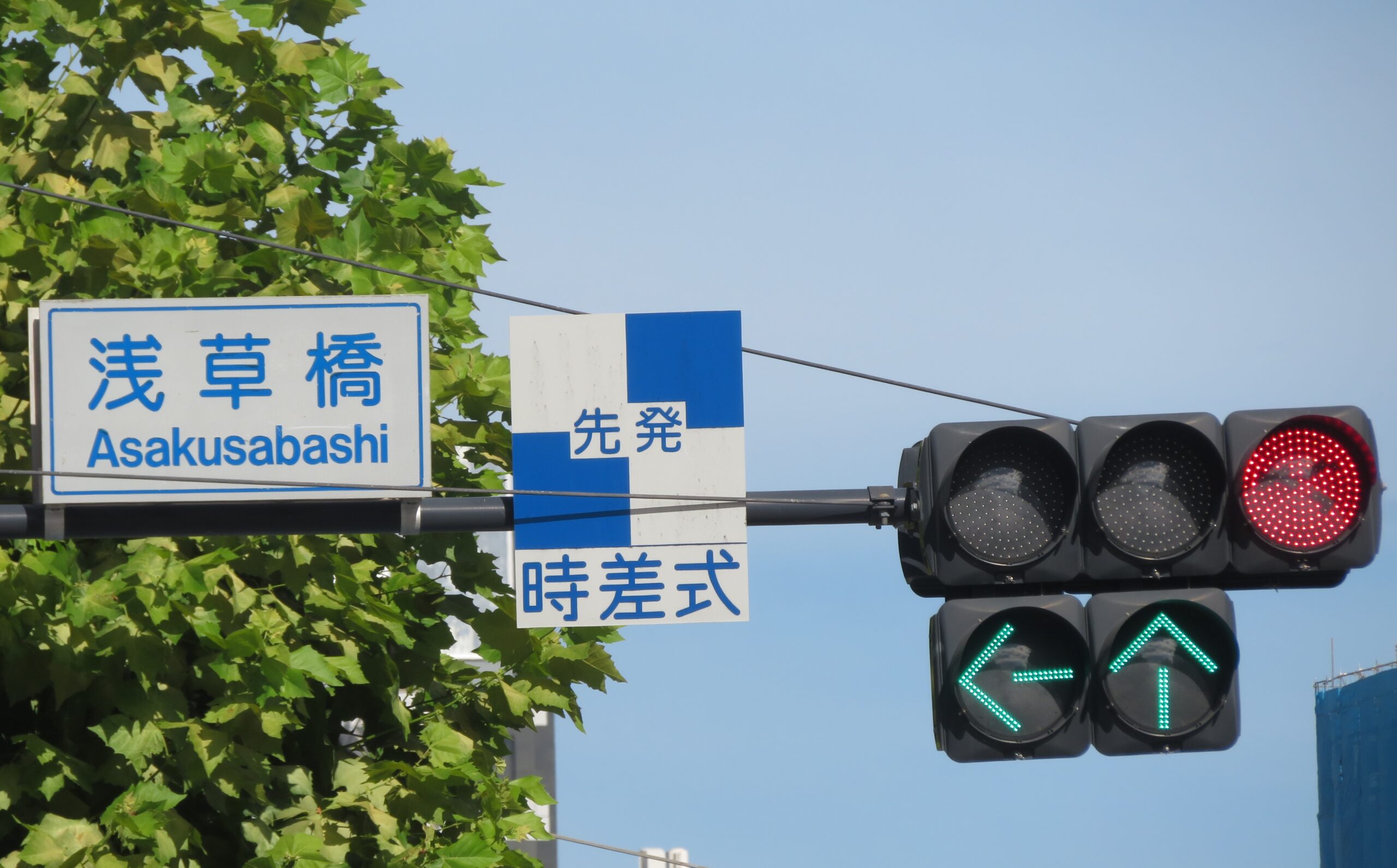
Beyond colour, the physical orientation of Japanese traffic signals surprises most newcomers. In the majority of countries, signals hang vertically with red at the top, yellow in the middle, and green at the bottom. In Japan, the dominant configuration is horizontal, mounted on overhead gantries or on poles at the roadside, with red on the right, yellow in the centre, and green (ao) on the left.
The horizontal layout was adopted partly for practical reasons: Japan receives significant snowfall in prefectures including Niigata (新潟), Akita (秋田), and Hokkaido (北海道), and a horizontal housing reduces snow accumulation on the lens covers. In high-snowfall areas, signals are sometimes mounted vertically with protective hoods, but the horizontal format remains the national standard in urban areas including Tokyo.
For residents of Minato-ku (港区) or Shibuya-ku (渋谷区) who drive, the horizontal layout becomes second nature quickly. The colour sequence, right to left, mirrors the Japanese convention of reading text from right to left in traditional formats, though traffic engineers have not formally cited that as a design rationale.
Arrow Signals, Pedestrian Crossings, and the Turn-on-Red Question
One of the most consequential differences for foreign drivers is Japan’s approach to turning at red lights. In the United States and several other countries, turning right on a red signal (or left, depending on which side of the road you drive on) is permitted after stopping unless a sign prohibits it. In Japan, this is not permitted. A red signal means stop and wait, with no default right-of-turn allowance. Proceeding on red without an explicit green arrow signal is a violation under the 道路交通法 (Dōkō Kōtsū Hō, Road Traffic Act).
Green arrow signals in Japan indicate that movement in the arrow’s direction is permitted even when the main signal is red or yellow. This applies to vehicles and, in some configurations, to pedestrians. Arrows appear as separate indicator lights adjacent to the main signal cluster and are used frequently at complex intersections in central Tokyo, including those around Roppongi (六本木), Aoyama (青山), and Shibuya (渋谷).
Pedestrian signals operate on a separate cycle from vehicle signals at most intersections. The pedestrian go signal is a walking figure in green (again, rendered in the ao blue-green shade), and the warning phase shows a flashing figure. Crossing during the flashing phase is technically permitted but inadvisable; the interval before the vehicle signal turns green is short, typically five to eight seconds at busy intersections in central Tokyo.
Bicycle Signal Rules: Changes Effective April 2026
The most significant recent development in Japanese traffic signal compliance for foreign residents involves bicycles. From April 1, 2026, Japan introduced a revised enforcement framework for cyclists, including an on-the-spot fine system colloquially known as the 青切符 (ao-kippu, blue ticket) system. Under this framework, police officers can issue immediate fines for specific cycling violations, including running red lights, without the matter proceeding through the full summary court process that previously applied.
The fine for running a red light on a bicycle under the April 2026 rules is ¥12,000 for a first offence in most prefectures, with escalating penalties for repeat violations within three years. Cycling on the wrong side of the road and using a mobile phone while cycling are also covered under the ao-kippu system. New bicycle fines and traffic rules for 2026 detail the full schedule of violations and fines.
For foreign residents living in central Tokyo neighbourhoods and commuting by bicycle, which is common in areas including Hiroo (広尾), Nishi-Azabu (西麻布), and Kita-Aoyama (北青山), the April 2026 changes represent a material shift. The previous enforcement approach was largely discretionary and rarely applied to cyclists at minor intersections. The ao-kippu system changes that calculus.
Signal compliance for cyclists in Japan follows the same basic rules as for vehicles: obey the signal facing you, stop on red, proceed on green, and do not enter the intersection during the amber phase. At intersections with dedicated bicycle signals, the bicycle signal governs; where no dedicated signal exists, cyclists follow the vehicle signal.
The Himakajima Exception and Other Signal Curiosities
Japan has one traffic light that turns green exactly once per year. On Himakajima (姫島), a small island in Aichi Prefecture (愛知県) with a year-round population of under 200, the island’s single traffic signal switches to green annually as part of a road safety education event for local elementary school children. The signal otherwise remains red. This traffic light in Japan only turns green once a year has attracted international attention, and while it is an extreme case, it illustrates how Japanese traffic infrastructure is sometimes adapted to hyperlocal conditions in ways that have no equivalent elsewhere.
More practically relevant for urban residents are the 時差式信号 (jisa-shiki shingō, staggered-phase signals) used at pedestrian crossings near schools and hospitals in central Tokyo. These signals give pedestrians a head start of three to five seconds before the vehicle signal changes, reducing conflict at high-footfall crossings. They are visually identical to standard signals, so the only indication is a small placard on the signal pole.
Sensory-equipped signals, called 感応式 (kanjō-shiki, vehicle-detection signals), adjust their cycle length based on real-time traffic volume. These are common on arterial roads in Minato-ku and Shibuya-ku. If you are waiting at what appears to be a malfunctioning signal, it may simply be a kanjō-shiki signal waiting for sufficient vehicle presence before cycling.
Living in Tokyo: Traffic Signals in Neighbourhood Context
For foreign residents considering where to live in central Tokyo, the practical experience of navigating intersections varies meaningfully by neighbourhood. Azabu (麻布) and Hiroo have a relatively low density of complex multi-phase intersections compared with Shibuya or Shinjuku (新宿), making them more manageable for drivers still acclimatising to Japanese road conventions. The main arterial roads in these neighbourhoods, including Gaien-Higashi Dori (外苑東通り) and Hiroo Dori (広尾通り), use standard horizontal signals with clearly marked pedestrian phases.
Areas closer to major transit hubs, including the intersections around Roppongi Hills (六本木ヒルズ) and Azabudai Hills (麻布台ヒルズ), involve more complex signal configurations with multiple arrow phases and dedicated turning lanes. Drivers new to Tokyo should allow extra time at these intersections until the signal logic becomes familiar.
Understanding the physical environment of a neighbourhood, including its road layout, signal density, and pedestrian infrastructure, is part of the due diligence that serious buyers conduct before committing to a residence. For buyers considering a マンション (manshon, Japanese usage for a freehold condominium, distinct from the English word “mansion”) in central Tokyo, walkability and street-level navigability are factors that affect daily quality of life in ways that floor plans and listing photos do not capture. Our apartment sizes in Japan guide covers how Japanese residential measurements work, and our apato vs manshon comparison explains the structural and legal differences between property types that foreign buyers most commonly encounter.
For buyers considering properties beyond the urban core, including traditional residential structures, the road and signal environment changes substantially. Rural prefectures use vertical signal configurations more frequently, and enforcement of cycling rules under the April 2026 ao-kippu system is less consistent outside major cities. Our guide to traditional houses for sale in Japan addresses the additional due diligence considerations that apply when moving beyond central Tokyo.
Koukyuu is a private buyer’s advisory for distinguished Tokyo residences in Nishi-Azabu, Kita-Aoyama, Roppongi Hills, and Azabudai Hills, focused exclusively on transactions of ¥300 million and above, with a licensed 宅建士 (takken-shi, Japan’s licensed real-estate transaction specialist) personally managing every stage from initial consultation through contract signing, a continuity most Tokyo agencies do not provide. Book a private consultation) to begin a confidential conversation about your requirements.