


Reviewed by a Koukyuu Takkenshi (宅地建物取引士)
Fact-checked against current Japanese real-estate law, tax rules, and market data by a nationally licensed specialist who oversees luxury transactions across Minato, Shibuya, and Chiyoda. In Japan, a Takkenshi is legally required to sign off on every property transaction, and about 15% of candidates pass the exam each year.
Toyota Rent a Car, Nippon Rent-A-Car, and ORIX Auto each operate more than 1,000 locations across Japan as of April 2026, making them the three largest domestic car rental networks in the country. For foreign residents and visitors, navigating Japanese rental contracts involves several layers of specificity — insurance structures, ETC (Electronic Toll Collection) card logistics, International Driving Permit requirements, and pricing that varies sharply by season and vehicle class. This guide works through each element with concrete figures so you can make an informed booking before you pick up the keys.
The Major Rental Companies and What Distinguishes Them
Five companies account for the bulk of foreign-facing car rental volume in Japan in 2026: Toyota Rent a Car, Nippon Rent-A-Car, ORIX Auto, Times Car, and Budget Rent a Car Japan. Budget operates approximately 120 locations across 35 prefectures and is the only internationally branded rental company with a significant Japan footprint. The domestic brands, particularly Toyota and Nippon, carry larger fleets and more rural coverage, which matters if you are driving from a major city into the countryside.
For foreigners living in Tokyo and renting for a weekend trip, the most practical pickup points are Shinjuku (新宿), Shibuya (渋谷), and the major airport counters at Narita (成田) and Haneda (羽田). Tokyo city-center rental rates for a compact car (Toyota Aqua class) typically run ¥6,000 to ¥9,000 per day in off-peak periods in 2026. Premium vehicles, including hybrid SUVs and minivans, range from ¥12,000 to ¥22,000 per day before insurance add-ons. Airport surcharges of ¥500 to ¥1,500 per rental are standard at both Narita and Haneda.
Times Car has expanded its one-way rental program significantly since 2025, allowing drop-offs at a different location from pickup for a flat one-way fee of ¥3,300 to ¥5,500 depending on distance band. This is useful for itineraries that move linearly, such as driving from Tokyo toward Hakone (箱根) or along the Izu (伊豆) Peninsula without backtracking.
Insurance in Japan: Two Mandatory Layers and Two Optional Ones
Japanese car rental insurance operates on a four-tier structure that differs from the single-CDW model common in North America and Europe. Understanding each tier before you sign the contract prevents expensive surprises at return.
Compulsory Automobile Liability Insurance (自賠責保険, jibaiseki hoken) is built into every rental by law. It covers bodily injury to third parties up to ¥30 million per victim in death cases and ¥4 million for injury. It does not cover property damage or damage to the rental vehicle itself. Voluntary Liability Insurance (任意保険, nin’i hoken) is the second layer, also included by all major rental companies in their standard rate. This extends third-party coverage to property damage and raises the bodily injury ceiling substantially, typically to unlimited or ¥100 million per incident depending on the policy. Confirm this is included in your quoted rate, as a small number of budget operators strip it out to advertise a lower headline price. Collision Damage Waiver (CDW, 車両補償, sharyou houshou) covers damage to the rental vehicle. Most companies offer this as an add-on for ¥1,000 to ¥1,500 per day. Without it, you are liable for repair costs up to the vehicle’s assessed value, which can reach ¥1.5 million to ¥3 million for a newer hybrid or SUV. Non-Operation Charge Waiver (NOC免除, NOC menjo) is the layer most foreign renters overlook. NOC (Non-Operation Charge) is a fee the rental company charges when a damaged vehicle cannot be rented out during repairs, regardless of fault. The standard NOC is ¥20,000 if the car can be driven back to the depot and ¥50,000 if it requires a tow. Waiving this costs ¥500 to ¥1,000 per day and is worth adding. The Japan Car Rental Guide from gltjp.com provides a clear breakdown of how NOC applies in practice across major operators.A note on overseas credit card coverage: several premium cards issued outside Japan claim to include CDW for international rentals. In practice, most Japanese rental companies require you to purchase their own CDW at the counter regardless of card coverage, and card-based CDW rarely covers the NOC component. Verify your card’s specific Japan policy before relying on it. Our Japan Credit Card Guide 2026 covers which card types are accepted and how foreign-issued cards interact with Japanese merchant requirements.
ETC Cards: How the Expressway Toll System Works
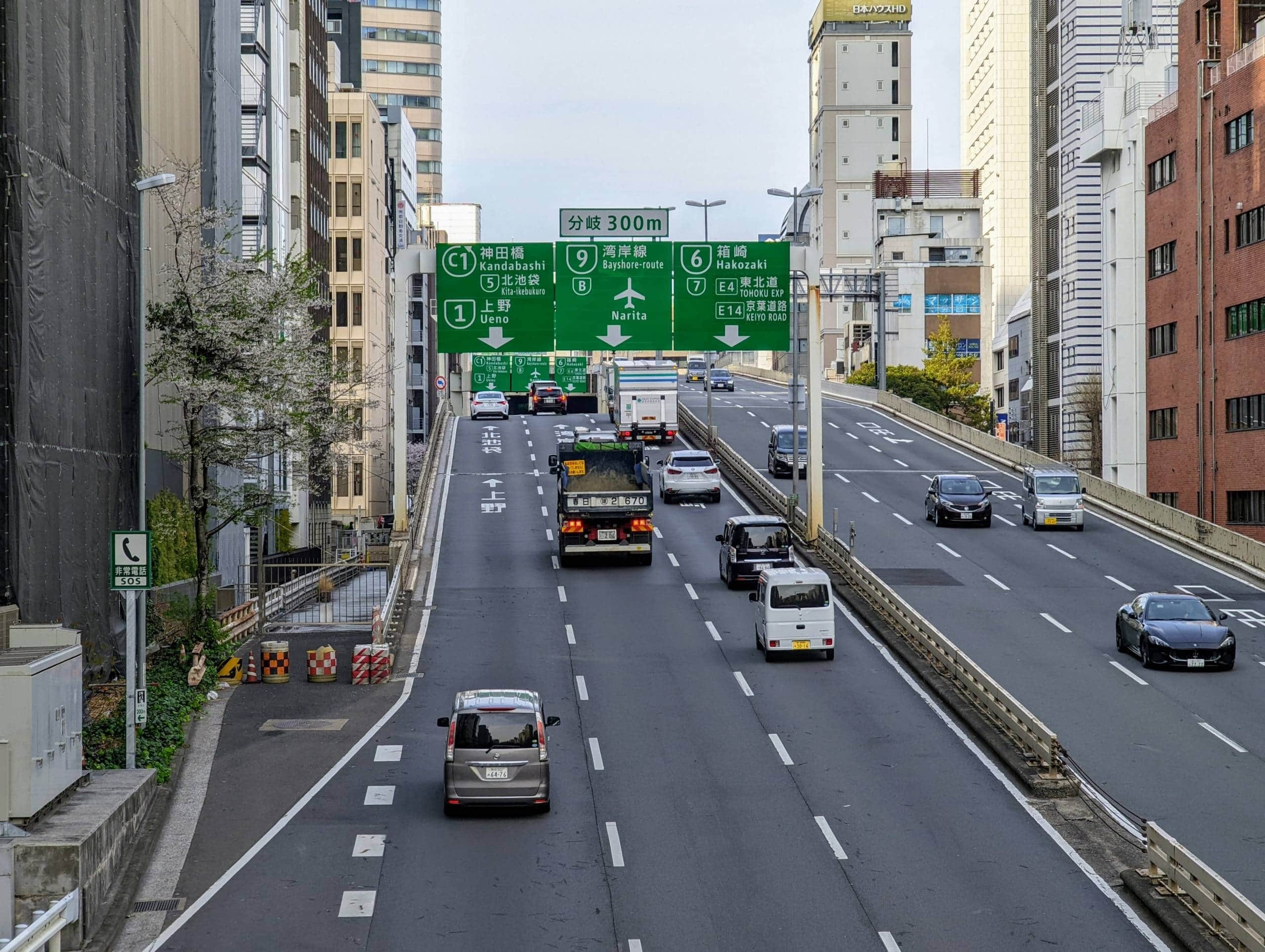
ETC (Electronic Toll Collection, 料金自動収受システム) is Japan’s cashless expressway toll system. Vehicles equipped with an in-car ETC unit pass through dedicated toll gates at low speed without stopping, with fees charged to a registered ETC card. As of 2026, the overwhelming majority of Japan’s expressway toll gates are ETC-compatible, and cash lanes are being phased out on several routes.
For rental customers, the process works as follows. The rental vehicle comes fitted with an ETC unit (ETC車載器, ETC-shasakiki). You rent an ETC card from the counter at an additional charge of ¥300 to ¥550 per rental period, not per day. The card is inserted into the unit before you drive. Toll charges accumulate on the card throughout your rental. At return, you settle the total toll balance, which is itemized on your receipt.
Expressway tolls in Japan are distance-based and vary by road class. A typical Tokyo-to-Hakone expressway run via the Tomei (東名) or Odawara (小田原) route costs approximately ¥2,600 to ¥3,400 in tolls one way as of 2026. A longer drive, such as Tokyo to Kyoto (京都) on the Tomei and Meishin (名神) expressways, runs ¥6,000 to ¥8,500 depending on vehicle class and route choices.
Some rental companies offer a flat-rate ETC plan for tourists, capping daily toll costs at a fixed amount (typically ¥1,500 to ¥2,000 per day) for a set number of days. These plans are available primarily through Toyota Rent a Car and Nippon Rent-A-Car and require advance booking. They represent good value on itineraries with heavy expressway use. According to ready2drivejapan.com’s 2026 driving guide, the per-rental ETC card fee is typically ¥300 to ¥500 for standard rentals.
If you are a long-term foreign resident in Japan and own a vehicle, you can apply for a personal ETC card through your Japanese bank or credit card issuer. The card is linked to your account and eliminates the rental-period surcharge entirely. This is relevant context if you are weighing car ownership as part of your Tokyo living costs, a topic covered in detail in our Cost of Moving to Japan: Complete 2026 Relocation Budget.
Driving Licenses and IDP Requirements for Foreign Renters
Japan accepts International Driving Permits (IDP, 国際運転免許証, kokusai-unten-menkyosho) issued under the 1949 Geneva Convention. This covers permits from most Western countries, including the United States, the United Kingdom, Australia, Canada, and most EU member states. Permits issued under the 1968 Vienna Convention alone (some Eastern European countries) are not accepted.
The IDP must be accompanied by your original national driving license at all times. Rental companies will inspect both documents at pickup. A valid IDP is required regardless of how long you have been in Japan, unless you have converted to a Japanese license (日本の運転免許証, nihon no unten-menkyosho).
Drivers from Switzerland, Germany, France, Belgium, Monaco, Slovenia, and Taiwan are exempt from the IDP requirement and may rent using their national license plus an official Japanese translation, available from the Japan Automobile Federation (JAF, 日本自動車連盟) for ¥3,000 per document.
If you are a foreign resident who has lived in Japan for more than one year, you are legally required to convert your foreign license to a Japanese one rather than continue using an IDP. Rental companies can and do verify length of stay against your residence card (在留カード, zairyu-card). Presenting an IDP after more than 12 months of continuous residence is grounds for refusal at the counter.
Booking Strategies and Where Prices Are Lowest
Direct booking through the rental company’s own English-language website typically produces the lowest base rate in 2026, as third-party aggregators add a margin of ¥500 to ¥2,000 per day. Toyota Rent a Car, Nippon, and ORIX all maintain functional English booking platforms with full insurance selection at checkout.
Peak pricing windows to avoid, or book well in advance for, include Golden Week (ゴールデンウィーク, late April to early May), Obon (お盆, mid-August), and the New Year period (年末年始, late December to early January). During these windows, compact car rates in Tokyo can reach ¥15,000 to ¥20,000 per day, and availability at city-center depots collapses within days of the period opening. Booking six to eight weeks ahead is standard practice for Golden Week 2026.
For foreign residents based in central Tokyo who need a car occasionally rather than regularly, the per-use economics often favor car-sharing services (カーシェアリング, car-sharing) over traditional rental. Times Car Share and Careco operate dense networks of reserved parking bays across Minato-ku (港区), Shibuya-ku (渋谷区), and Shinjuku-ku (新宿区). Rates start at ¥220 per 15 minutes for a compact, with no counter process, no insurance paperwork, and no return-time negotiation. The tradeoff is that car-share vehicles are compact and unsuitable for longer expressway trips with luggage.
For residents of central Tokyo neighborhoods who own a vehicle, parking costs are a significant fixed expense. Monthly parking in Minato-ku ranges from ¥40,000 to ¥80,000 per month in 2026 depending on proximity to Roppongi (六本木) or Azabu (麻布). Our guide to parking in Tokyo covers how to locate and contract a parking space, including the legal requirement under the 車庫証明 (shako-shomei, garage certificate) system to prove a parking space before registering a vehicle.
Practical Checklist Before You Pick Up the Keys
The following items apply to foreign renters in Japan regardless of which company or vehicle class you choose.
Documents to bring: Original national driving license, valid IDP (Geneva Convention), passport, and your Japanese residence card if you are a registered resident. Some companies also request a second form of ID. Payment: All major rental companies accept Visa and Mastercard for the deposit hold, which is typically ¥30,000 to ¥50,000 placed on the card at pickup and released within 3 to 7 business days of return. American Express is accepted at Toyota, Nippon, and Budget but not universally at ORIX or Times Car. Cash-only customers face restrictions at most major operators. Insurance selection at the counter: Confirm that your rate includes voluntary liability insurance. Add CDW (¥1,000 to ¥1,500 per day) and NOC waiver (¥500 to ¥1,000 per day) unless you have verified, Japan-specific card coverage in writing from your card issuer. ETC card: Request it at booking, not at the counter, to ensure availability. Confirm whether your rental includes a flat-rate toll plan or a pay-as-you-go card. Fuel: Japan rental cars are returned full. Fuel type (regular, premium, or hybrid) is marked on the dashboard near the fuel cap. Regular (レギュラー) petrol averaged ¥174 per liter in the Tokyo metropolitan area in April 2026. Parking in cities: Urban street parking in Tokyo is largely prohibited. Use coin-operated lots (コインパーキング, coin-parking), which charge ¥300 to ¥600 per 30 minutes in central wards. Illegally parked vehicles are towed within hours, and retrieval fees start at ¥30,000.Koukyuu is a private buyer’s advisory for distinguished Tokyo residences in Nishi-Azabu (西麻布), Roppongi Hills (六本木ヒルズ), and Azabudai Hills (麻布台ヒルズ), focused exclusively on transactions of ¥300 million and above, with a licensed 宅建士 (takken-shi, Japan’s licensed real-estate transaction specialist) personally handling every stage from the first consultation through signing. To begin a private conversation, book a private consultation).