

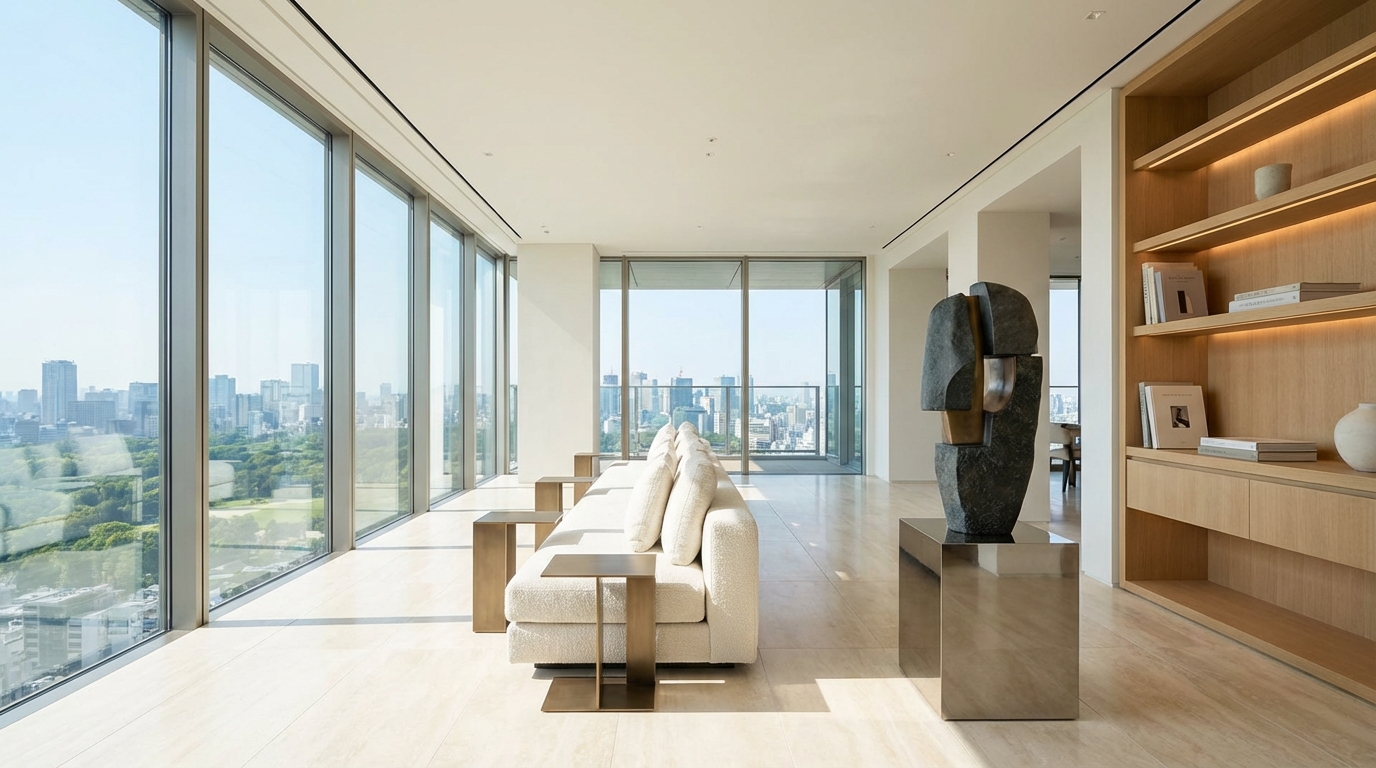
Understanding Japanese apartment layouts: 1K, 1DK, 1LDK, and beyond
The rental listing reads “1LDK, 45㎡, Shibuya.” For anyone unfamiliar with Japanese apartment notation, these alphanumeric codes appear cryptic. Yet they describe the entire spatial structure of a residence with precision. The system reduces floor plans to a formula: numbers indicate private rooms, letters define shared spaces. Once decoded, these abbreviations reveal exactly what a property offers before viewing a single photograph.
Japanese apartment layouts follow a standardized classification system used across Tokyo and the entire country. The notation applies to properties at every price point, from compact studios in suburban wards to spacious residences in Minato-ku (港区). Understanding this system becomes essential for anyone searching the Tokyo rental or purchase market.
The foundation: How Japanese apartment codes work
Japanese apartment layout codes combine numbers and letters. The number indicates private rooms—typically bedrooms. The letters describe communal spaces: kitchens, dining areas, and living rooms.
K stands for kitchen (キッチン). This designates a kitchen area separate from the main living space, typically 4-6 square meters. The kitchen contains basic cooking facilities but offers minimal counter space.
DK means dining-kitchen (ダイニングキッチン). This space combines kitchen and dining functions, generally ranging from 6-10 square meters. The area accommodates a small dining table alongside cooking facilities.
LDK indicates living-dining-kitchen (リビングダイニングキッチン). This merged space serves all three functions: cooking, dining, and living. In a 1LDK apartment, the LDK typically measures 8-14 square meters. Larger apartments allocate more space—a 3LDK might feature an LDK of 16-20 square meters or more.
R stands for room (ルーム), indicating a one room apartment where all functions occur in a single undivided space.
The number preceding these letters counts private rooms separate from the kitchen or LDK. A 2LDK apartment contains two bedrooms plus a living-dining-kitchen area. A 3LDK offers three bedrooms plus the shared LDK space.
1R: The one room apartment
A 1R apartment (ワンルーム) contains a single undivided room. The entire living space—sleeping area, work space, and relaxation zone—occupies one room. The kitchen sits within this same room, typically as a compact unit along one wall. Only the bathroom and toilet occupy separate spaces.
These apartments generally measure 15-25 square meters. In central Tokyo locations like Shibuya (渋谷) or Shinjuku (新宿), 1R apartments serve students and young professionals prioritizing location over space. The layout offers minimal privacy and limited storage.
According to Tokyo rental market data from 2026, 1R apartments in the 23 wards average ¥70,000-¥95,000 monthly, with significant variation based on proximity to major stations and building age.
1K: Kitchen separation changes everything
A 1K apartment introduces a critical distinction: the kitchen occupies a separate area from the main room. A door or partition divides the kitchen space from the bedroom, creating two distinct zones within the apartment.
The main room in a 1K apartment typically measures 6-8 tatami mats (畳), approximately 10-13 square meters. The kitchen area adds another 4-6 square meters. Total apartment size generally ranges from 20-30 square meters.
This separation provides practical advantages. Cooking odors remain contained in the kitchen area. The bedroom maintains a cleaner environment. Storage increases slightly, as the kitchen space often includes a small entrance area (玄関) with room for shoes and outerwear.
A 1K apartment suits single professionals who cook regularly. The layout costs approximately ¥10,000-¥20,000 more per month than a comparable 1R apartment in the same Tokyo neighborhood, according to rental data compiled by major listing platforms in 2026.
1DK: Adding dining space
The 1DK layout expands the kitchen into a dining-kitchen area. This space typically measures 6-10 square meters, large enough to accommodate a small dining table with two chairs. The bedroom remains separate, usually sized at 6-8 tatami mats.
Total apartment size for a 1DK ranges from 30-40 square meters. The dining-kitchen creates a buffer zone between the entrance and bedroom, improving privacy for residents who occasionally host guests. The space functions as a casual entertaining area without requiring guests to enter the bedroom.
In Tokyo’s central wards, 1DK apartments attract young couples and professionals in their late twenties to early thirties. The layout provides enough separation for two people to occupy different zones simultaneously—one person cooking while another works in the bedroom.
Monthly rent for a 1DK apartment in Tokyo’s 23 wards averages ¥95,000-¥130,000 in 2026, with premium locations commanding significantly higher rates. Buildings constructed after 2020 typically feature improved insulation and modern fixtures, adding ¥15,000-¥30,000 to monthly costs.
1LDK: The bedroom plus living space standard
A 1LDK apartment contains one bedroom and a living-dining-kitchen area. This layout represents a significant spatial upgrade. The LDK typically measures 10-16 square meters, providing genuine living space separate from the sleeping area. The bedroom measures 6-8 tatami mats as standard.
Total square meters for a 1LDK apartment range from 40-60 square meters. The layout creates clear functional zones: sleeping, living, and cooking each occupy distinct areas. This separation suits couples, professionals working from home, or individuals who entertain regularly.
The 1LDK apartment serves as the baseline for comfortable long-term residence in Tokyo. The living area accommodates a sofa, television, and dining table. The bedroom remains a dedicated sleeping space. Storage typically improves, with closets in both the bedroom and entrance area.
According to Tokyo apartment market analysis from 2026, 1LDK apartments represent approximately 25% of rental inventory in central wards like Minato (港区), Shibuya (渋谷区), and Meguro (目黒区). Monthly rent ranges from ¥140,000 in outer wards to ¥250,000+ in prime central locations.
For international residents relocating to Tokyo, the 1LDK apartment layout provides familiar spatial organization. The living room functions as it would in Western apartments, creating a public space distinct from private sleeping quarters.
2DK: Two bedrooms with dining-kitchen
A 2DK apartment contains two separate bedrooms and a dining-kitchen area. Each bedroom typically measures 6 tatami mats (approximately 10 square meters). The DK space measures 6-10 square meters. Total apartment size ranges from 40-55 square meters.
This layout appears frequently in buildings constructed during the 1970s and 1980s. The 2DK served as standard family housing during Japan’s economic growth period. Today, these apartments attract small families, roommates, or individuals who require a separate workspace.
The dining-kitchen in a 2DK apartment provides less living space than an LDK. Residents typically use one bedroom for sleeping and the other as a combination workspace and storage area. The DK functions primarily for meals, with limited room for relaxation furniture.
Rental rates for 2DK apartments in Tokyo average ¥110,000-¥160,000 monthly in 2026. These properties often cost less than comparable 1LDK apartments despite offering more rooms, as the overall living space remains similar and buildings tend to be older.
2LDK: The small family standard
A 2LDK apartment contains two bedrooms and a living-dining-kitchen area. This layout represents the standard for couples with one child or two working professionals who require separate spaces. The LDK typically measures 12-16 square meters, providing genuine living space. Each bedroom measures 6-8 tatami mats.
Total apartment size for a 2LDK ranges from 55-75 square meters. The layout allows for clear functional separation: a master bedroom, a second bedroom for a child or home office, and a proper living area for family time and entertaining.
In Tokyo’s residential neighborhoods like Setagaya (世田谷区) and Suginami (杉並区), 2LDK apartments dominate family housing. Buildings near good school districts command premium rents. Properties within walking distance of express train stations cost ¥180,000-¥280,000 monthly in 2026.
The 2LDK layout also appears in luxury buildings in central Tokyo. In areas like Hiroo (広尾) and Azabu (麻布), modern 2LDK apartments in premium buildings rent for ¥350,000-¥600,000 monthly. These properties feature higher ceilings, better fixtures, and superior common facilities.
3LDK: Spacious family residence
A 3LDK apartment provides three bedrooms plus a living-dining-kitchen area. This layout accommodates families with two children or multi-generational households. The LDK measures 14-20 square meters or more. Bedrooms range from 6-10 tatami mats each.
Total apartment size for a 3LDK typically exceeds 70 square meters, with many properties ranging from 75-95 square meters. In central Tokyo, 3LDK apartments appear primarily in established residential neighborhoods rather than commercial districts.
These apartments suit families planning extended residence in Tokyo. The three-bedroom layout provides a master bedroom, children’s rooms, and potential space for a home office or guest room. Storage capacity increases substantially compared to smaller layouts.
Monthly rent for a 3LDK apartment in Tokyo’s 23 wards ranges from ¥200,000 in outer areas to ¥500,000+ in central residential neighborhoods. Purchase prices for 3LDK apartments in desirable school districts routinely exceed ¥100,000,000, with properties in prime locations reaching ¥200,000,000-¥300,000,000.
Floor plan examples and spatial reality
Japanese apartment floor plans reveal how efficiently space gets utilized. A 45-square-meter 1LDK apartment might feel more spacious than expected due to thoughtful layout design. Conversely, a poorly designed 2DK can feel cramped despite similar total area.
Modern Japanese apartments maximize space through several design elements. Built-in storage reduces the need for freestanding furniture. Compact bathroom units (ユニットバス) integrate bathtub, sink, and toilet in minimal space. Sliding doors (襖) eliminate the swing radius required by Western-style doors.
Ceiling height significantly impacts perceived space. Older apartments typically feature 2.3-2.4 meter ceilings. Buildings constructed after 2010 often provide 2.5-2.6 meter ceilings, creating a more open feeling despite identical floor space.
Balcony space varies considerably. A 1LDK apartment might include a 4-6 square meter balcony, while larger apartments feature 8-12 square meter outdoor areas. In Tokyo’s dense urban environment, balconies serve primarily for laundry drying rather than outdoor living.
Measuring Japanese apartments: Square meters and tatami mats
Japanese apartments use two measurement systems. Official listings specify square meters (平米), while room sizes often reference tatami mats (畳).
One tatami mat measures approximately 1.62 square meters, though regional variations exist. A 6-tatami room equals roughly 10 square meters. An 8-tatami room measures about 13 square meters. Modern apartments use 団地間 (danchi-ma) measurements, slightly smaller than traditional 京間 (kyo-ma) dimensions.
Advertised square meter figures typically include balcony space at 50% of actual balcony area. This calculation method, standard across Japan, means the interior living space measures slightly less than the advertised total.
Storage areas like closets count toward total square meters. A 50-square-meter 1LDK might include 4-5 square meters of closet space, reducing actual living area to 45-46 square meters.
What does the five-minute rule mean in Japan?
The five-minute rule refers to punctuality expectations in Japanese business and social contexts. Arriving five minutes early demonstrates respect and proper preparation. This cultural norm extends to apartment viewings, contract signings, and meetings with property management companies.
For apartment hunting in Tokyo, the five-minute rule applies practically. Arrive at viewing appointments early to observe the neighborhood, check noise levels, and assess walking distance from the nearest station. Property agents expect punctuality and may begin viewings with other clients if someone arrives late.
Location and layout intersect in Tokyo
The same apartment layout commands vastly different rent depending on location within Tokyo. A 1LDK apartment in Roppongi (六本木) might rent for ¥280,000 monthly, while an identical layout in Nerima (練馬区) costs ¥140,000.
Central Tokyo neighborhoods—Minato (港区), Shibuya (渋谷区), and Chiyoda (千代田区)—offer premium locations with shorter commutes and better amenities. Apartments in these areas cost 50-100% more than equivalent layouts in outer wards.
Residential neighborhoods like Meguro (目黒区), Setagaya (世田谷区), and Suginami (杉並区) provide quieter environments with better access to parks and schools. Families often choose these areas for 2LDK and 3LDK apartments, accepting longer commutes in exchange for more living space and better educational facilities.
Station proximity dramatically affects apartment pricing. Properties within five minutes’ walk of a major station command premium rents. Each additional five minutes of walking distance typically reduces rent by 5-10%.
Choosing the right layout for Tokyo residence
The appropriate apartment layout depends on household size, work arrangements, and lifestyle priorities. Single professionals working long hours often find a 1K apartment sufficient, as the residence serves primarily as a sleeping space.
Remote workers require more space. A 1LDK apartment provides a dedicated living area that can accommodate a proper desk setup separate from the bedroom. The LDK functions as daytime workspace and evening relaxation area.
Couples generally require a 1LDK apartment minimum for comfortable long-term residence. The separate bedroom and living area allow two people to occupy different spaces simultaneously. Couples planning to remain in Tokyo for several years often choose 2LDK apartments, using the second bedroom as an office or guest room.
Small families with one child typically start with a 2LDK apartment. As children age and require their own rooms, families upgrade to 3LDK layouts. International families often find Japanese apartment sizes smaller than expected, making layout efficiency critical.
Luxury apartments and layout variations
Premium apartments in Tokyo’s most distinguished addresses offer layout variations beyond standard classifications. A luxury 2LDK apartment in Aoyama (青山) or Shirokane (白金) might measure 85-100 square meters, significantly exceeding typical 2LDK dimensions.
High-end properties feature enhanced specifications: higher ceilings, better soundproofing, premium fixtures, and superior storage solutions. The LDK in a luxury apartment might measure 25-30 square meters, approaching the size of an entire 1LDK apartment in a standard building.
Buildings constructed for the luxury market include amenities that reduce the need for apartment space: fitness facilities, guest rooms, and concierge services. Residents can host guests in building common areas rather than requiring larger apartments.
According to Tokyo luxury market data from 2026, apartments priced above ¥300,000,000 average 90-120 square meters for 2LDK layouts and 120-160 square meters for 3LDK configurations. These properties appear primarily in Minato-ku (港区), particularly in neighborhoods like Azabu (麻布), Hiroo (広尾), and Roppongi (六本木).
Practical considerations beyond layout codes
Japanese apartment layouts follow predictable patterns, but individual properties vary in quality and functionality. Several factors beyond the basic layout code affect livability.
Window orientation determines natural light. South-facing apartments (南向き) receive maximum sunlight and command premium prices. North-facing units cost less but remain darker year-round.
Floor level impacts noise, views, and privacy. Higher floors reduce street noise and provide better views but cost more. Ground-floor apartments offer convenience but less security and privacy.
Building age correlates with specifications. Properties constructed after 2000 typically feature better insulation, modern bathroom units, and improved kitchen facilities. Buildings from the 1980s and 1990s offer lower rents but may require renovation.
Earthquake resistance varies by construction era. Buildings constructed after 1981 meet current seismic standards (新耐震基準). Properties built before 1981 follow older standards and may require seismic reinforcement.
The apartment search process in Tokyo
Understanding layout codes streamlines the Tokyo apartment search. Online listing platforms allow filtering by layout type, narrowing thousands of properties to relevant options. Search parameters typically include layout, square meters, location, and maximum rent.
Major real estate portals like Suumo and Homes list hundreds of thousands of Tokyo apartments. English-language services like Real Estate Japan and Plaza Homes cater to international residents. All platforms use the standard layout notation system.
Viewing appointments typically show 3-5 properties in a single session. Real estate agents organize efficient routes visiting multiple apartments in the same neighborhood. Most viewings last 15-20 minutes per property.
Application processes require substantial documentation: residence card or passport, employment verification, emergency contact information, and guarantor details. International residents often use guarantor companies (保証会社) rather than individual guarantors.
Initial costs typically total 4-6 months’ rent: security deposit (敷金), key money (礼金), agent fees, guarantor company fees, and first month’s rent. Some properties advertise reduced initial costs to attract tenants in competitive markets.
Market trends in Tokyo apartment layouts
Tokyo’s apartment market shows clear preferences by demographic segment. According to rental market analysis from 2026, 1K and 1R apartments account for approximately 40% of rental transactions in central Tokyo, driven by single-person households.
The 1LDK apartment remains the most versatile layout, attracting both single professionals seeking space and couples without children. These properties maintain strong rental demand across economic cycles.
Demand for 2LDK and 3LDK apartments concentrates in established residential neighborhoods with good schools. Families prioritize school district quality over proximity to business districts, accepting longer commutes for better educational environments.
New construction increasingly emphasizes larger LDK spaces. Buildings completed in 2025 and 2026 often feature LDK areas 10-15% larger than equivalent apartments from the 2010s. Developers respond to changing lifestyle patterns, with more residents working from home and requiring flexible living spaces.
Compact luxury apartments—high-specification 1LDK and 2LDK units in premium locations—represent growing market segment. These properties attract affluent professionals who prioritize location and quality over space, particularly in neighborhoods like Azabu (麻布), Hiroo (広尾), and Aoyama (青山).
Koukyuu represents buyers seeking distinguished properties in Tokyo’s most established addresses. For those considering residence in the city’s prime neighborhoods, we provide confidential guidance on properties that match specific requirements. Begin a private conversation with our concierge team.