

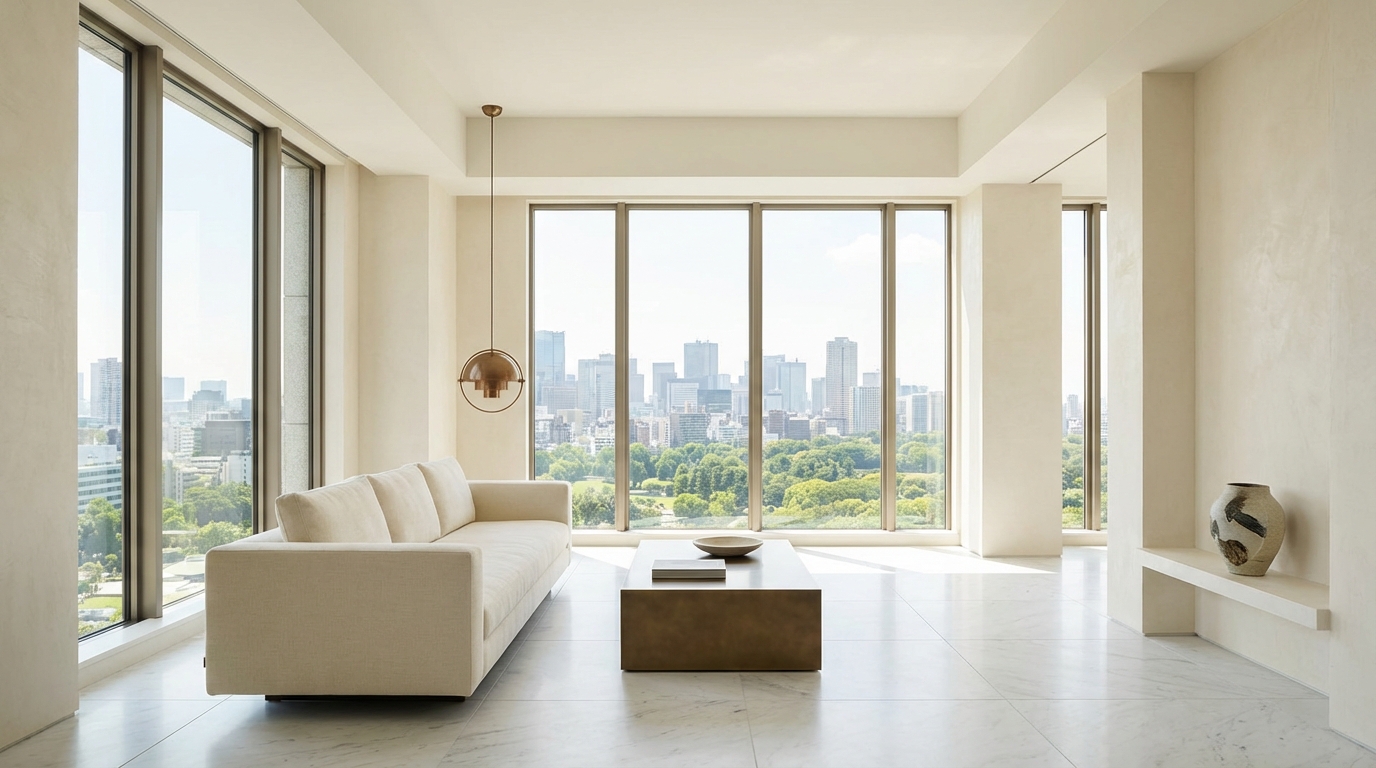
A man stands in his apartment in Nakano, measuring 9.5 square meters. The front door opens directly onto a space containing a bed, a desk, a small refrigerator, and a narrow path to the bathroom. The window overlooks a similar building three meters away. The monthly rent: ¥45,000 ($300 USD). This is Tokyo’s micro apartment market in 2026, where space compresses to its absolute minimum and thousands choose to live in rooms smaller than a standard parking space.
Why Tokyo produces the smallest apartments in the developed world
Tokyo’s micro apartment phenomenon stems from three converging forces: land scarcity, zoning flexibility, and economic pressure.
The city’s 23 special wards contain 9.7 million people within 627 square kilometers. Land prices in central Tokyo average ¥2.5 million per square meter in districts like Minato and Shibuya, according to the Tokyo Metropolitan Government’s 2026 land assessment. When land costs this much, developers maximize returns by building vertically and dividing horizontally.
Japan’s building standards law sets a minimum dwelling size of just 7 square meters for rental properties with shared facilities. Individual municipalities can impose stricter requirements, but many Tokyo wards maintain this baseline. The result: legal apartments that measure smaller than a typical hotel room.
The third factor is demographic. Single-person households now represent 50.3% of all Tokyo households, data from the Tokyo Metropolitan Government shows. Young professionals, students, and service workers create sustained demand for affordable solo living options in a city where the average new apartment costs ¥6,800 per square meter to rent.
Inside Tokyo’s smallest legal residences
Micro apartments in Tokyo typically range from 7 to 15 square meters. The Japanese real estate industry categorizes them as ワンルーム (one-room) or 1R properties, though the smallest examples fall into an unofficial category some call “super compact” or マイクロアパート (micro apartment).
A standard 9 square meter unit contains:
- A main living space measuring approximately 3 meters by 3 meters
- A unit bath (bathroom and shower combined in a prefabricated module)
- A compact kitchen area with a single induction burner and small sink
- Storage limited to one closet or overhead shelf
- No separate bedroom, dining area, or workspace
The largest micro apartments, approaching 15 square meters, might include a small loft bed accessed by ladder, creating vertical separation between sleeping and living zones. Some newer buildings incorporate fold-down desks, wall-mounted tables, and murphy beds to maximize flexibility within the limited footprint.
Tokyo Kantei, a real estate research firm, reported in early 2026 that the average floor area for newly listed studio apartments in Tokyo’s 23 wards reached 21.3 square meters. Micro apartments at 15 square meters or below represent the bottom quintile of this market.
Who chooses to live in 10 square meters
The typical micro apartment resident falls into several distinct categories.
Students and new graduates form the largest group. A 22-year-old starting a career at a Tokyo company might earn ¥220,000 monthly. With a micro apartment rent of ¥50,000, housing consumes 23% of income compared to 35-40% for a standard studio. The space sacrifice enables savings or discretionary spending.
Service industry workers represent another significant segment. Restaurant staff, retail employees, and hospitality workers often work long hours and use their apartments primarily for sleeping. A delivery driver interviewed by the Nikkei in 2026 described his 8.5 square meter room in Itabashi as “just a place to shower and sleep between shifts.”
Minimalists and intentional compact living advocates choose micro apartments for philosophical rather than purely economic reasons. YouTube channels like “Tokyo Tiny Room Tours” showcase residents who have deliberately downsized, organizing their essential possessions with precision.
Temporary residents and visa holders sometimes select micro apartments for their flexibility. Many require only a two-year lease rather than the standard renewable contracts, and some landlords accept foreign tenants more readily for these properties than for larger units.
The demographic skews young. Data from Tokyo’s housing bureau indicates 73% of micro apartment residents are under 35, and 89% live alone.
Pricing across Tokyo’s wards in 2026
Micro apartment rents vary significantly by location, building age, and amenities.
Central wards (Minato, Shibuya, Chiyoda): ¥65,000-¥90,000 for 9-12 square meters. A 10 square meter unit in Roppongi listed in March 2026 rented for ¥82,000 monthly.
Inner residential wards (Meguro, Setagaya, Shinagawa): ¥55,000-¥75,000 for similar sizes. Proximity to major stations commands premiums of ¥8,000-¥15,000.
Outer wards (Kita, Adachi, Edogawa): ¥38,000-¥55,000. The lowest rents appear in buildings more than 15 minutes’ walk from stations.
Student areas (Nakano, Suginami, Nerima): ¥42,000-¥58,000, with clustering around university locations.
These figures represent rent alone. Initial move-in costs in Tokyo typically include:
- Deposit (敷金): 1-2 months’ rent
- Key money (礼金): 0-2 months’ rent (non-refundable)
- Agency fee: 0.5-1 month’s rent
- Advance rent: 1 month
A ¥50,000 micro apartment might require ¥200,000-¥300,000 to move in, depending on the landlord’s terms.
Utility costs run lower than standard apartments. Residents report average monthly expenses of ¥3,000-¥5,000 for electricity and ¥2,000 for water, reflecting the small space and limited appliances.
The economics of extreme density
From a cost-per-square-meter perspective, micro apartments represent Tokyo’s most expensive housing.
A 10 square meter apartment renting for ¥60,000 costs ¥6,000 per square meter monthly. A 50 square meter apartment in the same building might rent for ¥180,000, or ¥3,600 per square meter. The smaller unit costs 67% more per unit of space.
This pricing structure reveals the value proposition: micro apartments provide access to Tokyo addresses and independent living at the lowest absolute monthly cost, even though the space efficiency is poor. A resident pays for location and autonomy, not for square meters.
The model works for developers as well. A building plot that might accommodate eight 25-square-meter studios can instead house twelve 15-square-meter units. Even with slightly lower per-square-meter rents, the additional units generate higher total revenue. Construction costs per unit also decline as kitchens, bathrooms, and utilities scale down.
This economic logic explains the continued construction of micro apartments despite criticism from housing advocates. The Real Estate Economic Institute documented 2,847 new micro apartment units completed in Tokyo’s 23 wards in 2025, a 12% increase from the previous year.
Living strategies in minimal space
Residents develop specific techniques to make micro apartments functional.
Vertical storage becomes essential. Wall-mounted shelves, over-door organizers, and ceiling-height storage units maximize the unused vertical space. A resident in Koenji described keeping seasonal clothing in vacuum-sealed bags stored above the bathroom.
Furniture selection prioritizes multi-function pieces. Beds with built-in storage drawers, folding desks, and nesting tables appear in most units. Some residents replace beds with futons that fold away daily, converting sleeping space into living space.
Digital minimalism reduces physical possessions. Books become ebooks, music becomes streaming, and documents become cloud files. One resident profiled in a 2026 housing magazine owned exactly 247 physical items, each selected for necessity or meaningful value.
External space utilization extends the effective living area. Residents treat nearby convenience stores as pantries, buying food daily rather than storing groceries. Cafes and libraries serve as workspaces. Public baths and gyms provide amenities impossible to fit in the apartment.
Strict acquisition discipline prevents accumulation. The “one in, one out” rule—discarding one item for each new purchase—maintains equilibrium in a space with zero margin for clutter.
These adaptations work for some personalities and fail for others. The psychological impact of extreme spatial constraint varies considerably by individual tolerance and lifestyle requirements.
The regulatory and social debate
Tokyo’s micro apartments generate ongoing controversy among housing policy experts, urban planners, and social welfare advocates.
Critics argue that 9 square meters falls below acceptable human housing standards. The World Health Organization recommends a minimum of 12 square meters per person for health and dignity. Some Tokyo ward assemblies have proposed raising minimum apartment sizes to 15 or 18 square meters.
Supporters counter that restricting micro apartments would reduce housing supply and increase costs, potentially forcing low-income residents into worse situations: longer commutes from distant suburbs, overcrowded share houses, or unstable housing arrangements.
The Japanese government’s 2025 housing policy review acknowledged the tension between housing standards and affordability but stopped short of recommending national minimum size requirements beyond the existing 7 square meter baseline.
Some wards have implemented indirect restrictions. Chiyoda, Shibuya, and Minato now require developers to include a minimum percentage of family-sized units (50+ square meters) in new residential buildings, effectively limiting micro apartment construction.
The social dimension extends beyond regulation. Japan’s declining birth rate correlates with housing patterns that favor solo living. Some demographers suggest that the prevalence of tiny apartments contributes to delayed marriage and family formation, though causation remains difficult to establish.
Comparing Tokyo’s micro apartments to other global cities
Tokyo’s micro apartments exist within a broader international trend toward compact urban housing, but they represent an extreme point on the spectrum.
Hong Kong produces even smaller units, with subdivided apartments sometimes measuring 5-6 square meters. However, Hong Kong’s micro apartments typically result from informal subdivision of existing units rather than purpose-built construction.
New York City permits apartments as small as 23 square meters (250 square feet) under standard zoning, with some experimental “micro unit” buildings approved at 19-21 square meters. This remains substantially larger than Tokyo’s smallest offerings.
London sets a minimum of 37 square meters for a studio flat under its space standards, though older conversions sometimes fall below this threshold.
Singapore allows studio apartments down to 35 square meters in public housing, with private developments occasionally going smaller.
Tokyo’s combination of legal minimums, economic pressure, and cultural acceptance of compact living produces the developed world’s smallest mass-market apartments. The city’s efficient public transportation network enables this density by reducing the need for private vehicle storage and allowing residents to access services beyond their immediate neighborhoods.
The question of value and livability
Whether micro apartments represent reasonable housing depends entirely on individual circumstances, priorities, and alternatives.
For a 23-year-old earning ¥230,000 monthly, a ¥48,000 micro apartment in Kichijoji provides independent living in a desirable neighborhood. The alternative might be a ¥75,000 standard studio in a distant suburb with a 90-minute commute, or a share house with roommates and limited privacy. The micro apartment delivers autonomy and location at the cost of space.
For a 35-year-old professional working from home three days weekly, the same apartment becomes impractical. The lack of a dedicated workspace, the inability to host guests, and the psychological weight of constant spatial constraint outweigh the cost savings.
Livability factors beyond size include:
Building quality: Newer micro apartments often include better soundproofing, ventilation, and natural light than older units. A well-designed 11 square meter apartment can feel more livable than a poorly configured 18 square meter space.
Location value: A micro apartment five minutes from Shibuya Station provides access to employment, services, and social opportunities that a larger apartment in Saitama cannot match.
Life stage: Micro apartments function better as temporary solutions during specific life phases—early career, student years, or transitional periods—rather than long-term residences.
Personality fit: Some people thrive in minimal environments and find the constraint liberating. Others experience claustrophobia and stress.
The rental data suggests high turnover. Average tenancy in micro apartments runs 18-24 months, compared to 3-4 years for standard studios, according to Tokyo apartment management companies. Most residents view these spaces as stepping stones rather than destinations.
Alternatives in Tokyo’s housing ecosystem
Tokyo offers several alternatives to micro apartments for budget-conscious residents.
Share houses (シェアハウス) provide private bedrooms ranging from 8-15 square meters with shared kitchens, living rooms, and sometimes bathrooms. Monthly costs run ¥40,000-¥70,000 with utilities included. The trade-off: less privacy but more total space and social interaction.
Leopalace and monthly apartments offer furnished short-term rentals with more flexible lease terms. These typically start at 18-20 square meters and cost ¥70,000-¥90,000 monthly, targeting temporary workers and corporate relocations.
Suburban studios in cities like Kawasaki, Saitama, or Chiba provide 20-25 square meters for ¥55,000-¥65,000, with commute times of 40-60 minutes to central Tokyo.
Older buildings in inner Tokyo sometimes offer 18-20 square meter studios for ¥60,000-¥70,000. These lack modern amenities and may have aging infrastructure, but provide more space at comparable prices to newer micro apartments.
Dormitories and company housing remain options for students and employees at larger corporations, though availability has declined over the past decade.
Each alternative involves different compromises between space, location, cost, privacy, and lease flexibility. The persistence of micro apartments in the market indicates they occupy a specific niche that alternatives don’t fully address.
The future trajectory of Tokyo’s smallest homes
Several trends will shape micro apartment supply and demand through the rest of the 2026 decade.
Remote work normalization may reduce demand as workers prioritize home office space over location proximity. Conversely, the shift might increase demand for micro apartments as secondary pied-à-terre options for hybrid workers who maintain suburban primary residences.
Aging population dynamics will gradually reduce the pool of young renters who currently fill micro apartments. Tokyo’s population peaked in 2025 and is projected to decline slowly through 2040, potentially softening rental demand across all segments.
Regulatory pressure continues building in several wards. If minimum apartment sizes increase to 15 or 18 square meters across Tokyo, the current 7-12 square meter segment would disappear from new construction, though existing buildings would remain.
Construction technology may enable better space utilization. Modular furniture systems, transforming interiors, and IoT-enabled compact appliances could make small spaces more livable, sustaining demand even as alternatives improve.
Cultural shifts toward sustainability and minimalism might increase acceptance of compact living as an environmental choice rather than purely an economic necessity.
The immediate outlook for 2026-2027 suggests continued construction and stable occupancy rates. Developers continue to find micro apartments profitable, and Tokyo’s high cost structure ensures ongoing demand for the lowest-priced independent living options.
What the micro apartment market reveals about Tokyo
The existence and scale of Tokyo’s micro apartment sector illuminates several characteristics of the city’s housing market and urban structure.
First, it demonstrates extreme land value concentration. Only in places where land costs ¥2-3 million per square meter does subdividing space to 9 square meters make economic sense. The micro apartment serves as a price signal, indicating that location value overwhelms space value in Tokyo’s central areas.
Second, it reflects regulatory pragmatism. Tokyo’s relatively permissive minimum standards prioritize housing supply and affordability over space mandates. This approach contrasts with cities that set higher minimums and consequently face more severe housing shortages.
Third, it reveals cultural adaptation to constraint. The Japanese concept of 間 (ma)—the meaningful use of negative space—extends to residential design. The acceptance of compact living reflects broader cultural comfort with spatial efficiency and minimalism.
Fourth, it exposes the economic pressure on young workers. That thousands of employed professionals choose 9 square meter apartments indicates that entry-level wages have not kept pace with Tokyo’s cost of living, particularly housing costs.
The micro apartment market functions as both symptom and adaptation: a symptom of Tokyo’s housing cost crisis and an adaptation that enables continued urban density and accessibility.
Tokyo’s micro apartments represent the logical extreme of urban housing economics. They provide the minimum viable independent living space at the minimum viable cost in a city where both land and proximity carry extraordinary value. For some residents during some life phases, this equation makes sense. The 10 square meter room in Nakano offers autonomy, location, and affordability in exchange for nearly every other housing amenity.
Koukyuu operates in Tokyo’s residential market at the opposite end of the spectrum, representing buyers seeking properties at the ¥300M+ level in addresses like Azabu and Hiroo. For a confidential conversation about Tokyo’s luxury market, reach our concierge team.