

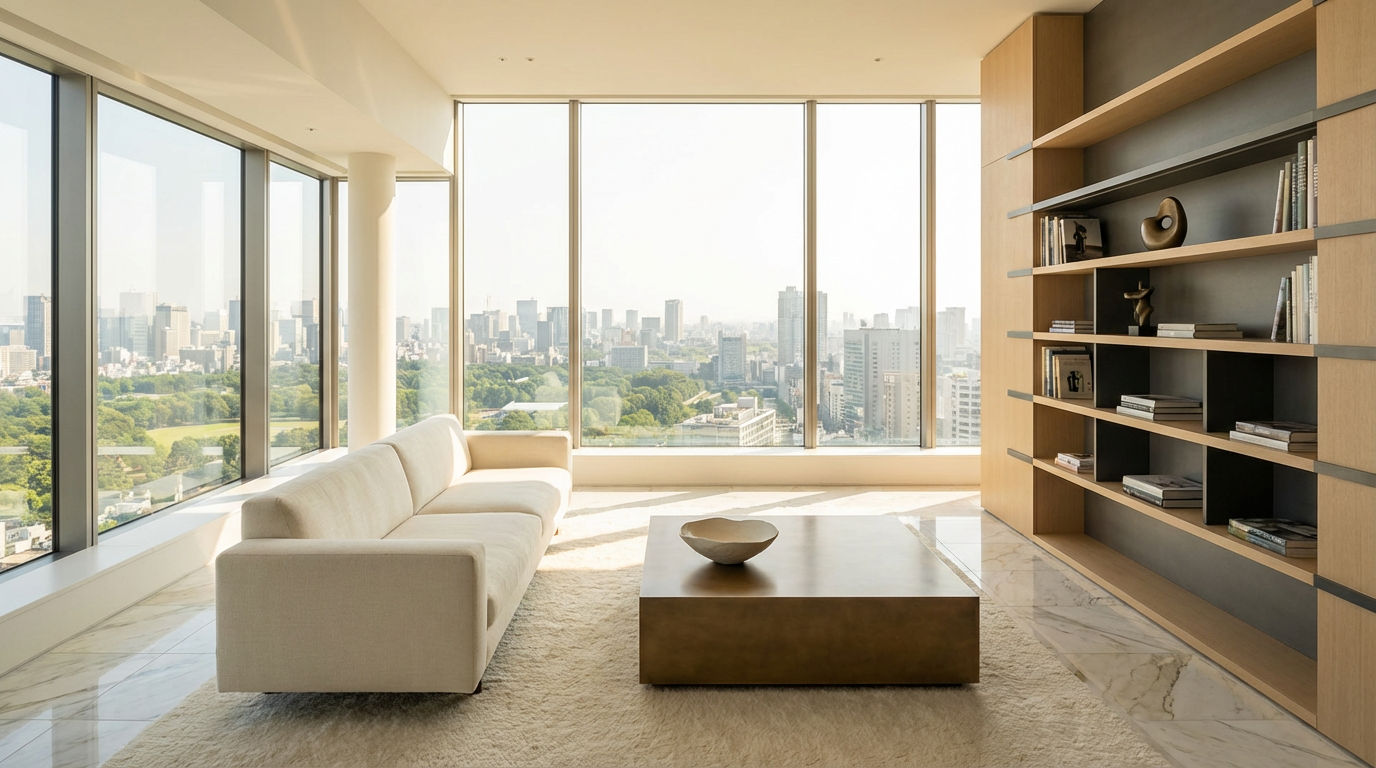
The conference room overlooks Marunouchi. Outside, the Imperial Palace gardens stretch beneath a March sky. Inside, a foreign buyer sits across from a loan officer at a major Japanese bank, documents arranged in neat stacks between them. The conversation that follows will determine whether this buyer joins the growing number of non-Japanese residents who own property in Tokyo, or returns to renting for another year.
Understanding mortgage access for foreign residents in Japan
Japanese banks extend home loans to foreign buyers under specific conditions. The framework differs substantially from mortgage systems in North America or Europe, where citizenship rarely factors into lending decisions. In Japan, residency status, employment stability, and language ability shape a lender’s assessment as much as income or credit history.
According to data from the Japan Housing Finance Agency, approximately 12% of mortgage applications in major metropolitan areas in 2026 come from non-Japanese nationals. The approval rate for these applications sits at roughly 68%, compared to 82% for Japanese nationals. The gap reflects risk assessment models that weigh visa duration and cultural integration alongside traditional financial metrics.
Foreign buyers seeking a mortgage in Japan face a straightforward reality: banks prefer borrowers who demonstrate long-term commitment to remaining in the country. A work visa with three years remaining carries more weight than one expiring in twelve months, regardless of the applicant’s financial position.
Eligibility requirements that determine loan approval
Residency status forms the foundation of mortgage eligibility for foreigners. Permanent residency (永住権) provides the strongest position. Banks view permanent residents through the same lens as Japanese nationals, removing visa duration from the risk calculation entirely. The application process simplifies, interest rates decrease, and loan-to-value ratios improve.
Without permanent residency, foreign buyers need a valid work visa with substantial remaining duration. Most Japanese banks require a minimum of three years remaining on the visa at the time of application. Some institutions accept applications with shorter durations but compensate through higher interest rates or reduced loan amounts.
Employment history in Japan matters more than global career trajectory. A senior executive relocating from London with twenty years of experience starts from zero in the eyes of Japanese lenders. Banks typically require a minimum of one to three years of continuous employment with a Japanese company or the Japanese branch of a foreign firm.
According to Prestia, a division of SMBC Trust Bank that specializes in services for foreign residents, the standard employment requirement sits at three years for most loan products. Some banks reduce this to one year for borrowers with permanent residency or those employed by large multinational corporations with established Japanese operations.
Annual income thresholds vary by institution and property location. The baseline typically starts at ¥4 million to ¥5 million annually for standard properties. Luxury properties in central Tokyo require demonstrated income of ¥10 million or higher. Banks calculate maximum loan amounts using a debt-to-income ratio, generally capping housing costs at 30-35% of gross annual income.
Language ability influences approval odds more than foreign buyers anticipate. While some banks offer English-language services, most loan officers conduct business in Japanese. The application process involves complex financial terminology and legal concepts. Banks assess whether a borrower can understand the contract terms, payment schedules, and legal obligations.
Tokyo Star Bank and Prestia provide English-language support throughout the application process, making them frequent choices for foreign buyers. However, their interest rates typically run 0.2% to 0.5% higher than Japanese-language services at competing institutions.
Required documents for mortgage applications
The documentation process for house loans in Japan demands precision. Missing or incorrectly prepared documents extend approval timelines by weeks or months.
Identity and residency verification requires a residence card (在留カード), valid passport, and residence certificate (住民票) issued within three months of application. Foreign buyers need the residence certificate to show current address and household composition. Some banks request additional documentation proving visa history in Japan.
Income verification demands more extensive evidence than most foreign buyers expect. A single year of tax returns does not suffice. Banks require:
- Employment certificate (在職証明書) from the current employer
- Income tax withholding slips (源泉徴収票) for the past two to three years
- Residence tax payment certificates (住民税課税証明書) for the same period
- Bank statements showing salary deposits for the past six months
Self-employed applicants face additional scrutiny. Banks require three years of tax returns, business registration documents, and detailed financial statements prepared by a certified accountant.
Property documentation includes the sales contract, property registry information (登記簿謄本), building plans, and condominium management documents for マンション purchases. The bank conducts an independent appraisal to verify the property value matches the purchase price.
Additional financial disclosures cover existing debts, other assets, and financial obligations. Banks examine credit card balances, car loans, student loans, and any other recurring payments that affect debt-to-income calculations.
Banks that extend mortgages to foreign buyers
The landscape of lenders willing to provide a mortgage loan to non-Japanese buyers remains limited but navigable. Each institution brings distinct requirements and advantages.
Prestia (SMBC Trust Bank) built its reputation serving the foreign community in Tokyo. The bank offers comprehensive English-language support and understands the specific circumstances of expatriate buyers. Loan officers expect foreign applicants and structure their processes accordingly. Interest rates typically range from 1.2% to 2.5% depending on residency status and loan structure.
Tokyo Star Bank actively markets to foreign residents and provides bilingual services. The bank accepts applications from borrowers without permanent residency, provided they meet employment and visa duration requirements. According to their 2026 loan product disclosures, interest rates for foreign buyers start at 1.5% for variable-rate loans and 1.8% for fixed-rate products.
Suruga Bank developed a specialized program for foreign buyers in major metropolitan areas. The bank accepts applications from borrowers with shorter employment histories in Japan compared to traditional lenders. Suruga Bank requires a minimum annual income of ¥5 million and at least one year of continuous employment. The trade-off comes through higher interest rates, typically 2.0% to 2.8%.
SMBC (Sumitomo Mitsui Banking Corporation) extends home mortgage loans to foreign buyers with permanent residency or highly stable employment situations. The bank offers competitive interest rates, often 0.5% to 0.8%, but requires Japanese language ability and extensive documentation. Most loan officers conduct business exclusively in Japanese.
Mizuho Bank and MUFG Bank consider applications from foreign buyers on a case-by-case basis. Both institutions prefer borrowers with permanent residency and strong ties to Japan. English support varies by branch, with locations in central Tokyo offering more bilingual services than regional offices.
Interest rates and loan structures in 2026
Interest rate environments in Japan remain distinct from most developed economies. According to the Bank of Japan’s March 2026 policy statements, benchmark rates continue their gradual normalization after decades of ultra-low rates, though they remain well below global averages.
Variable-rate mortgages currently range from 0.5% to 2.5% depending on the lender and borrower profile. Japanese nationals with permanent employment at large corporations access rates at the lower end. Foreign buyers without permanent residency typically receive quotes in the 1.5% to 2.5% range.
Variable rates in Japan adjust based on the bank’s prime lending rate, which responds to Bank of Japan policy changes. The rate can shift twice annually, though most banks provide caps limiting how much the rate can increase in a single adjustment period.
Fixed-rate mortgages offer stability at a premium. Ten-year fixed rates range from 1.2% to 2.8%, while 35-year fixed products reach 1.8% to 3.2%. Foreign buyers often prefer fixed rates despite higher costs, particularly those uncertain about their long-term plans to reside in Japan.
Loan-to-value ratios for foreign buyers typically cap at 80% without permanent residency. This means a ¥100 million property requires a ¥20 million down payment minimum. Buyers with permanent residency can access loan-to-value ratios up to 90%, and sometimes 100% for properties below certain price thresholds.
The Japan Housing Finance Agency offers a government-backed loan program called Flat 35, which provides fixed rates for the full 35-year term. Foreign buyers with permanent residency can access Flat 35, though those on work visas face restrictions. The current Flat 35 rate sits at approximately 1.8% for qualified borrowers.
The permanent residency advantage
Permanent residency transforms the mortgage landscape for foreign buyers. The status removes the primary risk factor that makes Japanese banks hesitant: the possibility that the borrower will leave Japan before repaying the loan.
Data from the Ministry of Justice shows that permanent residency applications increased 23% between 2024 and 2026, driven partly by foreign residents seeking to improve their position in the property market. The standard path to permanent residency requires ten years of continuous residence in Japan, though highly skilled professional visa holders can qualify in as little as one year under specific conditions.
With permanent residency, foreign buyers access:
- Interest rates matching those offered to Japanese nationals
- Loan-to-value ratios up to 90% or higher
- Simplified documentation requirements
- Broader selection of lenders willing to consider the application
- Longer loan terms, up to 35 years regardless of age at application
Without permanent residency, banks calculate maximum loan terms based on visa expiration dates and retirement age, often resulting in shorter repayment periods and higher monthly payments.
Application timeline and process
The mortgage application process in Japan follows a structured sequence that typically spans two to three months from initial inquiry to final approval.
Pre-approval takes two to four weeks. The buyer submits basic financial information and the bank provides a preliminary assessment of loan amount and terms. This step proves crucial before making offers on property in Japan, as sellers expect buyers to demonstrate financing capability.
Formal application begins after the buyer signs a purchase contract. The bank conducts detailed review of all documentation, verifies employment and income, and orders a property appraisal. This phase consumes four to six weeks.
Final approval arrives after the bank completes its assessment. The buyer then schedules a contract signing (契約) at the bank, where all parties review and execute the loan documents. This meeting typically requires two to three hours and proceeds entirely in Japanese unless the buyer specifically arranged for English-language services.
Disbursement occurs on the property settlement date. The bank transfers funds directly to the seller’s account, and the buyer receives the property title. The entire process from application to disbursement averages 60 to 90 days for foreign buyers, compared to 45 to 60 days for Japanese nationals.
Common questions about buying property as a foreigner
Can you buy a house in Japan as a foreigner? Japanese law places no restrictions on foreign ownership of real estate. Non-Japanese buyers hold the same property rights as Japanese nationals. The challenge lies in securing financing rather than legal barriers to ownership.
Is mortgage in Japan for foreigners legal? Banks operate under regulations that permit lending to non-Japanese nationals. The decision to approve or decline a loan application rests with individual institutions based on their risk assessment criteria. No law prevents foreign buyers from obtaining a home loan in Japan.
Why do some banks decline foreign applicants? Risk models account for the statistical likelihood of loan default. Foreign buyers without permanent residency present higher perceived risk due to the possibility of leaving Japan before completing loan repayment. Banks that decline foreign applications make business decisions rather than discriminatory ones, though the practical effect creates barriers for non-Japanese buyers.
Can you get a 100-year mortgage in Japan? Multi-generational mortgages exist in Japan but remain rare and typically unavailable to foreign buyers. These loans, sometimes extending 100 years, allow family members to inherit the debt alongside the property. The structure requires deep roots in Japan and multi-generational commitment that banks rarely see in foreign applicants.
Is it true you can buy a house in Japan for $500? Properties in depopulated rural areas occasionally sell for nominal amounts, sometimes under ¥100,000. These situations involve abandoned homes in communities facing severe demographic decline. Local governments effectively give away properties to attract residents. These opportunities exist far from Tokyo and come with significant renovation obligations. Foreign buyers face practical challenges accessing these programs without Japanese language ability and long-term rural residency commitment.
Can you live on $1,000 a month in Japan? While unrelated to mortgages, this question appears frequently in foreign buyer research. Living costs in Tokyo far exceed $1,000 monthly. A modest lifestyle in central Tokyo requires ¥300,000 to ¥400,000 monthly ($2,000 to $2,700 at current exchange rates). Foreign buyers seeking mortgages in Tokyo’s luxury market face different financial realities than budget travelers.
Strategic considerations for foreign buyers
Timing the application relative to visa renewal creates advantage. Applying for a mortgage immediately after receiving a visa extension shows maximum remaining duration, improving approval odds and potentially securing better interest rates.
Building banking relationships before applying helps. Foreign residents who maintain accounts, conduct regular transactions, and establish history with a Japanese bank improve their standing when requesting a home mortgage loan. Some banks offer preferential rates to existing customers with substantial deposits or investment accounts.
Considering co-borrowers expands options. Married couples where one spouse holds permanent residency while the other maintains a work visa can apply jointly, leveraging the stronger residency status. The bank evaluates the application based on the most favorable circumstances between the two applicants.
Property selection influences approval likelihood. Banks more readily approve loans for properties in established neighborhoods with stable values. A マンション in Minato Ward (港区) near Azabu (麻布) or Shirokane (白金) presents lower risk than a detached house in a rapidly depreciating suburb.
Tax implications and deductions
Japan provides mortgage interest deductions (住宅ローン控除) that reduce annual income tax. Foreign buyers with valid residency status qualify for these deductions under the same terms as Japanese nationals.
The current deduction allows borrowers to claim 0.7% of the outstanding loan balance as a tax credit for up to 13 years. For a ¥50 million loan, this generates ¥350,000 in annual tax reduction during the initial years. The benefit decreases as the principal balance declines.
Foreign buyers planning to leave Japan before completing loan repayment face potential complications. Early repayment penalties vary by lender but typically range from 1% to 3% of the outstanding balance. Selling the property and repaying the loan before departing avoids ongoing payment obligations from abroad.
The role of real estate agents in the process
Japanese real estate transactions follow distinct protocols. Agents represent either the buyer or seller, not both, though the same brokerage may have agents on both sides of a transaction.
A buyer’s agent assists with mortgage applications by coordinating between the buyer, bank, and seller. This includes scheduling appraisals, ensuring document preparation meets bank requirements, and managing timeline expectations. For foreign buyers navigating language barriers, an agent with bilingual capability proves valuable.
Commission structures in Japan typically total 3% of the purchase price plus ¥60,000 and consumption tax, split between buyer and seller agents. This commission covers transaction support including mortgage facilitation.
Building the path to property ownership
Foreign residents who live in Japan long-term and meet employment requirements access legitimate paths to property ownership through Japanese mortgages. The process demands more preparation and documentation than buyers experience in many other countries, but the framework exists and functions.
The difference between approved and declined applications often reduces to preparation quality rather than fundamental eligibility. Foreign buyers who research requirements, organize documentation thoroughly, and approach appropriate lenders achieve approval at rates approaching those of Japanese nationals.
Koukyuu represents international buyers navigating Tokyo’s luxury residential market, including mortgage facilitation with institutions experienced in foreign buyer transactions. For buyers seeking properties in Tokyo’s most distinguished addresses, begin a private conversation with our concierge team.