


Reviewed by a Koukyuu Takkenshi (宅地建物取引士)
Fact-checked against current Japanese real-estate law, tax rules, and market data by a nationally licensed specialist who oversees luxury transactions across Minato, Shibuya, and Chiyoda. In Japan, a Takkenshi is legally required to sign off on every property transaction, and about 15% of candidates pass the exam each year.
Yokohama City mailed approximately 890,000 fixed-asset tax notices on April 8, 2026, marking the annual reassessment cycle that determines carrying costs for property owners across Minami Ward (港南区), Kōhoku Ward (港北区), and the Minato Mirai 21 waterfront district. For foreign investors evaluating Yokohama as an alternative to central Tokyo, these notices disclose more than payment amounts. They reveal the structural mechanics of Japanese property taxation that directly affect net yields, particularly the interaction between base rates, residential land relief, and urban boundary redesignation.
The 2026 Rate Structure: What the Notice Actually Says
Yokohama’s 2026 fixed-asset tax (固定資産税, koteishisan-zei) maintains its statutory 1.4% of taxable standard value, unchanged from 2025. The city planning tax (都市計画税, toshi-keikaku-zei) holds at 0.3%, applicable only within urbanization promotion areas (市街化区域, shigaika kuiki). These rates appear modest against global luxury markets, but their application follows Japanese assessment methodology that diverges significantly from Anglo-American practice.
The taxable standard value is not market value. It derives from the Ministry of Land, Infrastructure, Transport and Tourism’s published route values (路線価, rosenka), recalibrated every three years. The 2025 route value update, effective for fiscal 2025-2027, raised assessments in Yokohama’s central business districts by 8-12%, with Minato Mirai 21 showing particular strength given ongoing office absorption and the 2024 completion of several mixed-use towers.
For residential land, the tax notice reveals critical relief mechanics. Parcels up to 200 square meters qualify for a 1/6 reduction in fixed-asset tax and 1/3 reduction in city planning tax. This small-lot relief (小規模住宅用地特例, shōkibo jūtakuchi tokurei) expires at 200.01 square meters. A 250-square-meter Minato Mirai apartment site receives no relief on the excess 50 square meters, creating a marginal tax rate cliff that sophisticated buyers model before acquisition.
Urban Boundary Redesignation: The 2027 Liability Jump
The 8th urban boundary review (第8回線引き見直し, dai-hachikai senbiki minaoshi), concluded in 2025, continues to migrate parcels from urbanization control areas (市街化調整区域, shigaika chōsei kuiki) to urbanization promotion areas. This administrative redesignation carries direct tax consequences.
Parcels newly designated as urbanization promotion areas face two changes. First, city planning tax liability begins where previously none existed. Second, route value assessments typically adjust upward by approximately 30% upon boundary revision, based on historical Yokohama reassessment patterns. The critical timing: land redesignated in 2025 sees these reassessments effective fiscal 2027 (Reiwa 9), not 2026.
Investors acquiring in Minami Ward or Kōhoku Ward during 2026 should verify their parcel’s boundary status in the official zoning map (用途地域図, yōto chiiki zu) maintained by Yokohama City Planning Bureau. A property currently exempt from city planning tax may carry a latent 0.3% liability plus reassessment upside effective April 2027. Due diligence should include the 2025 boundary review appendix, available through the city’s geographic information system portal.
The Non-Resident Tax Position: No Surcharge, No Deduction
Yokohama’s fixed-asset tax regime applies identically to residents and non-residents. There is no foreigner surcharge, no withholding mechanism, and no currency conversion facility. Payment is yen-denominated, due in quarterly installments or annual lump sum.
However, the mortgage interest deduction (住宅ローン控除, jūtaku rōn kōjo) requires Japan-sourced taxable income. Non-residents without domestic salary or business income cannot offset financing costs against property tax liabilities. This structural asymmetry means a leveraged foreign buyer in Minato Mirai bears the full 1.4% fixed-asset tax plus debt service, without the tax shield available to domestic salary earners.
Inheritance tax (相続税, sōzoku-zei) exposure presents additional complexity. The 2017 tax reform shortened the “temporary resident” exemption window from five years to ten years of prior residence for certain visa categories. Assets held by non-resident heirs remain subject to Japanese inheritance tax on worldwide assets if the decedent held Japanese address registration (住民票, jūminhyō) at death. Estate planning for Yokohama property should address this exposure explicitly, particularly given Kanagawa Prefecture’s position as a primary residence location for returning Japanese executives.
Minato Mirai 21: Event Economics and Occupancy Patterns
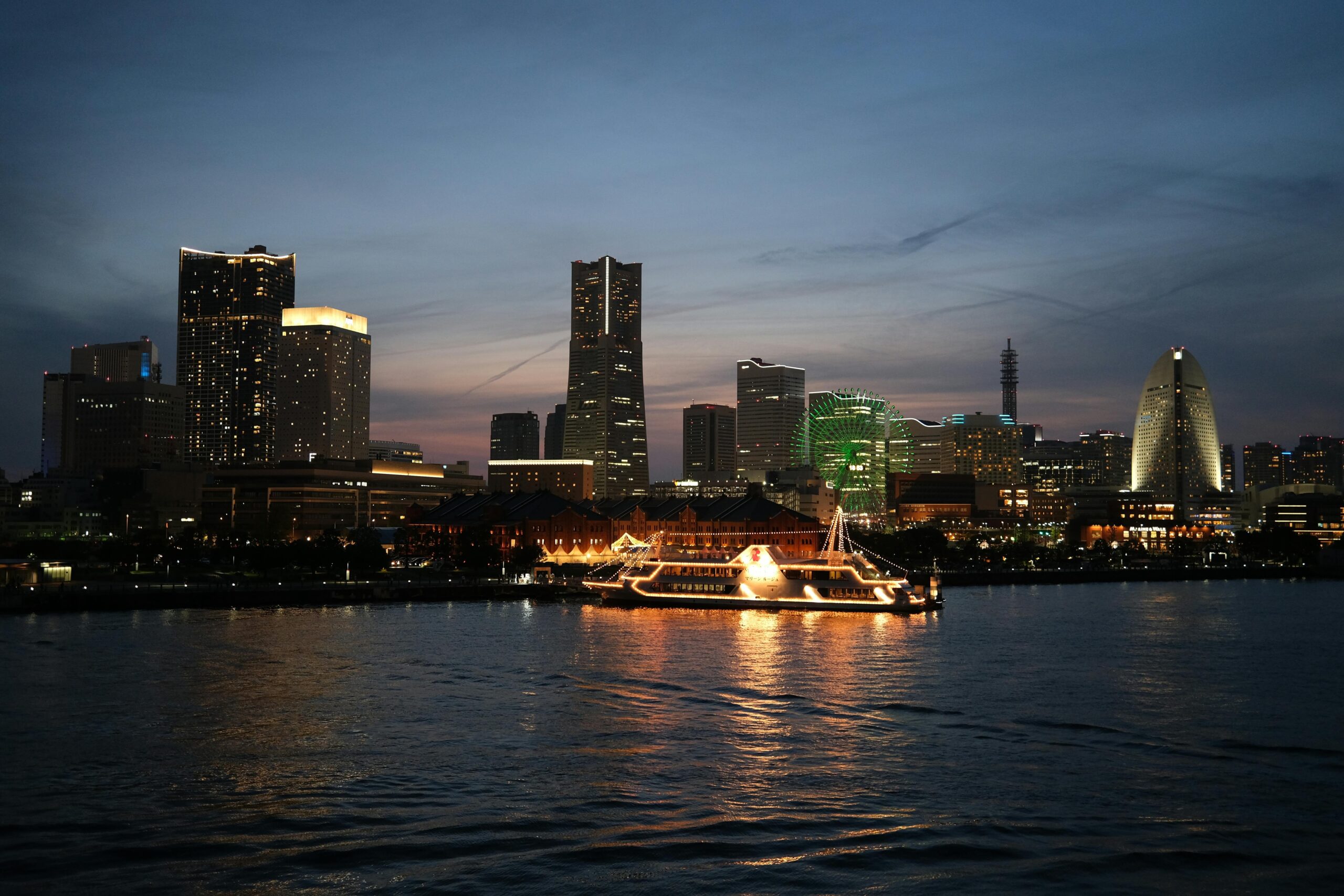
The Minato Mirai 21 district functions as Yokohama’s primary venue for seasonal programming that affects short-term rental demand and, indirectly, resale liquidity. The 2025-2026 event calendar illustrates this dynamic.
The Yokohama Minatomirai Winter Holiday 2025-2026 runs November 11, 2025 through January 12, 2026, featuring illumination installations along Sakura-dori and the waterfront promenade. The Minato Mirai Bon Odori Festival returns to Rinko Park in mid-August 2026, typically drawing 30,000-40,000 participants for two evenings of traditional dance. Weekend fireworks (weekend hanabi) occur on selected Saturdays throughout the year, announced monthly on the Minato Mirai 21 official website.
These events create predictable occupancy spikes for serviced apartments and short-stay units in the Landmark Tower, Queen’s Square, and adjacent residential towers. Investors analyzing gross yield should disaggregate event-period premiums from baseline rents. The Sakura-dori cherry blossom festival (Minato Mirai 21 Sakura Festa), held late March through early April, similarly distorts April lease commencement patterns.
The Yokohama Minatomirai Countdown Cruise 2025-2026, operated by private charter, sold advance reservations through December 20, 2025, indicating sustained demand for waterfront New Year’s experiences. This programming density distinguishes Minato Mirai from Tokyo’s comparable bayside districts, which lack equivalent centralized event management.
Transaction Mechanics: From Offer to Touki
Yokohama property transactions follow the national standard prescribed by the Civil Code and the Real Estate Brokerage Act (宅地建物取引業法, takuchi tatemono torihiki gyō hō). The statutory sequence proceeds: property search, offer letter (買申書, kai-mōsho), earnest money deposit (手付金, tetsuke-kin, typically 10%), sales contract (売買契約, baibai keiyaku),重要事項説明 (jūyō jikō setsumei, the statutory pre-contract disclosure meeting), and finally 登記 (touki, title transfer registration) at the Kanagawa Legal Affairs Bureau Yokohama Branch.
For Minato Mirai 21 properties, buyers should verify the building management association’s (管理組合, kanri kumiai) long-term repair plan (長期修繕計画, chōki shūzen keikaku) and accumulated reserve fund (積立金, tsumitate-kin). Several towers completed in the 1993-1997 construction wave face simultaneous elevator, facade, and waterproofing renewal cycles. The 2026 reserve fund balance and projected special assessments (臨時徴収金, rinji chōshū-kin) should be extracted during due diligence, as these capital calls can exceed ¥5 million per unit in aging towers.
Foreign buyers without Japanese language facility require certified translation of the sales contract and 重要事項説明 document. The Kanagawa Prefecture Foreign Consultation Corner provides non-binding guidance, but legal representation is standard for transactions above ¥100 million. Unlike Tokyo’s Minato Ward (港区), where international transaction volume has normalized bilingual closing procedures, Yokohama’s lower foreign buyer penetration means more variability in documentation quality.
Comparing Carrying Costs: Yokohama Against Tokyo Minato
A direct tax comparison between Yokohama’s Minato-adjacent wards and Tokyo’s Minato Ward (港区) reveals structural similarity with local variation. Both jurisdictions apply the 1.4% fixed-asset tax base rate. Tokyo Minato Ward imposes an additional metropolitan tax (都民税, tomin-zei) on residents, but this does not affect property holding costs.
The meaningful distinction lies in assessment methodology. Tokyo’s route values, updated annually, have risen more steeply than Yokohama’s since 2020, particularly in Azabu (麻布), Hiroo (広尾), and Shirokane (白金). A ¥500 million residential property in Tokyo Minato Ward typically carries higher absolute tax burden than a comparable Yokohama asset, though the gap has narrowed as Minato Mirai 21 achieves price parity with secondary Tokyo wards.
For investors seeking exposure to Greater Tokyo without central Tokyo price points, Yokohama’s Minami Ward and Kōhoku Ward offer lower entry valuations with comparable tax efficiency. The trade-off is liquidity: Minato Mirai 21 resale volume runs approximately 40% below comparable Tokyo submarkets, extending holding periods for exit.
Koukyuu represents buyers seeking distinguished Tokyo residences in Azabu (麻布), Hiroo (広尾), and Shirokane (白金), focused exclusively on transactions of ¥300 million and above. A licensed 宅建士 (takken-shi, Japan’s licensed real-estate transaction specialist) personally handles every stage of the engagement, from the first consultation to the signing. book a private consultation).