


Reviewed by a Koukyuu Takkenshi (宅地建物取引士)
Fact-checked against current Japanese real-estate law, tax rules, and market data by a nationally licensed specialist who oversees luxury transactions across Minato, Shibuya, and Chiyoda. In Japan, a Takkenshi is legally required to sign off on every property transaction, and about 15% of candidates pass the exam each year.
Tokyo’s cherry blossoms reached full bloom (満開, mankai) on March 27, 2026, per the Japan Meteorological Association’s specimen tree in Chiyoda Ward. By April 1, a forecast storm accelerated petal fall (花吹雪, hanafubuki) across the capital. The entire viewing window compressed to roughly eleven days. For foreign buyers timing property visits to coincide with Tokyo’s most photographed season, this volatility carries practical weight. Sakura timing has grown less predictable; the 2026 season arrived two days later than initially forecast, yet still ranked among the earliest on record. Understanding how bloom schedules vary across neighborhoods, and how official forecasts actually work, helps align residence viewings with reliable windows of access.
How the 2026 Forecast Shifted Between Announcements
The Japan Meteorological Association released its first 2026 Tokyo forecast on March 6, predicting full bloom for March 25. The March 25 update pushed this to March 27. First bloom (開花, kaika) had already occurred on March 19, when 61 blossoms opened on the official Chiyoda specimen tree. The gap between first bloom and full bloom stretched to eight days, slightly longer than the typical five-to-seven day interval.
The 2026 season marked the twentieth consecutive year of the Association’s blossom forecasting program. Their models rely on post-autumn temperature accumulation, particularly October-through-February thermal patterns. Warmer winters compress the timeline; 2026 continued a pattern of consecutive early seasons across eastern Japan. The Association’s forecast accuracy for Tokyo typically falls within two days, though local microclimates create neighborhood-level variation of three to five days.
For property buyers, this forecasting infrastructure matters. A viewing scheduled for late March based on early forecasts risks arriving to bare branches or, conversely, missing peak bloom entirely. The most reliable strategy anchors visits to the statistical peak window, March 28 through April 3, accepting that specific locations may deviate.
Full Bloom Status Across Prime Residential Wards
As of March 30, 2026, the Tokyo Metropolitan Government Parks Bureau confirmed full bloom across all major viewing locations. The distribution of cherry trees and current programming varies significantly by ward, with implications for accessibility and crowd density.
Chiyoda Ward (千代田区)Chidorigafuchi (千鳥ヶ淵) maintains approximately 260 Somei Yoshino along the Imperial Palace moat. The Chiyoda Sakura Matsuri runs through April 22, 2026, extended from 2025’s shorter programming. Boat rentals operate until 19:30 during the light-up period, requiring advance online reservation. The location’s proximity to Otemachi and Marunouchi commercial districts makes it accessible for buyers reviewing properties in Chiyoda-ku’s residential pockets near the palace.
Minato Ward (港区)Shiba Park, adjacent to Tokyo Tower, holds roughly 200 cherry trees with direct views of the tower framed by blossoms. The ward’s higher elevation neighborhoods, Hiroo (広尾) and Shirokane (白金), experience marginally later blooming due to cooler nighttime temperatures. Azabu (麻布) areas near Arisugawa-no-miya Memorial Park saw peak bloom approximately two days after Chiyoda’s official date.
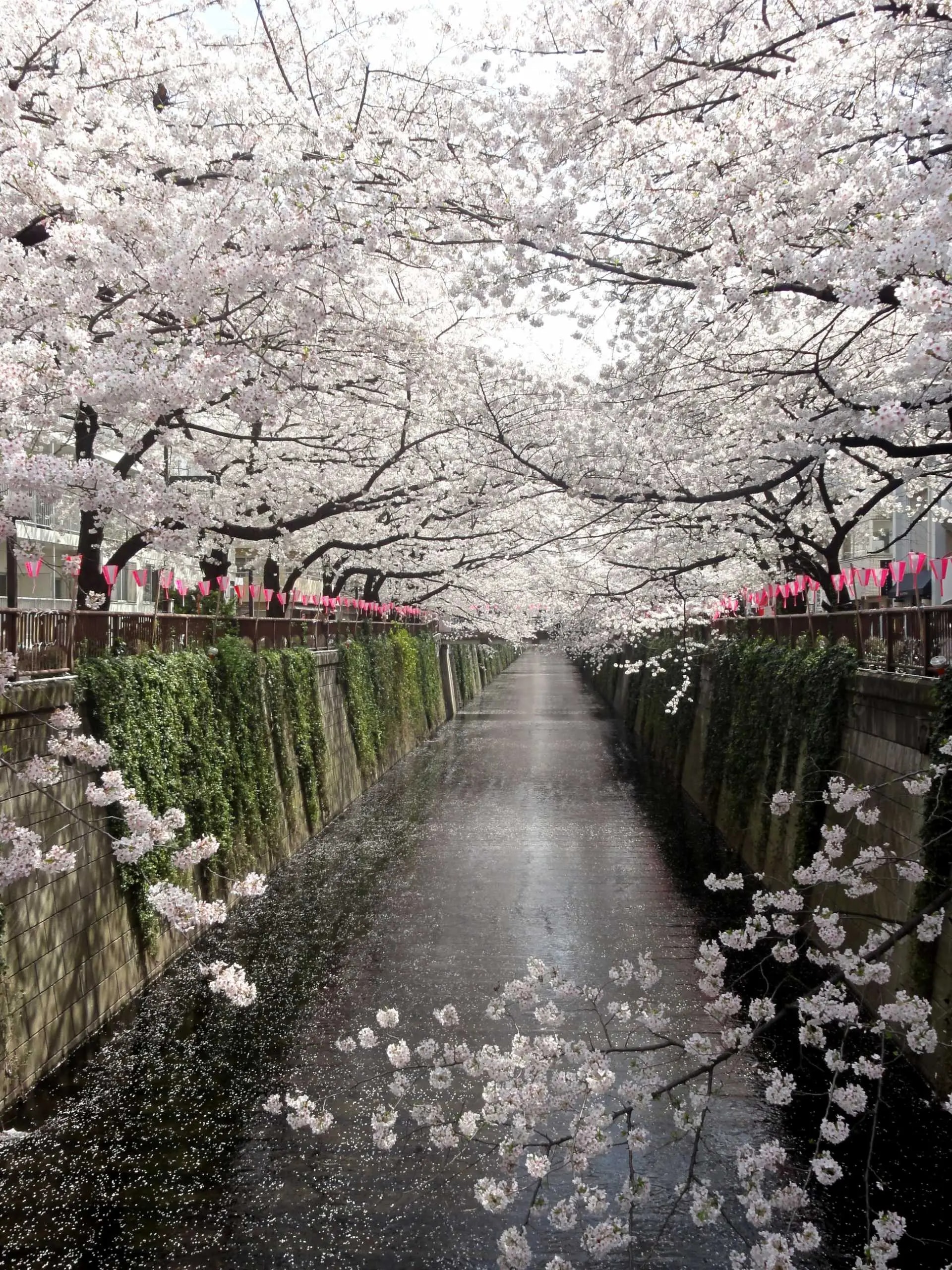
Shibuya Ward (渋谷区)Yoyogi Park, with 600 trees, and the Meguro River (目黒川) corridor represent Shibuya’s primary sakura assets. The 40th Nakameguro Sakura Matsuri convened March 28–29, 2026, with evening bonbori lantern lighting continuing through March 31. The river’s 800 trees create a 3.8-kilometer canopy effect particularly dense between Ikejiri-Ohashi and Nakameguro stations. For buyers considering Sangenjaya or the western Shibuya ward periphery, the Meguro River corridor offers the most concentrated bloom exposure.
Shinjuku Ward (新宿区)Shinjuku Gyoen (新宿御苑) contains 1,000 trees across 65 varieties, providing the longest effective season through staggered blooming. Entry required advance reservation for March 28–29 and April 4–5, 2026, between 10:00 and 16:00. Alcohol prohibition and controlled entry reduce the festival atmosphere but increase predictability for visitors scheduling around property appointments.
The Mechanics of Hanami Access and Timing
Hanami (花見), the practice of blossom viewing, operates on distinct schedules across Tokyo’s major locations. Understanding these mechanics prevents scheduling conflicts during concentrated property search periods.
Reservation RequirementsOnly Shinjuku Gyoen implemented mandatory entry reservations for 2026 peak dates. Other locations operate on first-come capacity. However, several high-traffic sites now utilize timed entry or advance ticketing for specific experiences: Chidorigafuchi boat rentals require online booking 48 hours minimum in advance; Rikugien’s Spring Night Special (春夜の六義園) evening viewing requires separate admission purchase; Yakatabune (屋形船) dinner cruises on the Sumida River book fully 7–10 days ahead during peak season.
Illumination SchedulesNight viewing (夜桜, yozakura) extends effective access hours but follows strict termination dates. Meguro River’s lighting ended March 31, 2026, two days after full bloom. Sumida Park maintained illumination until April 5, 18:30 to 21:00. Chidorigafuchi’s extended programming through April 22 represents the longest 2026 illumination window among central Tokyo locations.
Weekday vs. Weekend PatternsCrowd density at Ueno Park, Shinjuku Gyoen, and Meguro River peaks 3.5x higher on weekends versus weekdays, per Tokyo Metropolitan Police Department crowd estimates. For buyers combining property viewings with hanami, Tuesday through Thursday mornings before 10:00 offer the most efficient access. Post-16:00 weekdays also show reduced density, though illumination crowds reconcentrate at lit locations.
Late-Season Varieties and Extended Viewing Options
The standard Somei Yoshino season concluded rapidly in 2026 due to April 1 rainfall. However, late-blooming varieties (八重桜, Yae-zakura) and specific garden collections extend viewing potential into mid-April.
Koishikawa Korakuen (小石川後楽園)This Bunkyo Ward garden maintains 30 specimen trees including rare Ukon-zakura (green-flowered variety) and multiple weeping cherry (しだれ桜, shidare-zakura) specimens. The garden’s famous 70-year-old weeping cherry passed peak by March 30 but retained partial bloom through April 4. Yae-zakura varieties peaked April 12–15, 2026, per the Tokyo Parks Bureau tracking.
Jindai Botanical GardenLocated in Chofu, western Tokyo, this garden maintains Japan’s most comprehensive cherry collection with approximately 1,300 trees representing 200 varieties. Late-blooming species including Ichiyo, Fugenzo, and Kanzan typically reach peak 14–21 days after Somei Yoshino, creating a reliable second window for buyers whose schedules missed the main season.
Private and Semi-Private AlternativesSeveral residential-adjacent options reduce crowd exposure. The grounds of Hotel Chinzanso Tokyo (Bunkyo) maintain 100 cherry trees with private garden access for restaurant and hotel guests. The Prince Sakura Tower Tokyo (Minato) garden contains 200 trees accessible to guests and dining patrons. These locations do not publish bloom status publicly but generally track 2–3 days behind nearby public parks due to shading from surrounding structures.
Practical Coordination for Property Buyers
Foreign buyers scheduling Tokyo residence searches during sakura season face specific constraints that reward advance planning.
Weather ContingencyThe 2026 season demonstrated petal fall acceleration from single rainfall events. Buyers scheduling viewings for atmospheric context, or photographing properties with blossom backdrops, should build 48-hour flexibility into their itineraries. Post-rain locations recover visually within 3–4 days as remaining buds open, but the full-canopy effect diminishes permanently.
Transportation TimingMajor hanami locations experience 40–60 minute queue times for taxis during peak bloom weekends. The Metro Ginza Line, Hibiya Line, and Tozai Line serving Ueno, Nakameguro, and Kudanshita stations operate at 180% capacity during sakura peak. For property viewings in Azabu, Hiroo, or Shirokane, morning appointments before 9:30 avoid both commuter and hanami crowds.
Documentation and Professional AccessLicensed 宅建士 (takken-shi, Japan’s licensed real-estate transaction specialist) availability compresses during late March as industry professionals also prioritize hanami scheduling. For transactions requiring 重要事項説明 (juuyou-jikou-setsumei, the statutory pre-contract disclosure meeting) during this window, confirmation 10–14 days in advance is advisable. Koukyuu maintains licensed specialist continuity through all transaction stages, including peak seasonal periods when conventional agencies route clients through unlicensed sales staff.
The 2026 season’s compression, from full bloom to significant petal fall within five days, reinforces the value of neighborhood-specific bloom tracking over reliance on central Tokyo forecasts. For buyers evaluating properties across multiple wards, the 2–3 day lag between Chiyoda and western Minato bloom peaks created a narrow but usable window for comparative viewing.
Koukyuu represents buyers seeking distinguished Tokyo residences in Azabu (麻布), Hiroo (広尾), and Shirokane (白金), focused exclusively on transactions of ¥300 million and above. A licensed 宅建士 personally handles every stage of the engagement, from the first consultation to the signing, including scheduling coordination around seasonal constraints like the compressed 2026 sakura window. Book a private consultation).