


Reviewed by a Koukyuu Takkenshi (宅地建物取引士)
Fact-checked against current Japanese real-estate law, tax rules, and market data by a nationally licensed specialist who oversees luxury transactions across Minato, Shibuya, and Chiyoda. In Japan, a Takkenshi is legally required to sign off on every property transaction, and about 15% of candidates pass the exam each year.
Land prices in Yoyogi-Uehara (代々木上原) appreciated 11.83% year-on-year in 2026, reaching ¥1,696,000 per square meter according to the Reiwa 8 official land price announcement. This acceleration, up from 10.83% in 2025, positions the neighborhood as the fastest-appreciating established residential zone in central Tokyo. For high-net-worth foreign residents evaluating a move to the capital, the area offers a distinctive combination: proximity to Shibuya’s commercial density without its vertical intensity, dual-line rail access, and a tax structure that rewards long-term residential ownership through substantial exemptions.
Real Estate Market and Land Price Trends in 2026
The 2026 land price data reveals a bifurcated market within Yoyogi-Uehara’s compact geography. Commercial-zoned plots near the station command ¥2.12 million per square meter at premium addresses like Uehara 2-4-8, while low-rise residential zones in Ōyamachō (大山町) and Nishihara (西原) trade at ¥1.43–1.60 million per square meter. This spread of nearly ¥700,000 per square meter between adjacent blocks reflects the strict zoning enforcement that characterizes Shibuya Ward’s planning approach.
Category I Low-Rise Residential Zones (第一種低層住居専用地域) dominate the northern and western portions of the station area, enforcing height limits of 10–12 meters and floor area ratios of 150–200%. These constraints, often framed as limitations, function as value preservation mechanisms. The 2026 construction pipeline shows only 847 new units approved in the broader Yoyogi-Uehara planning district, compared to 2,340 in Daikanyama-Ebisu and 4,120 in central Shibuya. Supply discipline supports price stability.
For buyers considering entry points, the rental market offers orientation. Hmlet Yoyogiuehara, completed in 2022, lists furnished 41m² one-bedroom units at ¥334,000 monthly with pet negotiation permitted. Unfurnished units in comparable RC construction (鉄筋コンクリート造, reinforced concrete) range ¥280,000–¥320,000 for 40–45m², while vintage 1980s stock in steel-frame construction trades at ¥190,000–¥240,000. These figures establish baseline yield expectations for investors: gross yields of 3.2–3.8% on new construction, 4.5–5.2% on older stock.
Understanding Fixed Asset and City Planning Taxes
Property tax liability in Tokyo operates through a two-tier system administered by the Tokyo Metropolitan Government (都税), not Shibuya Ward. Fixed asset tax (固定資産税) applies at 1.4% of assessed value; city planning tax (都市計画税) adds 0.3%. The critical variable for HNW buyers is the residential land exemption structure, which can reduce effective rates by 50–83%.
Small-scale residential land (小規模住宅用地), defined as plots of 200m² or less, receives the most favorable treatment: assessed at one-sixth of value for fixed asset tax and one-third for city planning tax. General residential land (一般住宅用地) exceeding 200m² is assessed at one-third and two-thirds respectively. A ¥300 million assessed residential plot of 200m² generates annual tax of approximately ¥1.05 million versus ¥5.1 million without exemption.
New construction relief compounds these savings. Fire-resistant buildings of three or more stories receive 50% fixed asset tax reduction for five years; other construction receives three years. For a ¥150 million newly constructed residence on ¥200 million land, the combined exemptions can reduce first-year property tax burden below ¥800,000 on ¥350 million total asset value.
The 2024 reassessment cycle, which took effect January 2025 and remains current through 2026, increased Shibuya Ward residential land valuations by an average of 8.4%. Yoyogi-Uehara’s 11.83% appreciation outpaced this, meaning recent buyers face higher absolute tax bills despite unchanged rates. Prospective purchasers should model tax liability at current rosenka (路線価, inheritance tax route value) levels plus 15–20% to account for reassessment lag.
Inheritance Tax Valuation and Rosenka Rates
Japan’s inheritance tax (相続税) applies to worldwide assets for residents and Japan-situs assets for non-residents. Real estate valuation uses rosenka, set at approximately 80% of official land prices. The 2025 Reiwa 7 rosenka tables for Yoyogi-Uehara reveal the precise valuation discounts available:
| Location | Rosenka (¥/m²) | Premium/Discount to Official Price |
|---|---|---|
| Ōyamachō 34-9 (standard commercial) | 1,000,000 | -41% |
| Uehara 2-10-6 (standard residential) | 980,000 | -42% |
| Uehara 1-18-2 (medium-rise residential) | 920,000 | -46% |
The leasehold ratio (借地権割合) for the area is 70% (C designation), meaning leased land is valued at 70% of freehold for inheritance purposes. This creates structuring opportunities for estate planning, though the 2023 tightening of beneficial ownership reporting requirements has reduced the practical utility of certain arrangements.
For foreign residents, the critical threshold is the ¥30 million basic exemption plus ¥6 million per statutory heir. A ¥300 million Tokyo property, after rosenka discount and residential land adjustment, might assess at ¥180–200 million for inheritance purposes. With a surviving spouse and one child, the taxable base falls to ¥138–158 million, attracting marginal rates of 20–30% rather than the headline 40–55% brackets.
The 2026 tax year brings no structural changes to inheritance taxation, though the National Tax Agency has indicated enhanced scrutiny of cross-border trust structures. Residents considering permanent establishment should document the commencement date carefully, as the five-year temporary resident exemption from foreign asset reporting has been progressively restricted since 2020.
Transportation Access: Chiyoda and Odakyu Lines
Yoyogi-Uehara Station’s dual-line configuration defines its residential appeal. The Tokyo Metro Chiyoda Line offers direct service to Otemachi (12 minutes), Nijubashimae (14 minutes), and Kita-Senju (22 minutes) without transfer. The Odakyu Odawara Line provides access to Shinjuku (12 minutes express, 18 minutes local) and continues to Kanagawa prefecture destinations including Odawara, Hakone, and Enoshima.
The Chiyoda Line’s 2024–2025 capacity expansion, which added two trains per hour during peak periods, has reduced crowding indices from 183% to 156% on the Yoyogi-Uehara to Omote-Sando segment. This operational improvement, combined with the line’s reputation for reliability, makes it preferable to the JR Yamanote Line for time-sensitive commutes.
For residents working in Roppongi or Azabu, the Chiyoda Line’s Nogizaka Station offers 8-minute connection times, though many prefer the 15-minute walk from Yoyogi-Uehara through Aoyama Cemetery for the exercise and streetscape quality. The Odakyu Line’s romancecar limited express, accessible with seat reservation from Shinjuku, provides weekend access to Hakone in 85 minutes.
Cycling infrastructure in the station area has improved incrementally. The 2025 completion of the Yoyogi Park bicycle highway extension creates protected lanes connecting to Shinjuku Gyoen and the Imperial Palace outer moat. Bicycle parking at the station remains constrained, with monthly reserved slots commanding ¥3,500–¥5,500 and waitlists of 4–8 months for covered facilities.
Neighborhood Character: Nishihara, Ōyamachō, and Uehara
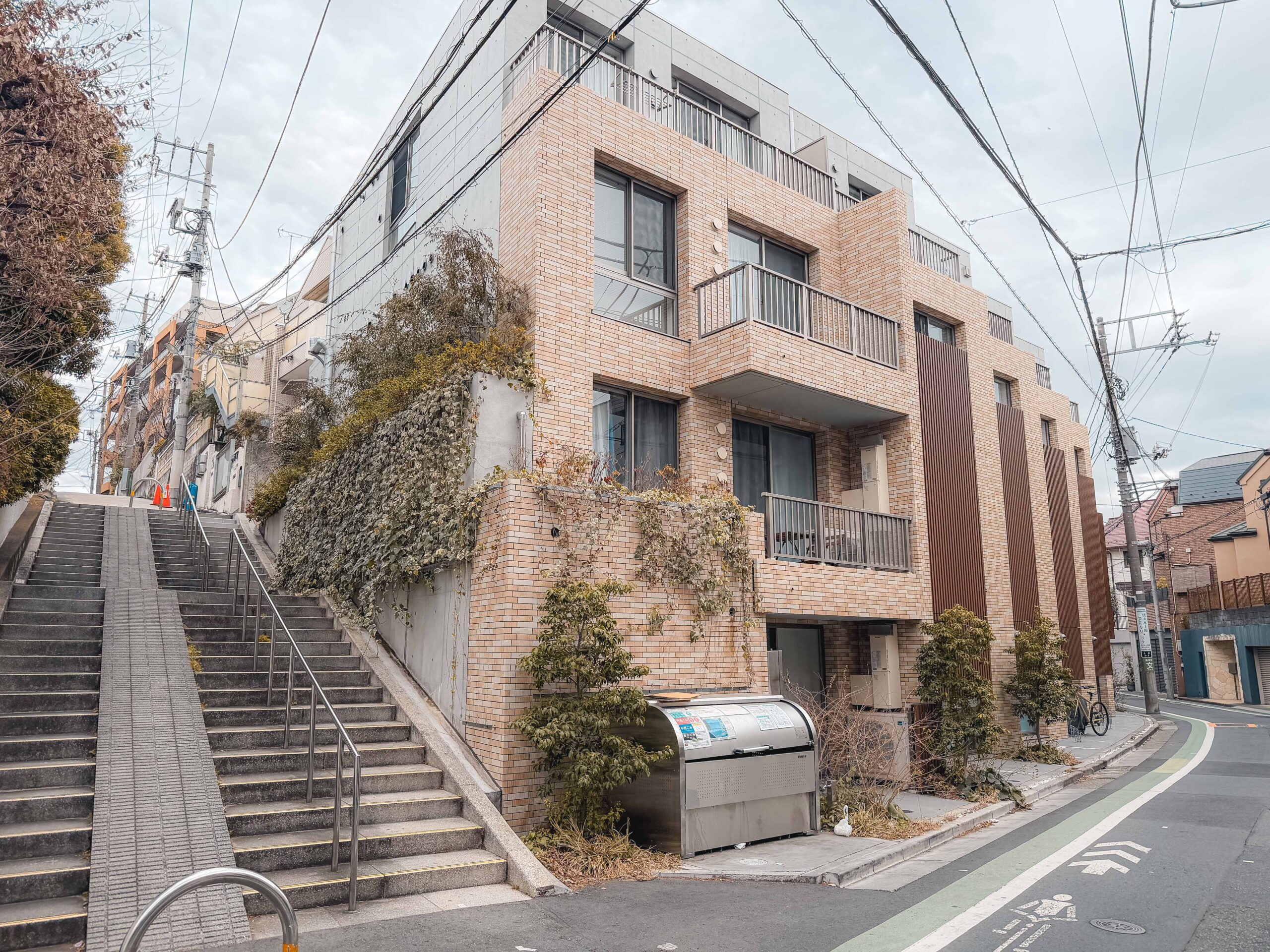
The three principal districts surrounding Yoyogi-Uehara Station offer distinct residential profiles within a 10-minute walking radius. Nishihara (西原), to the northwest, contains the highest concentration of detached houses (戸建て) and low-rise apartment buildings from the 1970s–1980s. Street widths here average 4–5 meters, below modern fire safety standards, which constrains redevelopment to individual lot replacement rather than block-scale projects.
Ōyamachō (大山町), directly north of the station, presents a more heterogeneous built environment. The 2023 completion of Parkhouse Yoyogiuehara Ōyamachō, a 14-unit luxury condominium by Mitsubishi Estate, demonstrated that premium pricing (¥2.8 million per tsubo, approximately ¥847,000 per m²) could be achieved in this sub-district. The development sold out in six weeks, with 40% of purchasers identified as foreign nationals or returnees.
Uehara (上原), the station’s namesake and eastern quadrant, maintains the strongest commercial presence. The 2024 renovation of the Odakyu-affiliated shopping precinct added three restaurant tenants targeting international residents, including a natural wine bar and a third-wave coffee roaster. This incremental commercial evolution, rather than the disruptive redevelopment seen in Sangenjaya or Shimokitazawa, preserves the neighborhood’s established rhythm.
Tokyo University Komaba Campus lies 15 minutes southwest on foot, contributing a permanent population of graduate students and faculty with international backgrounds. The presence of this research-intensive campus, rather than the undergraduate Hongo campus, means the demographic skews toward postdoctoral researchers and visiting scholars aged 28–40 rather than undergraduates.
Living Costs and Rental Market Overview
Beyond housing, Yoyogi-Uehara’s cost structure aligns with central Tokyo benchmarks with specific local variations. The 2026 Shibuya Ward consumer price index shows 3.2% year-on-year inflation, with food and beverage costs at restaurants increasing 4.7%.
Grocery options include a Seijo Ishii flagship (premium supermarket chain) at the station, Maruetsu Petit (conventional supermarket) on Nishihara-dori, and the Yoyogi-Uehara shotengai (商店街, traditional shopping street) vendors for produce and prepared foods. The Saturday morning Yoyogi Park farmers market, accessible in 12 minutes by bicycle, offers direct-from-producer pricing 15–30% below retail for seasonal vegetables.
Healthcare access is concentrated at the medium-tier. National Hospital Organization Tokyo Medical Center, a 15-minute Chiyoda Line ride at Sendagaya, provides English-language outpatient services. The neighborhood itself lacks a major hospital, with residents typically traveling to Keio University Hospital (Shinjuku, 12 minutes) or St. Luke’s International (Tsukiji, 18 minutes) for specialized care.
International education options within walking distance remain limited. The British School in Tokyo’s Shibuya campus is 18 minutes by Chiyoda Line and transfer; International School of the Sacred Heart is 22 minutes. For families prioritizing school proximity, Hiroo or Azabu may offer superior logistics despite higher property costs.
Tax Considerations for Foreign Property Owners
Foreign residents face additional compliance layers when acquiring Tokyo real estate. The real estate acquisition tax (不動産取得税), assessed at 3% of fixed asset tax valuation for residential land and buildings, includes a 2024–2026 reduction to 1.5% for newly constructed housing meeting energy efficiency standards. This temporary measure, extended in the 2025 tax reform, reduces acquisition cost by ¥4.5 million on a ¥300 million new construction purchase.
Rental income taxation operates through withholding at source for non-residents: 20.42% (income tax plus reconstruction surtax) unless reduced by applicable tax treaty. The Japan-UK treaty reduces this to 10%; the Japan-US treaty permits election into progressive taxation for US citizens. Residents with 永住権 (eijuuken, Japanese permanent residency) or Japanese spouses are taxed on worldwide income and may credit foreign taxes paid.
Exit tax considerations have grown more salient since the 2020 expansion of the regime. Residents exceeding five years of stay with financial assets exceeding ¥100 million face deemed disposition taxation on unrealized securities gains upon permanent departure. Real estate is excluded from this calculation, but the five-year clock resets upon re-entry, creating planning complexity for rotational expatriates.
For purchasers requiring financing, the 2026 mortgage environment shows divergence by residency status. Japanese banks extend variable-rate loans at 0.475–0.625% to permanent residents with Japanese income. Non-resident or non-permanent-resident borrowers face 1.25–1.85% rates from institutions including SMBC Prestia and Shinsei Bank, with maximum loan-to-value ratios of 50–70% and mandatory life insurance coverage.
Koukyuu is a private buyer’s advisory for distinguished Tokyo residences in Minato-ku, Hiroo, and Shirokane, focused exclusively on transactions of ¥300 million and above. A licensed 宅建士 (takken-shi, Japan’s licensed real-estate transaction specialist) personally handles every stage of the engagement, from the first consultation to the signing — a continuity most Tokyo agencies do not offer. Book a private consultation).