

Reviewed by a Koukyuu Takkenshi (宅地建物取引士)
Fact-checked against current Japanese real-estate law, tax rules, and market data by a nationally licensed specialist who oversees luxury transactions across Minato, Shibuya, and Chiyoda. In Japan, a Takkenshi is legally required to sign off on every property transaction, and about 15% of candidates pass the exam each year.
Yokohama’s residential property market in 2026 spans a wide price band, from ¥28.8 million for used condominiums in suburban wards to ¥163 million for luxury tower apartments near Yokohama Station. Japan’s second-largest city offers foreign buyers a distinct alternative to Tokyo, with established international communities in Yamate (山手) and Naka-ku (中区), lower entry prices than central Tokyo, and direct rail access to the capital. This guide covers current market segments, tax obligations, regulatory considerations, and neighborhood profiles for HNW international buyers evaluating houses for sale in Yokohama.
Yokohama Residential Property Market Overview: Segments and Pricing
The yokohama residential property market in 2026 divides into four distinct segments, each with different buyer profiles and price points.
Used condominiums (中古マンション) in suburban wards trade at approximately ¥573,000 per square meter. A representative listing in Konan-ku (港南区), a 1LDK of 50 square meters built in 1995, asks ¥28.8 million. These properties typically occupy older mid-rise buildings (5 to 12 stories) with basic management infrastructure and appeal primarily to owner-occupants seeking affordable entry into the Yokohama market or investors targeting rental yield in commuter zones.
New luxury tower apartments (新築タワーマンション) command substantially higher prices. The Yokohama Front Tower in Kanagawa-ku (神奈川区), a 43-storey reinforced concrete tower completed in December 2023 with 459 units, sets the current benchmark. A resale 2LDK unit on the 32nd floor, 55.48 square meters, west-facing, recently renovated, is listed at ¥163 million, or ¥2.94 million per square meter. Monthly holding costs for this unit run ¥33,940, comprising management fees (管理費) of ¥27,440 and reserve contributions (修繕積立金) of ¥6,500. The tower sits 3 minutes’ walk from Yokohama Station via a pedestrian deck, placing it at the apex of Yokohama’s luxury residential hierarchy.
New detached houses (新築一戸建て) in prestige neighborhoods command ¥100 million and above. A 3LDK+S detached house in Mameguchidai, Naka-ku, completed in March 2026, occupies 128 square meters of building area on a 144-square-meter plot and is listed at ¥109.8 million. Located in a Category 1 Low-Rise Exclusive Residential Zone (第一種低層住居専用地域) with a 50% building coverage ratio (建ぺい率) and 100% floor-area ratio (容積率), the property sits 5 minutes’ walk from JR Yamate Station. This segment attracts both Japanese and foreign buyers seeking single-family ownership in established international neighborhoods.
Residential land (売地, vacant plots) without existing structures offers a fourth entry point. An unimproved 203-square-meter lot in Ichigao-cho, Aoba-ku (青葉区), 4 minutes’ walk from Ichigao Station, is listed at ¥74.8 million, or ¥368,000 per square meter. Buyers purchasing land typically plan custom-built homes or hold for development.
Luxury Apartments Yokohama: The Yokohama Front Tower and High-End Market
The Yokohama Front Tower has become the definitive luxury apartments Yokohama benchmark since its completion in late 2023. The tower’s location in Kanagawa-ku, immediately adjacent to Yokohama Station via a climate-controlled pedestrian bridge, makes it the most accessible high-end residential asset in the city. Current resale inventory spans 1LDK to 3LDK floor plans, with unit sizes from 45 to 95 square meters and prices ranging from approximately ¥95 million to ¥280 million depending on floor, orientation, and renovation status.
The luxury apartments Yokohama segment competes directly with mid-tier Tokyo properties. A comparable 2LDK in central Tokyo’s Minato-ku (港区) typically trades at ¥180 million to ¥240 million for similar vintage and condition. The Yokohama Front Tower’s ¥2.94 million per square meter unit rate reflects this compression: it is roughly 30 percent lower than equivalent Tokyo Midtown or Roppongi Hills pricing, yet offers comparable building specifications, 24-hour concierge service, and international resident populations.
Management is handled by a joint venture between Tokyu Community (東急コミュニティー) and Sotetsu Living Support (相鉄リビングサポート) under a full-delegation model (全部委託), with on-site day staff. The tower includes fitness facilities, a lounge, a children’s play area, and a 24-hour security desk. Parking is available at ¥30,000 to ¥45,000 per month depending on location within the tower’s three-level underground garage.
Yamate and Naka-ku: Traditional Prestige Addresses for Foreign Buyers
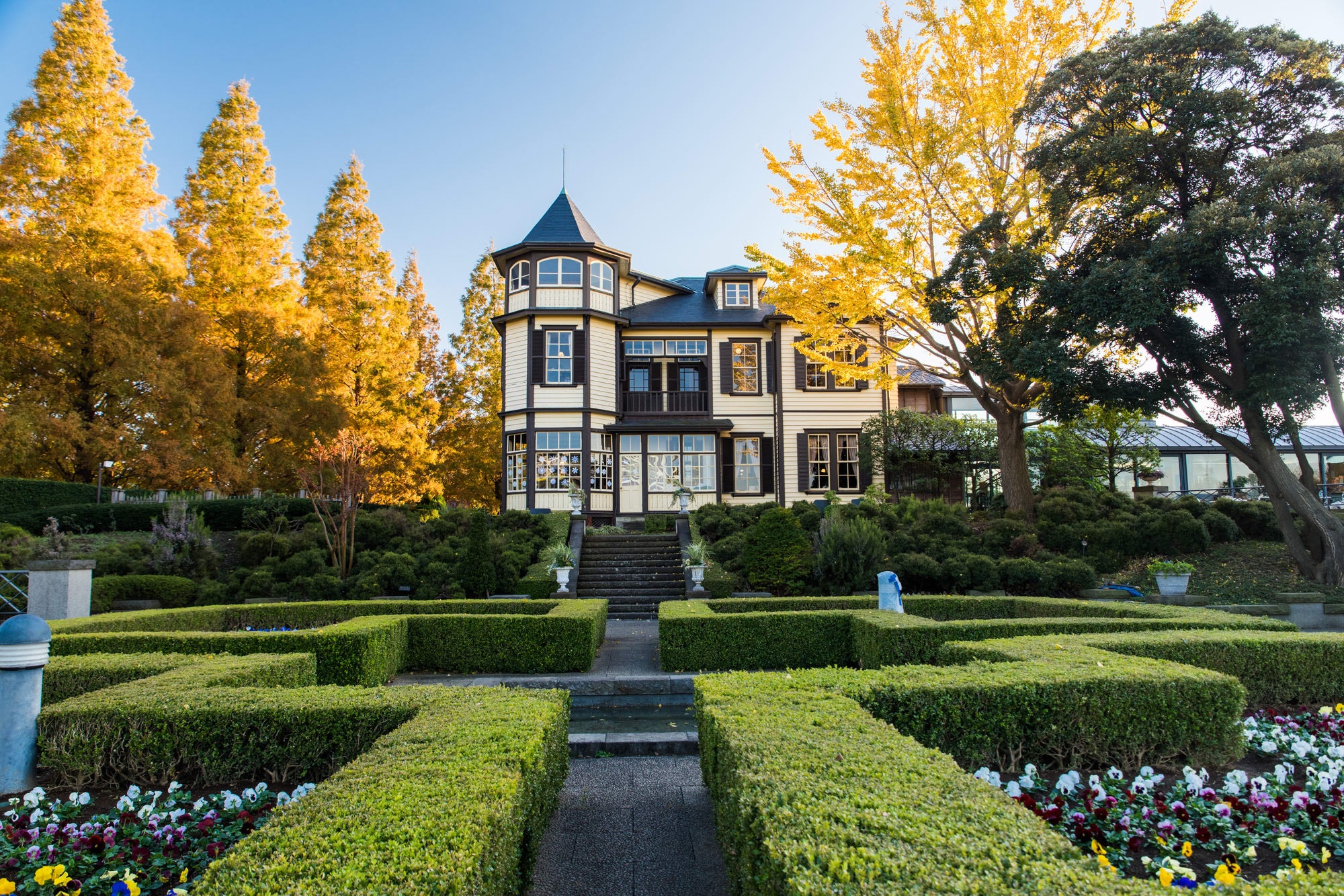
Yamate and Naka-ku remain the historical and cultural heart of Yokohama’s international residential community. The neighborhood’s tree-lined streets, low-density zoning, and proximity to international schools and expatriate services have attracted foreign residents since the 19th century. Today, detached houses Yokohama in this area command premium prices reflecting both scarcity and established demand.
New detached houses yokohama in Yamate now open at ¥100 million. The Mameguchidai listing at ¥109.8 million represents mid-market pricing for the zone. Larger or corner-plot properties in prime locations near Yamate Station can exceed ¥150 million. Used detached houses, typically 20 to 40 years old, range from ¥65 million to ¥95 million depending on condition and plot size.
Zoning regulations in Yamate enforce single-family residential character: the Category 1 Low-Rise Exclusive Residential Zone (第一種低層住居専用地域) restricts building height to 10 meters and floor-area ratio to 100 percent, preventing apartment construction or commercial use. This zoning stability is a primary reason foreign buyers favor the neighborhood; the streetscape and community character are protected by law.
Naka-ku as a whole encompasses several distinct sub-neighborhoods. Yamate itself is the prestige tier; adjacent areas like Motomachi (元町) and Ishikawa-cho (石川町) offer lower prices (¥60M to ¥85M for used houses) with similar international accessibility but slightly higher urban density. Foreigners relocating to Yokohama for corporate assignments often begin their search in Yamate, then expand to Motomachi or Ishikawa-cho if budget or family size constraints require it.
For detailed guidance on Yamate and neighboring prestige zones, review Yokohama Apartments for Sale in 2026: Prices, Yields, and What Foreign Buyers Must Know, which covers both luxury towers and traditional single-family neighborhoods.
Tax and Regulatory Framework for Foreign Property Owners in Yokohama
Japan imposes no restrictions on foreign ownership of residential real estate. Non-resident aliens and foreign corporations may purchase property without special approval, visa status, or residency requirement. However, foreign buyers must navigate several tax and regulatory obligations that differ from domestic Japanese purchasers.
Fixed-Asset Tax and City Planning Tax
All property owners, foreign and domestic, pay fixed-asset tax (固定資産税) at a standard rate of 1.4 percent of the assessed value (課税標準額). Yokohama City applies the maximum city planning tax (都市計画税) rate of 0.3 percent. Combined annual property tax on a ¥100 million house typically runs ¥1.7 million in the first year, declining slightly in subsequent years as the assessed value adjusts.
Small residential land receives a significant tax reduction: plots of 200 square meters or smaller qualify for a 1/6 reduction in fixed-asset tax (小規模住宅用地特例). This reduction applies regardless of buyer nationality. A 144-square-meter lot, like the Mameguchidai property, qualifies for the reduction on the full plot area.
Registration and License Tax
When purchasing property, buyers pay registration and license tax (登録免許税) to record the transfer of ownership at the Legal Affairs Bureau (登記). The rate is 0.4 percent for land and 0.3 percent for buildings (reduced rate through March 2027 under the Act on Special Measures Concerning Taxation, 租税特別措置法, Article 72). On a ¥109.8 million purchase comprising ¥50 million in land and ¥59.8 million in building, registration tax would total approximately ¥380,000.
Non-Resident Withholding and Exit Tax
When a non-resident foreign owner sells property, the buyer’s agent must withhold 10.21 percent of the gross sale price and remit it to the National Tax Agency (国税庁) under the non-resident withholding provision (源泉徴収, Article 212 of the Income Tax Act, 所得税法). This withholding is a credit against the seller’s final tax liability but creates a cash-flow friction for exit planning. Sellers should budget for this withholding when modeling repatriation scenarios.
For a more detailed exploration of tax mechanics and exit planning, consult Cheap Houses for Sale in Japan 2026: What Foreign Buyers Actually Find Beyond Tokyo, which addresses tax-efficient ownership structures for international investors.
Yokohama Property Prices and Market Comparison: Yokohama vs. Tokyo
Yokohama property prices in 2026 reflect a 25 to 35 percent discount to comparable Tokyo assets, driven by commute time, population demographics, and market perception. The Real Estate Economic Institute of Japan (不動産経済研究所) reported in January 2026 that the Kanagawa prefecture average new condominium contract price rose to approximately ¥65 million in 2025, up 12 percent year-on-year, driven largely by Yokohama Station-adjacent tower completions.
A 2LDK luxury apartment in central Tokyo’s Minato-ku trades at ¥2.8 to ¥3.2 million per square meter for 2023-2024 vintage stock. The same unit type in the Yokohama Front Tower trades at ¥2.94 million per square meter, placing Yokohama at the lower end of Tokyo’s mid-tier range. However, the commute from Yokohama to central Tokyo is 25 to 40 minutes by train, versus 5 to 15 minutes within Tokyo proper, which justifies the price differential for Tokyo-based workers.
Detached houses show a starker gap. A 3LDK detached house in Tokyo’s Shibuya-ku (渋谷区) or Minato-ku typically lists at ¥180 million to ¥250 million for 100 to 140 square meters of building area on similar-sized plots. The equivalent house in Yamate, Yokohama lists at ¥100 million to ¥130 million. This 40 to 50 percent discount reflects both the commute differential and the reality that Tokyo’s international business districts command a geographic premium that Yokohama does not.
The Ministry of Land, Infrastructure, Transport and Tourism (国土交通省) Real Estate Price Index (不動産価格指数) for the Kanto region showed used residential property prices up 8.2 percent year-on-year as of Q3 2025 (published February 2026), indicating steady appreciation across the broader region. Yokohama has benefited from this trend, though at a slower rate than central Tokyo.
Population Demographics and Long-Term Investment Considerations
Yokohama’s population trajectory presents both opportunity and risk for long-term property investors. The National Institute of Population and Social Security Research (国立社会保障・人口問題研究所) 2023 regional population projections show Yokohama City overall declining modestly, projected at negative 1.6 percent by 2035. However, this city-wide figure masks significant sub-ward variation.
Inner wards with strong station access and urban amenities are expected to hold or grow. Naka-ku, which includes Yamate and the Yokohama Station area, is projected to remain stable or grow slightly through 2035, driven by continued tower development and the concentration of international residents and corporate offices. Kanagawa-ku, where the Yokohama Front Tower stands, is similarly positioned for stability.
Suburban outer wards face steeper declines. Isogo-ku (磯子区), on the southern fringe of the city, is projected to decline 3.5 percent by 2035. Properties in such zones carry higher long-term resale risk and may face downward price pressure as the local population shrinks, reducing demand for family housing and increasing the proportion of vacant or abandoned properties.
For HNW buyers, this demographic reality argues strongly for station proximity (駅近) and ward-level location selection. A house in Yamate or Kanagawa-ku is far more defensible than an equivalent property in an outer suburban ward. The Yamate neighborhood’s established international character and proximity to Yokohama Station make it resilient to demographic headwinds; the Mameguchidai property, 5 minutes from the station, sits in the zone most likely to appreciate or hold value through 2035.
How to Buy Property in Yokohama: Regulatory Process and Timing
The purchase process for houses for sale in Yokohama follows the standard Japanese residential conveyance procedure, with specific steps and timelines that foreign buyers should understand.
Once a property is identified and an offer accepted, the buyer and seller execute a purchase agreement (売買契約) and the buyer pays an earnest-money deposit (手付金, typically 10 percent of the purchase price). This deposit is held in escrow by the agent and credited toward the final payment at closing.
Within two weeks of the purchase agreement, the agent must conduct the statutory pre-contract disclosure meeting (重要事項説明, juuyou-jikou-setsumei) in which a licensed real-estate transaction specialist (宅建士, takken-shi) reviews the property’s legal status, zoning, encumbrances, and material defects. For foreign buyers, this meeting should be conducted in English or with a qualified interpreter; many agents provide both.
The buyer then arranges financing (if required) and orders a property survey and title search. Most purchases close 30 to 45 days after the purchase agreement. At closing, the buyer pays the balance of the purchase price, the agent collects the real-estate transaction fee (仲介手数料, typically 3 percent of the purchase price plus 6 percent consumption tax, or approximately 3.3 percent total), and the buyer’s attorney or agent arranges registration of the ownership transfer (登記) at the Legal Affairs Bureau (法務局).
For foreign buyers without permanent residency (永住権), the process is identical in legal terms but may require additional documentation: a certificate of residence (住民票), a personal seal (実印) registered with the local ward office, and a tax identification number (個人番号 or マイナンバー). Many foreign buyers appoint a Japanese attorney or tax advisor to manage these administrative steps.
Yokohama station real estate, particularly towers like the Yokohama Front Tower, often closes within 30 to 40 days due to their popularity and high turnover. Yamate detached houses may take 45 to 60 days, reflecting lower transaction volume and the need for more thorough due diligence on older structures.
Koukyuu represents buyers seeking distinguished Tokyo residences in Azabu (麻布), Omotesando (表参道), and Aoyama (青山), focused exclusively on transactions of ¥300 million and above. A licensed 宅建士 (takken-shi) personally handles every stage of the engagement, from the first consultation to the signing, ensuring continuity and accountability throughout the process. Book a private consultation) to discuss your Tokyo acquisition strategy.