


Reviewed by a Koukyuu Takkenshi (宅地建物取引士)
Fact-checked against current Japanese real-estate law, tax rules, and market data by a nationally licensed specialist who oversees luxury transactions across Minato, Shibuya, and Chiyoda. In Japan, a Takkenshi is legally required to sign off on every property transaction, and about 15% of candidates pass the exam each year.
Residential land in Sangenjaya (三軒茶屋) is trading at ¥700,000 to ¥850,000 per square metre in 2026, according to the Ministry of Land, Infrastructure, Transport and Tourism’s 公示地価 (kouji-chika, the annual official land price survey). That figure represents a 3 to 5 percent year-on-year increase, and it sits well below comparable land in Minato Ward or Shibuya Ward, yet the commute to either is under 20 minutes. For high-net-worth foreign residents weighing a Tokyo address that trades on livability rather than postcode prestige, Sangenjaya deserves a careful look.
Location, Transit, and the Commute Case
Sangenjaya sits in Setagaya Ward (世田谷区), southwest Tokyo, the city’s most populous ward at roughly 940,000 residents. The station is two stops from Shibuya on the Tokyu Den-en-toshi Line (東急田園都市線), a journey of approximately five minutes. The Den-en-toshi Line connects directly to the Tokyo Metro Hanzomon Line (半蔵門線), meaning Otemachi and Tokyo Station are reachable in around 22 minutes without a transfer. Roppongi takes roughly 17 minutes via a Shibuya change; Shinjuku is also about 17 minutes.
A second line, the Tokyu Setagaya Line (東急世田谷線), runs as a two-car street tram from Sangenjaya westward to Gotokuji (豪徳寺), home of the maneki-neko (招き猫, the beckoning-cat figurine) temple. The tram is slow by Tokyo standards but gives the neighborhood a texture that no amount of urban planning can manufacture: passengers board at street level, the cars rattle past shotengai (商店街, covered shopping streets), and the whole corridor feels closer to a European tramway than to the high-speed rail infrastructure that defines most of inner Tokyo.
For buyers whose work anchors them to Marunouchi, Roppongi, or Shibuya, the commute profile is genuinely competitive with neighborhoods that command a 30 to 40 percent land-price premium.
Neighborhood Character: What the Numbers Do Not Capture
The name Sangenjaya translates literally as “three teahouses.” Three Edo-period establishments, Shigaraki, Kadoya, and Tanakaya, stood at the fork of Oyama-dori (大山道) and what is now National Route 246 (国道246号). One successor business, Tanakaya Tōen (田中屋陶苑), a ceramics shop, reportedly still operates at the original crossroads. That continuity is not incidental. Sangenjaya has absorbed successive waves of urban change, from postwar reconstruction through the bubble economy and its aftermath, without losing the grain of a working neighborhood.
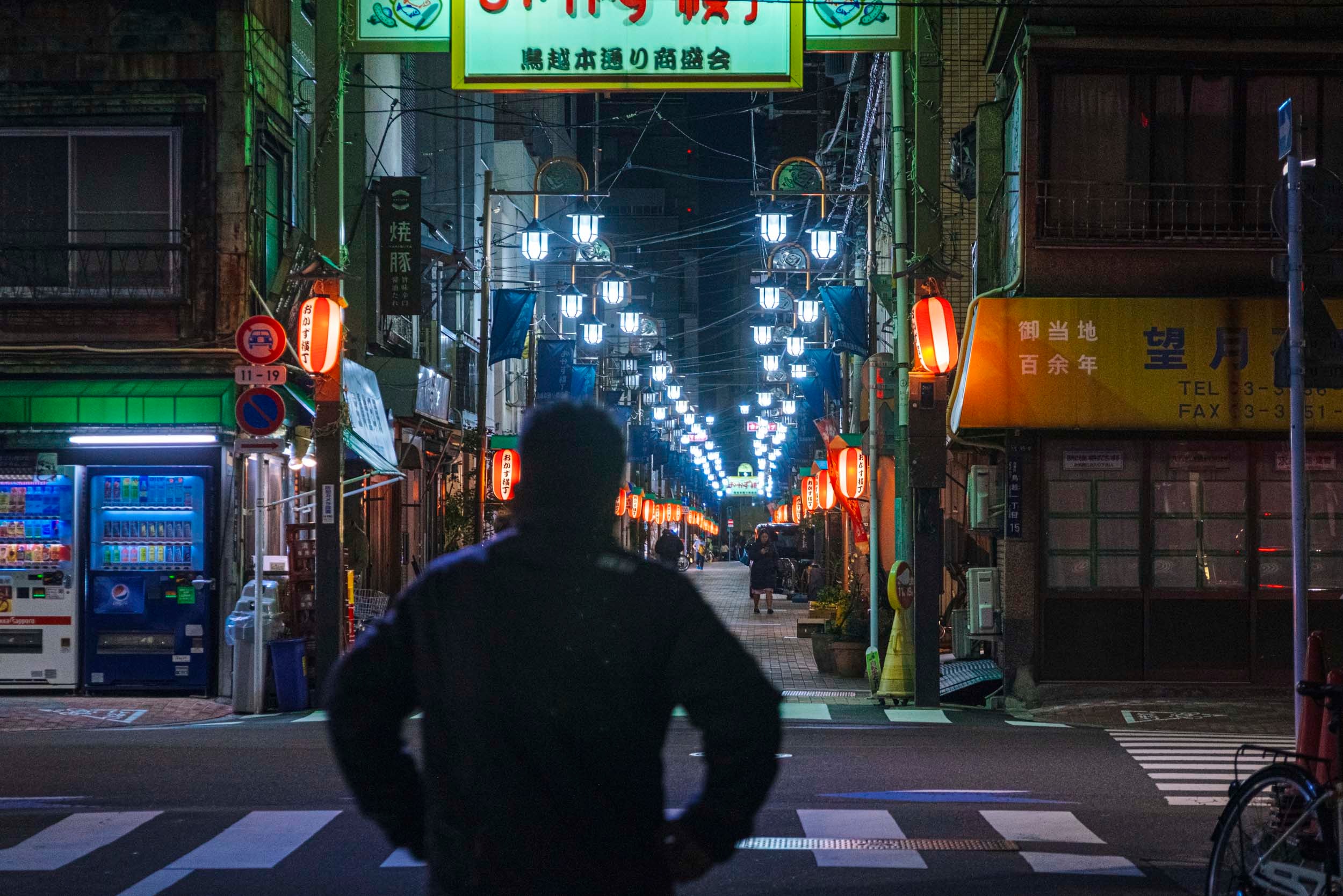
The most cited physical feature is the Sankaku Chitai (三角地帯, the Triangle Zone), a postwar alley district immediately north of the station. Yakiton (焼きとん, grilled pork offal skewers) start at ¥200 per skewer, and the bars are narrow enough that conversations between strangers at adjacent tables are unavoidable. The zone is not a tourist attraction in the conventional sense. It is where local residents eat on a Tuesday.
Carrot Tower (キャロットタワー), a 26-floor building directly above the station, contains a free observation deck and the Setagaya Public Theatre (世田谷パブリックシアター), a 600-seat venue with a consistent program of contemporary Japanese drama and international productions. The tower is the one concession to high-density development in an otherwise low-rise ward.
For families, the British School in Tokyo (BST) operates a Setagaya campus at Showa Women’s University (昭和女子大学), a direct answer to one of the most common practical questions foreign buyers ask about this part of the city. Setagaya Ward’s crime rate sits at approximately 0.8 incidents per 1,000 residents, among the lowest in Tokyo by ward-level public safety data.
Readers considering a similar profile slightly further west may find the complete guide to living in Shimokitazawa for foreign residents a useful parallel, as the two neighborhoods share a low-rise character and a resistance to large-scale redevelopment.
Real Estate Market Data: Prices, Supply, and Zoning
Resale マンション (manshon, Japanese usage for freehold condominium) prices in Setagaya Ward averaged ¥1,050,000 per square metre in Q3 2025, according to Tokyo Kantei (東京カンテイ) data, representing approximately ¥105 million for a 100-square-metre unit and a roughly 6 percent year-on-year increase. New-build supply in the Sangenjaya micro-market is structurally limited.
The reason is zoning. Much of Setagaya Ward is designated 第一種低層住居専用地域 (dai-isshu-teisou-juukyo-senyou-chiiki, Category 1 Low-Rise Exclusive Residential Zone), which caps building height at 10 metres and floor-area ratio (容積率, youeki-ritsu) at 100 to 150 percent. That constraint prevents the kind of high-rise supply that has softened prices in parts of Koto Ward and Kachidoki. The immediate station area carries a 近隣商業地域 (kinrin-shougyo-chiiki, Neighborhood Commercial Zone) designation that permits higher-density mixed-use development, which is why Carrot Tower exists, but the residential fabric beyond a few blocks of the station is protected.
Setagaya Ward’s current urban development master plan, updated in 2023, formally designates Sangenjaya as a 生活拠点 (seikatsu-kyoten, community hub), with policy emphasis on pedestrian infrastructure and small-scale retail preservation. No major station-area redevelopment projects are currently approved, a meaningful distinction from Shibuya or Shinjuku, where large-scale demolition and reconstruction have been ongoing for years.
Rental data provides a secondary read on the market. One-room and one-bedroom studios run ¥80,000 to ¥120,000 per month; 1LDK units (one living-dining-kitchen plus one bedroom) range from ¥130,000 to ¥160,000; two-bedroom configurations start around ¥150,000. Those figures are 25 to 35 percent below Minato Ward and Shibuya Ward equivalents, which matters to buyers who intend to hold the asset as a rental investment. For a broader view of how Sangenjaya fits within Tokyo’s premium residential geography, the Minato-ku neighborhood guide for foreign residents provides useful context on the price differential between wards.
Sangenjaya’s neighborhood profile on arealty.jp offers additional detail on the walkability and retail mix that sustains those rental yields.Tax Obligations for Foreign Buyers: What to Know Before Signing
Foreign buyers in Japan face the same tax obligations as domestic buyers, with a few additional layers that are worth understanding before any transaction.
固定資産税 (kotei-shisan-zei, fixed-asset tax) is levied annually at 1.4 percent of the assessed value (固定資産税評価額, kotei-shisan-zei-hyouka-gaku), which typically runs 50 to 70 percent of market value for residential property. 都市計画税 (toshi-keikaku-zei, city planning tax) adds 0.3 percent. Setagaya Ward falls within the 市街化区域 (shigaika-kuiki, urbanization promotion zone), so both taxes apply. The combined effective rate is 1.7 percent annually on assessed value. For a ¥150 million Sangenjaya condominium with an assessed value of ¥75 million to ¥90 million, the annual combined tax burden runs approximately ¥1.275 million to ¥1.53 million.
On disposal, non-resident sellers face 譲渡所得税 (joto-shotoku-zei, capital gains tax on real estate disposal) at 20.315 percent for short-term gains on assets held five years or less (15.315 percent national, 5 percent local), and 15.315 percent for long-term gains on assets held more than five years. A withholding mechanism under Article 212 of the 所得税法 (Shotoku-zei-hou, Income Tax Act) requires the buyer to withhold 10.21 percent of the gross sale price at source when purchasing from a non-resident seller. This is a procedural point that catches many foreign sellers off guard.
On inheritance, the 国税庁 (Kokuzeichou, National Tax Agency) implemented amendments effective April 1, 2025, tightening the 10-year rule for non-residents. Foreign nationals who have been non-resident for more than 10 years are now excluded from Japanese 相続税 (sozoku-zei, inheritance tax) on overseas assets, but Japanese-situs assets, including real estate, remain fully taxable regardless of residency status. The 路線価 (rosenka, roadside land price used for inheritance tax valuation) for key arterials in the Taishido (太子堂) and Sangenjaya 1-chome area was assessed at ¥480,000 to ¥560,000 per square metre in the 2025 publication, materially below market transaction prices. That gap is relevant to estate planning via direct real estate ownership.
For buyers considering higher-specification assets in this price range, the article on designer apartments in Tokyo addresses the due diligence and structural considerations that apply across Setagaya and adjacent wards.
Practical Considerations for Foreign Residents
Sangenjaya has a relatively small expatriate community compared with Hiroo (広尾) or Azabu (麻布), which is both a limitation and, depending on the buyer’s priorities, an advantage. The neighborhood operates almost entirely in Japanese. Signage, menus, and interactions at the ward office (区役所, kuyakusho) assume Japanese literacy. That is a practical constraint for buyers who have not yet reached functional Japanese proficiency, and it is worth factoring into a relocation decision.
On the infrastructure side, the British School in Tokyo’s Setagaya campus addresses schooling for families with children at the primary and secondary level. Setagaya Ward’s public library network, parks including Setagaya Park (世田谷公園), a 20-minute walk from the station with cherry blossoms and a miniature steam train, and the Setagaya Public Theatre provide a cultural and recreational base that is more than adequate for long-term residents.
Visa and permanent residency status do not affect the right to purchase real estate in Japan. Foreign nationals on any visa category, or on no visa at all, may hold freehold title. However, 永住権 (eijuuken, Japanese permanent residency) status does affect mortgage access. Major Japanese banks including Sumitomo Mitsui, Mizuho, and MUFG will lend to permanent residents on broadly similar terms to Japanese nationals. Non-permanent residents face a narrower lender pool, shorter maximum loan terms, and higher required down payments, typically 20 to 30 percent of purchase price. Buyers without PR who are financing a purchase should clarify lender eligibility before committing to a timeline.
The 重要事項説明 (juuyou-jikou-setsumei, the statutory pre-contract disclosure meeting) is a mandatory step in every Japanese real estate transaction. A licensed 宅建士 (takken-shi, Japan’s licensed real-estate transaction specialist) is legally required to conduct this meeting, explain the property’s legal status, zoning, encumbrances, and management obligations, and sign the disclosure document. In practice, many Tokyo agencies route clients through unlicensed salespeople for most of the process and produce the takken-shi only at this single required moment. Buyers who want licensed-specialist continuity across the entire transaction, from the initial brief through negotiation, due diligence, and 登記 (touki, the transfer of legal title recorded at the Legal Affairs Bureau), should confirm that arrangement explicitly before engaging an agency.
Sangenjaya in 2026: A Considered Summary
Sangenjaya is not a discovery. It has been a favored address for Tokyo residents who prioritize livability over address cachet for at least two decades. What has changed in 2026 is the arithmetic. Land prices up 3 to 5 percent year-on-year, resale condominium prices up roughly 6 percent, and a zoning structure that structurally limits new supply, all while rental yields remain 25 to 35 percent above Minato and Shibuya ward equivalents. The neighborhood’s designation as a community hub in the ward’s master plan signals policy continuity, not transformation. For a buyer whose brief includes a five-minute Shibuya commute, a low-rise residential character, a functioning international school, and a price point below the premium inner-ward market, Sangenjaya is one of a small number of Tokyo neighborhoods where those conditions converge.
Koukyuu is a private buyer’s advisory for distinguished Tokyo residences in Nishi-Azabu (西麻布), Omotesando (表参道), and Aoyama (青山), focused exclusively on transactions of ¥300 million and above, with a licensed 宅建士 personally handling every stage of the engagement from the first consultation to the signing of title transfer. Book a private consultation) to begin a confidential conversation about your Tokyo brief.