


Reviewed by a Koukyuu Takkenshi (宅地建物取引士)
Fact-checked against current Japanese real-estate law, tax rules, and market data by a nationally licensed specialist who oversees luxury transactions across Minato, Shibuya, and Chiyoda. In Japan, a Takkenshi is legally required to sign off on every property transaction, and about 15% of candidates pass the exam each year.
Land in Sangenjaya 2-chome (三軒茶屋2丁目) has appreciated 176.9% over the past 26 years, the single highest long-run appreciation rate recorded in Setagaya Ward (世田谷区) according to 2026 国土交通省 (Ministry of Land, Infrastructure, Transport and Tourism) 地価公示 (published land-price survey) data. That figure is not a rounding anomaly. It reflects a structural shift in how Tokyo’s inner southwest is valued, driven by a five-minute train ride to Shibuya and a neighborhood character that has resisted the homogenization visible in more tourist-facing districts. For foreign buyers evaluating where to allocate capital in 2026, Sangenjaya (三軒茶屋) deserves a precise look.
Location, Access, and the Transit Arithmetic
Sangenjaya sits in the western portion of Setagaya Ward, approximately 4.5 kilometers southwest of Shibuya (渋谷). The Tokyu Den-en-toshi Line (東急田園都市線) connects Sangenjaya Station to Shibuya in roughly five minutes across two stops. From Shibuya, the Hanzomon Line through-service continues northeast to Otemachi and Tokyo Station in approximately 22 minutes total. Shinjuku (新宿) is reachable via a Yamanote Line transfer at Shibuya in around 17 minutes.
A second line, the Tokyu Setagaya Line (東急世田谷線), operates as a tram-style local service from Sangenjaya Station west toward Shimotakaido (下高井戸), providing intra-ward connectivity that most Setagaya sub-districts lack. This dual-line access is a meaningful differentiator: residents can reach central Tokyo without routing through Shibuya when the tram serves their destination.
For expat families, the campus geography is also relevant. Temple University Japan is within practical commuting distance, and the British School in Tokyo’s Showa Women’s University-area site is accessible on foot or by a short tram ride. These proximity factors sustain rental demand from the international community and support resale liquidity.
Neighborhood Character: Three Zones Worth Distinguishing
Sangenjaya is often described as a single neighborhood, but buyers should think of it as three overlapping zones with distinct characters and different property implications.
The station-front precinct, centered on 太子堂 (Taishido), is anchored by キャロットタワー (Carrot Tower), a 26-story mixed-use complex completed in 1996 directly above the station exit. Carrot Tower houses the 世田谷パブリックシアター (Setagaya Public Theatre), a ward satellite office, ground-floor retail including Uniqlo and Tsutaya, and a free observation deck on the 26th floor with clear-day views toward Mount Fuji. The building is a useful orientation point: property within 200 meters of it commands a meaningful premium.
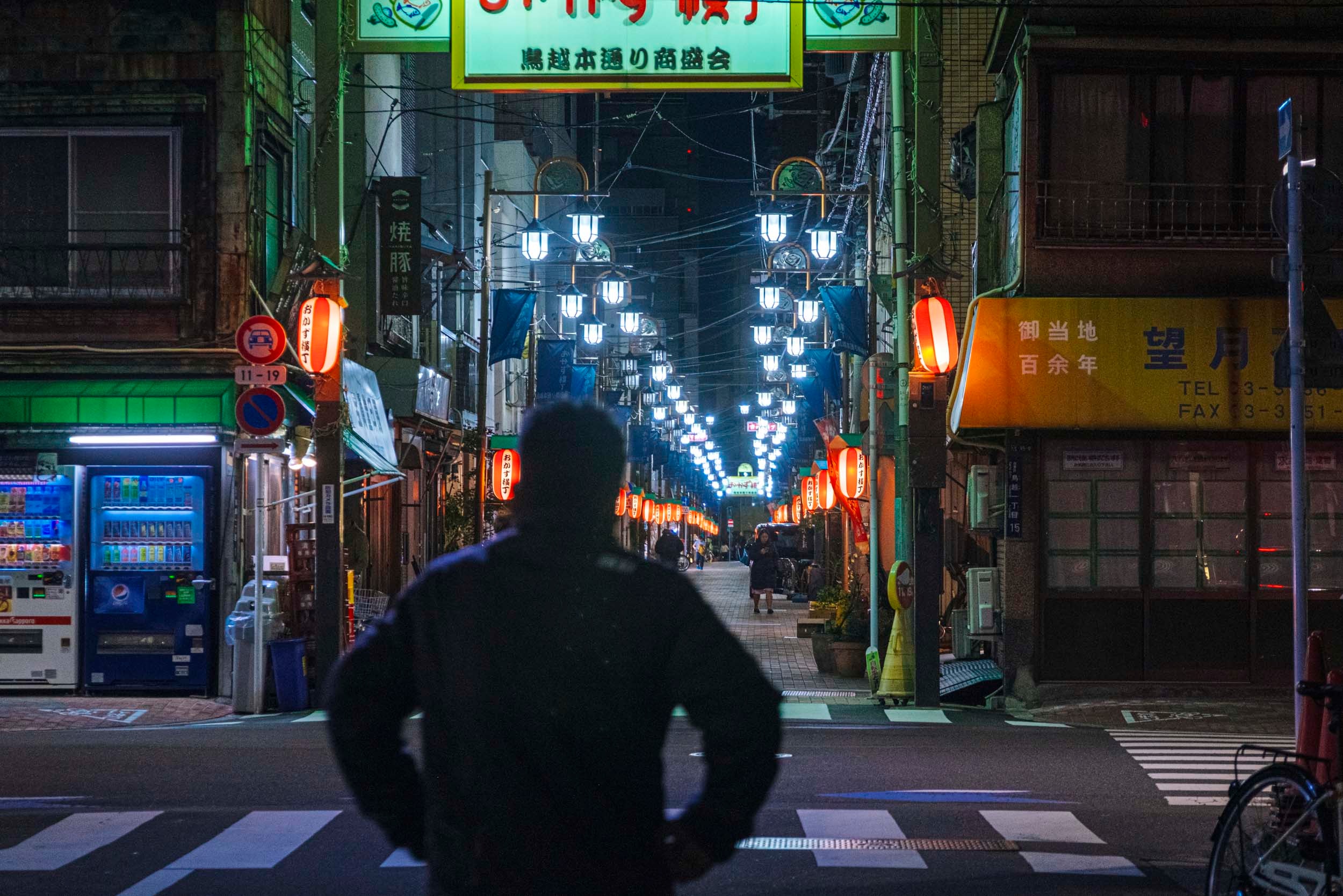
Immediately south and west of the station lies the 三角地帯 (Sankaku Chitai, the Triangle District), a dense grid of Showa-era alleyways lined with izakaya (居酒屋, Japanese gastropubs) and bars seating fewer than ten people each. This zone is the source of Sangenjaya’s reputation as a neighborhood that Tokyo residents actually use rather than visit. It is not a tourist circuit. The bars are unmarked, the clientele is local, and the streets are narrow enough that two people walking abreast fill the lane. For buyers, the Triangle is a lifestyle asset, not a development opportunity.
Beyond the immediate station area, the residential hinterland transitions into low-rise housing on quiet streets. Much of this zone falls within 第一種低層住居専用地域 (Category 1 Low-Rise Exclusive Residential Zone) under Japan’s zoning code, which restricts building height and prohibits commercial uses. This zoning classification is the structural reason Sangenjaya’s residential streets have retained their scale while adjacent commercial corridors have densified.
For further context on how Sangenjaya compares to other west-side neighborhoods with a similar independent character, the complete guide to living in Shimokitazawa for foreign residents in 2026 covers the adjacent Shimokitazawa (下北沢) market, which shares the Den-en-toshi corridor.
Land Prices and the Case for Setagaya Capital Appreciation
The 2026 地価公示 data provides specific figures worth quoting directly.
In 太子堂2丁目 (Taishido 2-chome), 60 meters from Sangenjaya Station, the assessed land price is ¥6.99 million per 坪 (tsubo, a Japanese unit of approximately 3.3 square meters), equivalent to roughly ¥2.12 million per square meter. That represents a 134.4% increase from the year 2000. In 三軒茶屋2丁目, 700 meters from the station, the figure is ¥4.76 million per tsubo, up 176.9% over the same period. In 三軒茶屋1丁目, 200 meters from the station, the price is ¥3.96 million per tsubo, up 116.3%.
For reference, the Setagaya Ward average in 2026 is ¥2.41 million per tsubo. A standard 30-tsubo (approximately 99 square meters) plot at the ward average costs approximately ¥72 million. The Taishido 2-chome figure is nearly three times the ward average.
These numbers matter for foreign buyers accustomed to comparing Tokyo against Minato Ward (港区) benchmarks. Azabu (麻布) and Hiroo (広尾) land prices remain higher in absolute terms, but Sangenjaya’s core sub-districts have outperformed many Minato Ward addresses on a percentage-appreciation basis over the past quarter-century. The driver is the Den-en-toshi Line’s sustained demand profile and the neighborhood’s resistance to over-development. Buyers who want a comparative view of what premium Minato Ward pricing looks like in 2026 can review the Minato-ku neighborhood guide for foreign residents covering Azabu, Roppongi, and beyond.
One structural caveat applies to the entire Setagaya market. Approximately 40% of ward roads are under 4 meters wide, which triggers セットバック (setback) obligations under the 建築基準法 (Building Standards Act). A setback requirement means the owner must yield a strip of land to the road boundary before rebuilding, effectively reducing the usable lot area. Any buyer considering a detached house or a tear-down-and-rebuild on a Sangenjaya plot must verify 接道義務 (road-frontage requirements) as part of pre-contract due diligence. This is not a minor administrative step; it can materially affect buildable floor area and therefore asset value.
Tax and Regulatory Framework for Foreign Buyers
Japan imposes no restrictions on foreign ownership of real estate. Non-residents and foreign nationals may purchase land and buildings freely under the 外国為替及び外国貿易法 (Foreign Exchange and Foreign Trade Act). Post-purchase reporting to the Bank of Japan is required for transactions above ¥100 million, but this is an administrative filing, not an approval process.
The recurring tax obligations are as follows. 固定資産税 (kotei shisan-zei, fixed-asset tax) is levied at a standard rate of 1.4% of the assessed value, known as the 課税標準額 (kazei hyoujun-gaku). 都市計画税 (toshi keikaku-zei, city planning tax) adds up to 0.3% for properties in urbanization promotion zones, and Setagaya Ward falls within this designation. For residential land on lots of 200 square meters or smaller, the assessed value used for fixed-asset tax is reduced to one-sixth of the official figure, and to one-third for city planning tax purposes, under Article 349-3 and Article 702 of the 地方税法 (Local Tax Act). These reductions are automatic for qualifying owner-occupied residential properties.
On acquisition, 不動産取得税 (fudousan shutoku-zei, real estate acquisition tax) applies at 3% of assessed value for residential property. The standard statutory rate is 4%, but the reduction to 3% is in effect under the 租税特別措置法 (Special Taxation Measures Act) through March 2027 under the current legislative schedule.
For buyers thinking about estate planning, Japan’s 相続税 (sozoku-zei, inheritance tax) taxes residents on worldwide assets and non-residents on Japan-sited assets. The 路線価 (rosen-ka, road-frontage assessed value used for inheritance tax calculations) for the Taishido and Sangenjaya sub-districts is published annually by the 国税庁 (National Tax Agency) each July. The 2025 rosen-ka publication showed continued appreciation along the Setagaya corridor. Owner-occupiers should also be aware of the 小規模宅地等の特例 (Special Provisions for Small Residential Lots), which can reduce the taxable value of a primary residence lot by up to 80% for plots of 330 square meters or smaller. This provision is significant for estate planning purposes and is worth discussing with a Japanese tax advisor before structuring a purchase.
For buyers considering a マンション (manshon, Japanese usage for a freehold condominium unit, distinct from the English word “mansion”) rather than a detached house, the guide to designer apartments in Tokyo for foreign buyers in 2026 covers the condominium-specific due diligence steps in detail.
Rental Market Context and Luxury Supply Constraints
Broad market rental data for the Sangenjaya area gives a useful baseline. As of current 2026 data, a 1R or 1K unit near the station averages approximately ¥100,700 per month. A 1LDK or 2DK averages ¥152,700. A 2LDK or 3DK averages ¥241,100. These figures reflect the general market across all building vintages and sizes.
For buyers evaluating yield on larger assets, the relevant observation is that luxury rental supply in Sangenjaya is thin. The neighborhood skews toward owner-occupied detached houses and smaller マンション buildings. Units of 100 square meters or more in new-build condition are scarce, which means the rental rate for such units, when they do appear, commands a premium above the broad averages cited above. Scarcity is a double-edged condition: it supports rental pricing but also limits the comparable transaction data available for valuation.
The Sangenjaya area guide on arealty.jp provides additional context on the neighborhood’s day-to-day commercial character for buyers weighing lifestyle factors alongside financial metrics.
Practical Considerations Before Making an Offer
Several procedural points are specific to the Japanese transaction process and are worth stating plainly for buyers without prior experience in this market.
Before any contract is signed, a 宅建士 (takken-shi, Japan’s licensed real-estate transaction specialist) is legally required to deliver a 重要事項説明 (juuyou-jikou-setsumei, the statutory pre-contract disclosure meeting) covering material facts about the property, including zoning classification, road-frontage status, building code compliance, and any encumbrances on title. This meeting is a legal requirement under the 宅地建物取引業法 (Real Estate Brokerage Act), and the document it produces is the primary vehicle for surfacing the setback issues and road-width conditions described above.
At contract execution, buyers pay a 手付金 (tetsuke-kin, earnest-money deposit, typically 10% of the purchase price). This deposit is at risk if the buyer withdraws without a contractual basis for doing so, so the due diligence phase before signing carries real financial stakes.
Title transfer, known as 登記 (touki, the transfer of legal title recorded at the Legal Affairs Bureau), is completed by a 司法書士 (shihou-shoshi, a licensed judicial scrivener) at closing. Foreign buyers do not need a Japanese address to complete touki, but they do need a certified translation of identification documents and, in most cases, a 印鑑証明 (inkan shomeisho, registered seal certificate) or an equivalent notarized signature process.
Mortgage access for non-residents is limited. Most Japanese megabanks and regional banks require either 永住権 (eijuuken, Japanese permanent residency) or a spouse who holds it. Buyers without PR status typically finance through international private banks, overseas equity release, or cash. This is not a barrier to ownership, but it is a factor in structuring the transaction timeline.
Koukyuu is a private buyer’s advisory for distinguished Tokyo residences in Nishi-Azabu (西麻布), Omotesando (表参道), and Aoyama (青山), focused exclusively on transactions of ¥300 million and above, with a licensed 宅建士 personally handling every stage from the first consultation through signing. Book a private consultation) to discuss how Sangenjaya or comparable Setagaya assets fit your acquisition brief.