


Reviewed by a Koukyuu Takkenshi (宅地建物取引士)
Fact-checked against current Japanese real-estate law, tax rules, and market data by a nationally licensed specialist who oversees luxury transactions across Minato, Shibuya, and Chiyoda. In Japan, a Takkenshi is legally required to sign off on every property transaction, and about 15% of candidates pass the exam each year.
Market Positioning and Transaction Floors
Kita Aoyama (北青山) occupies the northern half of the broader Aoyama district in Minato-ku (港区), bounded by Omotesando (表参道) to the south and Aoyama-dori (青山通り) to the north. As of April 2026, residential transactions in Kita Aoyama’s 1-chome through 3-chome postal zones reflect a pricing floor that begins at approximately ¥320 million for a two-bedroom マンション (manshon, Japanese usage for freehold condominium). Properties exceeding 100 square meters in newer towers routinely cross ¥500 million, with penthouses in landmark developments approaching ¥1.2 billion.
The neighborhood’s appeal to foreign buyers rests on three factors: walkability to international schools in Shibuya-ku (渋谷区) and Minato-ku, English-language amenities along Omotesando and Aoyama-dori, and proximity to embassies clustered in Akasaka (赤坂) and Azabu (麻布). The Omotesando Station complex, served by the Ginza (銀座線), Chiyoda (千代田線), and Hanzomon (半蔵門線) subway lines, sits at the southern edge of Kita Aoyama 3-chome, placing most residential addresses within a six-minute walk of three-line interchange access.
For foreign buyers navigating Japan’s residential market, the distinction between a licensed 宅建士 (takken-shi, Japan’s statutory real estate transaction specialist) and an unlicensed salesperson becomes material during the 重要事項説明 (juuyou-jikou-setsumei, the pre-contract disclosure meeting). Only a takken-shi may legally deliver this disclosure, yet most Tokyo agencies assign unlicensed staff to viewings, negotiation, and due diligence, introducing the licensed specialist only at the final signing. Koukyuu operates differently: a licensed takken-shi handles every stage of the engagement, from the first consultation to the signing, ensuring continuity and accountability throughout the transaction.
Residential Inventory and Architectural Context
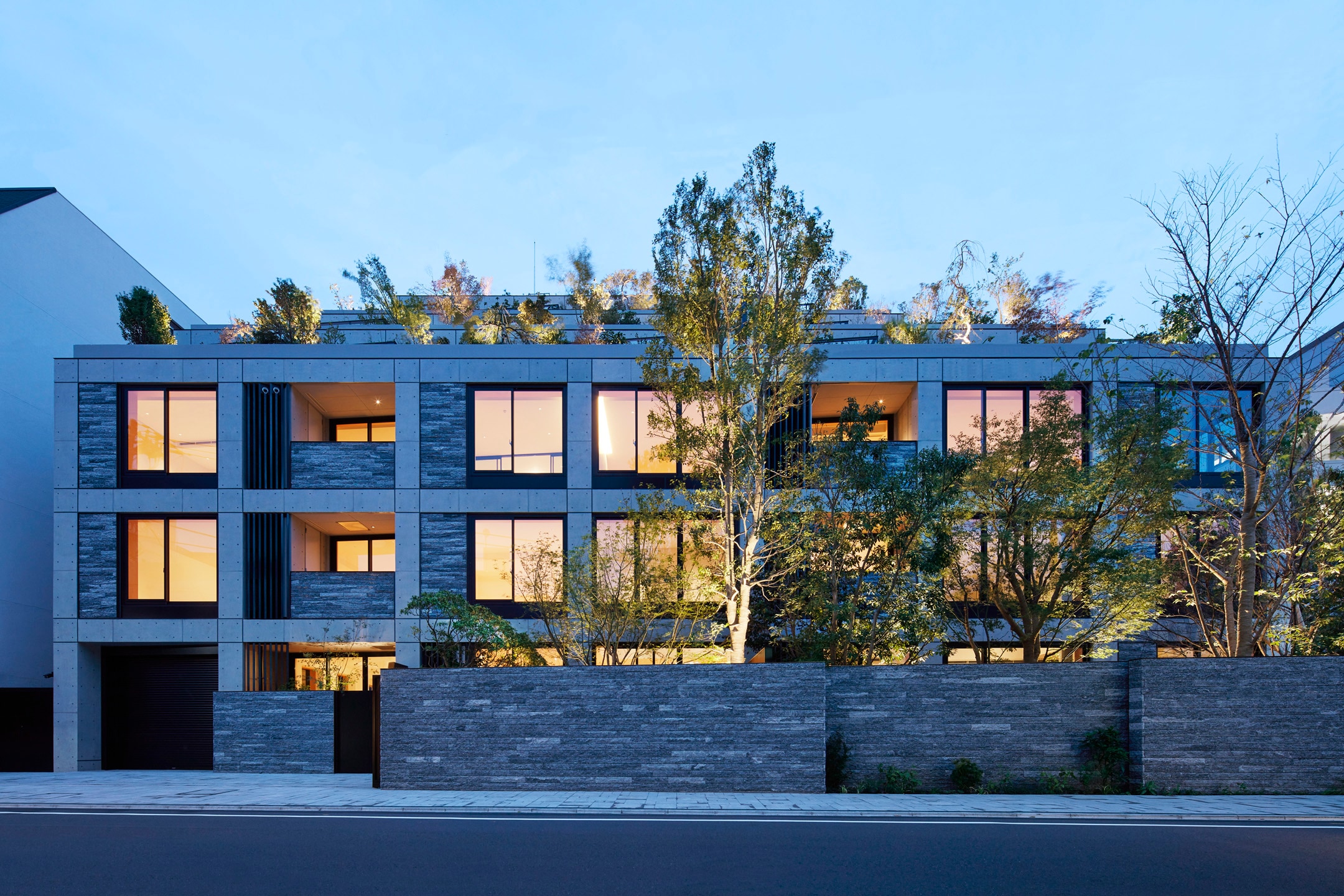
Kita Aoyama’s residential stock divides into three categories: pre-1995 mid-rise マンション (manshon) of six to eight floors, post-2000 tower residences exceeding 20 floors, and low-rise freehold 一戸建て (ikkodate, detached single-family homes) concentrated in the quieter 2-chome blocks. The Kita Aoyama 3-chome District Town Development Project, completed in 2022, introduced a 21-story green tower residence designed by Kengo Kuma and Associates, emphasizing vertical gardens and setback terraces that respond to Tokyo’s sloped topography between Aoyama-dori and Omotesando.
As of April 2026, the REINS (Real Estate Information Network, Japan’s national MLS) database shows 14 active listings in Kita Aoyama 1-chome through 3-chome priced above ¥300 million. Of these, nine are tower マンション (manshon) units built after 2015, three are mid-rise units in buildings constructed between 2005 and 2010, and two are 一戸建て (ikkodate) properties on plots exceeding 150 square meters. The median list price for a 2LDK (two-bedroom plus living-dining-kitchen layout) in a post-2015 tower stands at ¥485 million, with a median floor area of 82 square meters.
Foreign buyers often underestimate the importance of 管理費 (kanri-hi, monthly condominium management fees) and 修繕積立金 (shuuzen-tsumitate-kin, the reserve fund for major repairs). In Kita Aoyama’s newer towers, combined monthly fees for an 80-square-meter unit typically range from ¥42,000 to ¥68,000, with higher figures reflecting concierge services, 24-hour security, and shared amenities such as guest suites and fitness facilities. These fees are payable in yen and are not typically eligible for foreign currency hedging, a consideration for buyers whose income remains denominated in dollars, euros, or pounds.
Infrastructure, Schools, and Daily Amenities
Kita Aoyama’s infrastructure serves both residential and commercial functions. The neighborhood’s southern boundary along Omotesando supports flagship retail, including the Prada Aoyama store designed by Herzog & de Meuron and the Dior Omotesando boutique. The northern blocks along Aoyama-dori host corporate offices, design showrooms, and smaller galleries. Fergus McCaffrey Tokyo, located at 3-5-9 Kita-Aoyama, operates as a contemporary art gallery with regular exhibitions Tuesday through Saturday, 11:00 to 19:00.
For families, the nearest public elementary school is Aoyama Elementary School (青山小学校) in Minato-ku, a ten-minute walk from Kita Aoyama 2-chome. International options include the British School in Tokyo’s Shibuya campus, approximately 2.8 kilometers west, and Nishimachi International School in Azabu, 1.9 kilometers southeast. Both schools require 永住権 (eijuuken, Japanese permanent residency) or a valid long-term visa for enrollment, a hurdle for buyers arriving on business manager or investor visas without dependent provisions.
Daily shopping concentrates at the Aoyama branch of National Azabu supermarket, a 12-minute walk from Kita Aoyama 1-chome, and the Kinokuniya International supermarket in Aoyama 1-chome, which stocks imported groceries and English-labeled products. Medical services include the Tokyo Midtown Clinic in Akasaka, 1.6 kilometers east, which offers English-speaking general practitioners and specialist referrals.
Transaction Mechanics and Foreign Buyer Considerations
Foreign buyers purchasing in Kita Aoyama face the same legal framework as Japanese nationals, with no ownership restrictions on freehold マンション (manshon) or 一戸建て (ikkodate) properties. The transaction sequence proceeds as follows: offer submission, acceptance, 手付金 (tetsuke-kin, earnest money deposit of typically 10 percent), 重要事項説明 (juuyou-jikou-setsumei, the statutory disclosure meeting conducted by a licensed takken-shi), contract signing, balance payment, and 登記 (touki, title transfer recorded at the Legal Affairs Bureau).
Mortgage access for non-residents remains limited. As of April 2026, SMBC Prestia Bank and Sumitomo Mitsui Trust Bank offer non-resident mortgages with loan-to-value ratios capped at 50 to 60 percent, requiring a minimum down payment of 40 to 50 percent of the purchase price. Interest rates for non-resident borrowers range from 2.8 to 3.6 percent annually, compared to 0.8 to 1.4 percent for Japanese nationals with 永住権 (eijuuken, permanent residency). Foreign buyers without Japanese income documentation typically structure purchases as cash transactions or arrange offshore financing secured against assets in their home jurisdiction.
Property taxation in Kita Aoyama follows Minato-ku’s standard rates: 固定資産税 (kotei-shisan-zei, fixed asset tax) at 1.4 percent of assessed value annually, plus 都市計画税 (toshi-keikaku-zei, urban planning tax) at 0.3 percent, for a combined effective rate of 1.7 percent. Assessed values in Minato-ku typically approximate 60 to 70 percent of market transaction prices, resulting in an annual tax burden of roughly 1.0 to 1.2 percent of the purchase price for a newly acquired property.
Comparable Inventory and Pricing Context
Kita Aoyama’s pricing sits at the upper end of Minato-ku’s residential spectrum, comparable to Nishi-Azabu (西麻布) and Moto-Azabu (元麻布), and above Hiroo (広尾) and Shirokane (白金). A recent transaction at Park Court Jingu Kita-Sando The Tower, a 2LDK unit listed at ¥490 million, illustrates the pricing for a 78-square-meter residence in a post-2020 tower with direct access to Gaienmae Station on the Ginza Line. The building’s location in Jingumae (神宮前) 2-chome, immediately south of Kita Aoyama 3-chome, places it within the same catchment for international schools and English-language services.
For buyers seeking a lower entry point within the broader Aoyama area, Jingumae 5-chome Blanche, a 2LDK unit listed at ¥328 million, offers 68 square meters in a mid-rise building completed in 2008. The property sits 850 meters south of Kita Aoyama 3-chome, within a seven-minute walk of Omotesando Station. Buyers willing to consider Hiroo, 1.8 kilometers southeast, can access inventory such as Hiroo Garden Hills East Hill B Building, a 2LDK unit at ¥368 million, reflecting a 15 to 20 percent discount relative to equivalent Kita Aoyama addresses.
The ¥300 million threshold represents a meaningful floor in Tokyo’s luxury マンション (manshon) market. Properties below this level typically fall into the mass-market segment, characterized by smaller floor plates, lower ceilings, and reduced access to concierge or multilingual management services. For foreign buyers requiring English-language building management and proximity to international infrastructure, the ¥300 million floor aligns with the minimum viable product in neighborhoods such as Kita Aoyama, Azabu, and Shibuya-ku’s Hiroo district.
Liquidity, Exit Strategy, and Resale Context
Kita Aoyama’s resale market reflects Tokyo’s broader liquidity dynamics. As of April 2026, the average time on market for a マンション (manshon) unit priced above ¥300 million in Minato-ku stands at 78 days, according to REINS transaction data. Properties in Kita Aoyama’s 1-chome and 2-chome postal zones, closer to Omotesando Station, typically sell within 60 to 70 days, while 3-chome addresses farther from subway access extend to 85 to 95 days.
Foreign sellers face two tax considerations: 譲渡所得税 (joto-shotoku-zei, capital gains tax) and exit timing relative to visa status. For properties held five years or fewer, Japan’s short-term capital gains rate applies at 39.63 percent (30.63 percent national tax plus 9 percent resident tax). Properties held more than five years qualify for the long-term rate of 20.315 percent (15.315 percent national tax plus 5 percent resident tax). Non-residents without a Japanese tax identification number must appoint a 納税管理人 (nouzei-kanri-nin, tax agent) to handle filings and correspondence with the National Tax Agency.
Liquidity in the ¥300 million-plus segment depends heavily on the quality of the 重要事項説明 (juuyou-jikou-setsumei, statutory disclosure) and the accuracy of the building’s 修繕履歴 (shuuzen-rireki, repair history documentation). Buyers in this segment routinely request third-party building inspections and review the マンション管理組合 (manshon-kanri-kumiai, condominium owners’ association) meeting minutes for the preceding three years. Sellers who maintain organized documentation and provide transparent disclosure typically achieve faster sales and higher final prices.
Closing Perspective
Koukyuu is a private buyer’s advisory for distinguished Tokyo residences in Kita-Aoyama (北青山), Omotesando (表参道), and Minato-ku (港区), focused exclusively on transactions of ¥300 million and above. A licensed 宅建士 (takken-shi) personally handles every stage of the engagement, from the first consultation to the signing, a continuity most Tokyo agencies do not offer. Book a private consultation) to begin the process.