

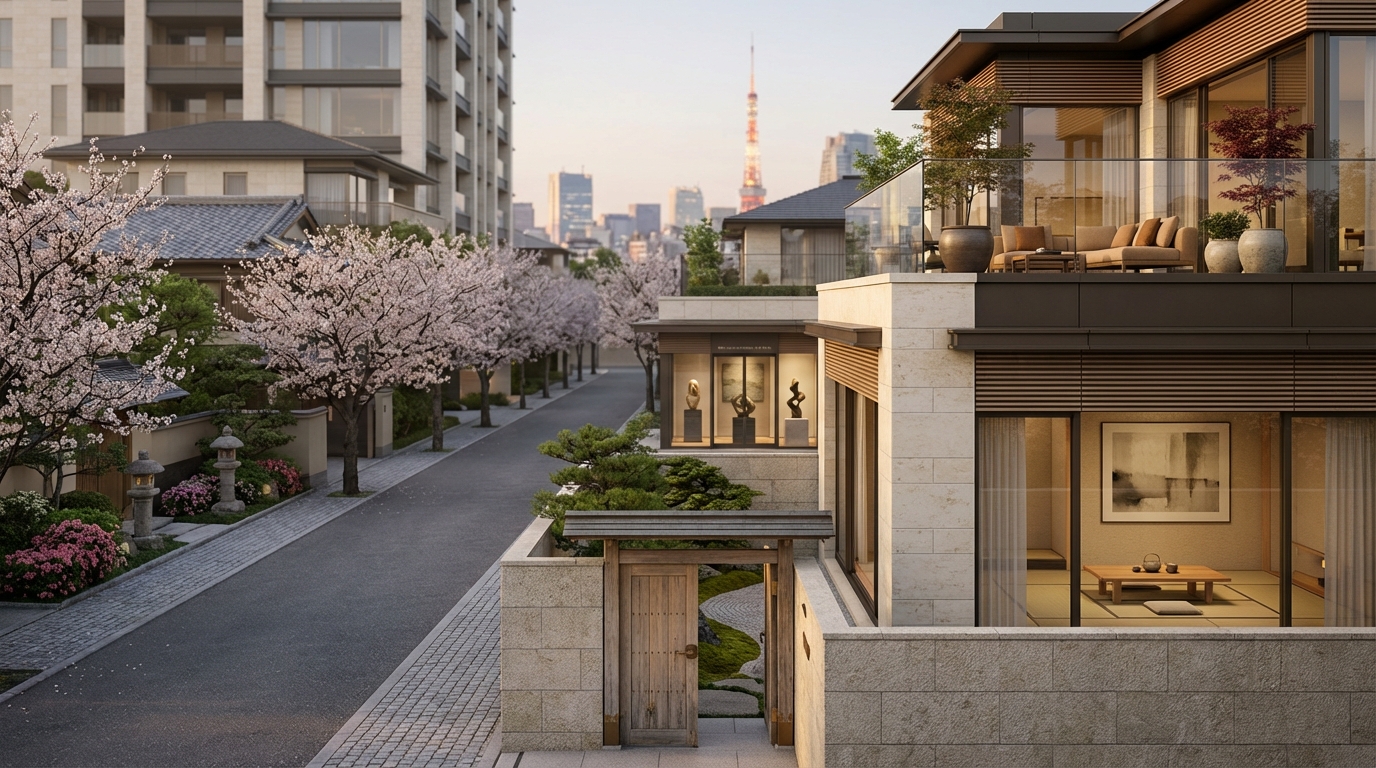
Buying property in Japan as a foreigner: a complete walkthrough
The process begins with a single question: can a foreigner purchase property in Japan? The answer surprises most international buyers. Japanese law places no restrictions on foreign property ownership. No visa requirement. No residency status prerequisite. No citizenship condition. A foreigner living abroad can buy a house in Japan with the same legal rights as a Japanese national.
This openness stands apart from many Asian markets. While neighboring countries impose ownership caps or require local partnerships, Japan allows full freehold ownership to anyone, regardless of nationality or residency. The Japanese Civil Code treats property rights uniformly across all buyers.
Yet legal permission differs from practical execution. The purchase process demands specific documentation, follows precise procedural steps, and requires navigation of systems designed primarily for domestic transactions. For overseas buyers especially, understanding the complete workflow from property search to final registration determines success.
Legal rights and restrictions for foreigners
Property ownership without residency
A foreigner can purchase real estate in Japan without holding a visa or living in Japan. The Foreign Exchange and Foreign Trade Act (外為法, Gaiho) governs cross-border transactions but does not prohibit property acquisition. Tokyo, Osaka, rural land in Hokkaido—all remain equally accessible to international buyers.
This applies to both residential and commercial properties. A US citizen, European investor, or Asian buyer holds identical ownership rights once the property transfers. The title deed (登記簿謄本, tokibo tohon) lists the owner’s name regardless of nationality.
The distinction between ownership and residency
Property ownership does not grant residency rights. Buying a home in Japan creates no pathway to a visa. A foreigner who purchases property must still comply with standard visa requirements to live in Japan beyond tourist allowances.
Japan offers no “golden visa” program tied to real estate investment. Some buyers assume a significant property purchase might facilitate permanent residency, but Japanese immigration law separates these matters entirely. Residency status depends on work authorization, family ties, or specific visa categories unrelated to property ownership.
For investment purposes, this separation works favorably. Foreign buyers can own, rent, and profit from Japanese real estate while residing elsewhere. Property management companies handle tenant relations, maintenance, and compliance for absentee owners.
Can foreigners buy property in Japan and rent it out?
Yes. Foreigners buy property in Japan for rental income without restriction. The same ownership rights extend to investment properties. Landlord obligations under Japanese tenancy law apply equally regardless of owner nationality.
Rental income becomes subject to Japanese taxation. Non-resident property owners pay income tax on rental proceeds, typically withheld at source by property management firms. The tax treaty between Japan and the owner’s home country may affect final tax liability.
Finding and selecting property
Working with a real estate agent
The Japanese real estate market operates through a network of licensed agents who access shared property databases. Most listings appear on platforms like REINS (Real Estate Information Network System), the industry’s central exchange.
For foreign buyers, selecting an agent with English capability and experience serving international clients streamlines the process. Tokyo agencies specializing in foreigner transactions understand documentation requirements that domestic-focused agents may find unfamiliar.
Agent fees in Japan typically reach 3% of the purchase price plus consumption tax, paid by both buyer and seller. This commission structure, capped by law, applies uniformly across transactions.
Property types available to foreigners
Japanese real estate includes several distinct categories. マンション (mansion) refers to condominiums, typically concrete apartment buildings with shared facilities. 一戸建て (ikkodate) means detached houses, either newly built or existing structures. Land purchases (land in Japan sold separately) allow custom construction.
Each property type carries different considerations. Condominiums involve monthly management fees and periodic major repair assessments. Detached houses require individual maintenance but offer greater privacy and customization. Age significantly affects pricing—Japanese buildings depreciate rapidly, with structures often valued near zero after 20-30 years while land retains value.
Regional considerations
Tokyo’s luxury market concentrates in central districts: Minato-ku encompasses Azabu (麻布), Hiroo (広尾), and Shirokane (白金), where properties regularly exceed ¥300 million. Shibuya-ku includes Daikanyama (代官山) and Aoyama (青山). These addresses command premium pricing due to location, international school access, and established foreign resident communities.
Outside Tokyo, Osaka, Kyoto, and resort areas like Niseko attract foreign investment. Rural properties can sell for remarkably low prices—the “$500 house in Japan” phenomenon references akiya (空き家, vacant houses) in depopulating regions. These properties exist but typically require substantial renovation and suit buyers willing to engage deeply with local communities rather than absentee investors.
Required documentation
For residents of Japan
Foreign buyers with residency in Japan follow a streamlined documentation path. Required items include:
- Passport and residence card (在留カード, zairyu card)
- Certificate of residence (住民票, juminhyo) issued by the local ward office
- Personal seal registration certificate (印鑑登録証明書, inkan toroku shomeisho)
- Proof of funds or loan pre-approval
The juminhyo shows current registered address. The inkan certificate validates the personal seal (印鑑, inkan) used to execute contracts—a requirement in Japanese legal transactions that carries more weight than signatures.
For overseas buyers
Foreigners purchasing property in Japan from abroad face additional documentation requirements. The critical document is an affidavit or certificate of seal impression (宣誓供述書, sensei kyojutsusho), which substitutes for the inkan certificate unavailable to non-residents.
This affidavit must be notarized at a Japanese embassy or consulate, or authenticated by a notary public in the buyer’s home country and then legalized (often through apostille for Hague Convention countries). The document confirms identity and authorizes the transaction.
Additional overseas buyer documents include:
- Valid passport (notarized copy)
- Proof of address in home country
- Certificate of legal competency (in some cases)
- Bank statements showing financial capacity
- Purchase offer letter (買付証明書, kaitsuke shomeisho)
The kaitsuke shomeisho represents a formal purchase offer. While not legally binding, it demonstrates serious intent and typically includes proposed price, conditions, and timeline.
The purchase process step by step
Property search and offer
The process begins with property identification through an agent or online platforms. After viewing, buyers submit a kaitsuke shomeisho. If the seller accepts, both parties move to contract preparation.
This preliminary stage involves price negotiation, condition verification, and timeline establishment. Japanese transactions typically move faster than Western markets—60 to 90 days from offer to closing is standard.
Purchase contract (売買契約書, baibai keiyakusho)
The formal purchase contract outlines all transaction terms. Key elements include:
- Property description and boundaries
- Purchase price and payment schedule
- Earnest money deposit (手付金, tetsukékin), typically 5-10% of purchase price
- Closing date (決済日, kessai bi)
- Condition of property and included fixtures
- Contingencies and cancellation terms
Both parties sign the contract in the presence of the real estate agent. The buyer pays the earnest money deposit at signing, which applies toward the purchase price at closing.
For overseas buyers, this stage may involve a proxy. Japanese law allows buyers to appoint a representative (売買契約代理人, baibai keiyaku dairi nin) who signs documents on their behalf. The proxy requires power of attorney, properly notarized and legalized according to the affidavit requirements above.
Due diligence period
Between contract signing and closing, buyers conduct final verification. This includes:
- Title search (登記簿謄本, tokibo tohon) confirming clean ownership
- Property inspection for structural or system issues
- Verification of building code compliance and permits
- Review of condominium management documents (for マンション purchases)
- Confirmation of property tax obligations
Japanese properties sell largely “as is” with limited seller disclosure requirements compared to Western markets. Professional inspection, while less common domestically, provides valuable protection for foreign buyers unfamiliar with Japanese construction standards.
Financing arrangements
Most foreigners purchasing property in Japan pay cash. Japanese banks traditionally hesitate to lend to non-residents or visa holders without permanent residency. Recent years have seen modest expansion in foreigner-friendly lending, but options remain limited.
For foreigners with permanent residency or long-term work visas, some Japanese banks offer mortgages. Requirements typically include:
- Permanent residency status or spouse visa
- Minimum three years of employment in Japan
- Stable income documented through tax returns
- Down payment of 20-30%
- Loan-to-value ratios capped at 70-80%
Interest rates for foreign borrowers often run 0.5-1% higher than rates for Japanese nationals. Shinsei Bank, SMBC Prestia, and several regional banks maintain programs for qualified foreign buyers.
International buyers without Japanese residency typically arrange financing in their home countries, using Japanese property as collateral through specialized international lenders. These loans carry higher rates and more restrictive terms than domestic financing.
Closing and settlement (決済・登記, kessai and toki)
Closing day brings all parties together—buyer, seller, agents, and often a judicial scrivener (司法書士, shiho shoshi). The shiho shoshi, a licensed legal professional, handles the property registration process.
The closing sequence follows a precise order:
For overseas buyers unable to attend closing in person, a settlement proxy (決済代理人, kessai dairi nin) executes these steps under power of attorney.
The shiho shoshi files the ownership transfer registration (所有権移転登記, shoyuken iten toki) with the Legal Affairs Bureau (法務局, homu kyoku). Registration typically completes within one to two weeks, after which the buyer receives the updated title deed showing their ownership.
Foreign Exchange and Foreign Trade Act reporting (外為法報告, Gaiho hokokusho)
The Foreign Exchange and Foreign Trade Act requires overseas buyers to file a post-transaction report. This notification, submitted through the Bank of Japan within 20 days of closing, discloses the property purchase for statistical and regulatory purposes.
The report requires basic transaction information: property location, purchase price, payment method, and intended use. Filing can occur through a Japanese bank handling the transaction or directly with the Bank of Japan.
Failure to file carries potential penalties, though enforcement focuses primarily on large commercial transactions. Most real estate agents guide foreign buyers through this requirement.
Costs beyond the purchase price
Acquisition taxes and fees
The purchase price represents only part of total acquisition costs. Additional expenses include:
Real estate acquisition tax (不動産取得税, fudosan shutoku zei): A one-time prefectural tax ranging from 3-4% of the assessed property value. Land and buildings are taxed separately. New residential properties may qualify for reductions.
Registration license tax (登録免許税, toroku menkyo zei): Charged when recording the ownership transfer, calculated as a percentage of property value. Rates vary by property type and buyer status, typically 1.5-2% for buildings and 1.5% for land.
Judicial scrivener fees: The shiho shoshi charges for registration services, typically ¥100,000-300,000 depending on property value and transaction complexity.
Real estate agent commission: 3% of purchase price plus ¥60,000, plus consumption tax (currently 10%). For a ¥100 million property, this reaches approximately ¥3.366 million.
Consumption tax: Applied to building value (not land) for new properties and to various service fees. Currently set at 10%.
Ongoing ownership costs
Annual property ownership in Japan incurs regular expenses:
Property tax (固定資産税, kotei shisan zei): Municipal tax based on assessed property value, typically 1.4% annually. Tokyo adds a city planning tax (都市計画税, toshi keikaku zei) of 0.3%, bringing the total to 1.7%.
Condominium fees (for マンション): Monthly management fees (管理費, kanri hi) and repair reserve funds (修繕積立金, shuzen tsumitate kin). Central Tokyo luxury condominiums charge ¥300-800 per square meter monthly.
Property management (for rental properties): Management companies typically charge 5-8% of monthly rent, handling tenant relations, rent collection, and maintenance coordination.
Insurance: Fire and earthquake insurance, particularly important given Japan’s seismic activity. Annual premiums vary by property value, construction type, and location.
For a ¥100 million condominium in central Tokyo (approximately 100㎡), annual carrying costs might include: ¥1.7 million in property taxes, ¥600,000 in management fees, and ¥100,000 in insurance—roughly ¥2.4 million annually before any mortgage payments.
Tax implications for foreign owners
Taxation for non-residents
Foreign property owners who do not live in Japan face taxation only on Japan-source income. Rental income from Japanese property incurs income tax at rates of 20.42% (national and local combined) withheld at source.
Upon property sale, non-residents pay capital gains tax. The rate depends on holding period: 39.63% for properties held less than five years (short-term), 20.315% for properties held five years or longer (long-term). These rates include national income tax, reconstruction surtax, and local inhabitant tax.
Tax treaties between Japan and many countries prevent double taxation, allowing foreign owners to claim credits for Japanese taxes paid against home country tax obligations.
Taxation for residents
Foreigners with residency status in Japan pay taxes as residents. Rental income adds to other income and faces progressive rates up to 55% (national and local combined) at the highest brackets. Mortgage interest, depreciation, and property management expenses provide deductible offsets.
Resident capital gains taxation follows the same rate structure as non-residents (39.63% short-term, 20.315% long-term) but allows more deductions and exemptions, particularly for primary residences.
Inheritance and gift tax
Japanese inheritance tax applies to property located in Japan regardless of owner nationality. Rates progress from 10% to 55% depending on inherited value and heir relationship. Foreign heirs inheriting Japanese property must file Japanese inheritance tax returns and may face complex cross-border estate issues.
Estate planning for foreign property owners should address both Japanese and home country inheritance rules to minimize tax burden and simplify transfer to heirs.
Special considerations for foreign buyers
Language barriers
Japanese remains the default language for real estate transactions. While English-speaking agents exist in major cities, legal documents, government filings, and official communications typically appear in Japanese only.
Foreign buyers benefit from engaging bilingual professionals: agents, shiho shoshi, and tax advisors who can navigate both languages. Translation services for critical documents add cost but provide essential clarity.
Cultural transaction norms
Japanese real estate transactions follow distinct cultural protocols. The concept of 礼金 (reikin, “key money”) in rental markets—a non-refundable payment to landlords—has no Western equivalent. Property conditions sell “as is” with minimal disclosure expectations.
Understanding these norms prevents misunderstandings. Japanese sellers expect decisiveness; extended negotiation after offer acceptance is uncommon. Transaction timelines run shorter than in many Western markets, requiring faster decision-making.
Building age and reconstruction
Japanese buildings depreciate rapidly. A 30-year-old house may have near-zero building value, with land comprising the entire property value. This differs markedly from Western markets where well-maintained older properties often appreciate.
Earthquake building codes have evolved significantly. Properties built after 1981 comply with “new earthquake standards” (新耐震基準, shin taishin kijun), offering better seismic performance. Buyers should verify construction date and consider seismic retrofitting for older properties.
Financing challenges
The difficulty foreigners face securing Japanese mortgages shapes the market. Cash purchases dominate foreign transactions, limiting the buyer pool but also creating opportunities for those with available capital.
Foreign buyers with permanent residency gain significant advantage in financing access. For those pursuing property purchase in Japan as a long-term strategy, securing permanent residency before property shopping expands options considerably.
Investment considerations and market dynamics
Can you live on $1,000 a month in Japan?
This question appears frequently but misleads regarding property investment returns. While possible in rural areas with minimal lifestyle expectations, Tokyo living costs run significantly higher. More relevant for property investors: rental yields in Tokyo average 3-4% gross for residential properties.
A ¥100 million property might generate ¥300,000 monthly rent (¥3.6 million annually), producing a 3.6% gross yield. After management fees, property tax, and maintenance, net yields typically fall to 2-3%. These returns lag global gateway cities but offer stability and currency diversification.
Is it true you can buy a house in Japan for $500?
Technically yes, but practically misleading. Akiya (vacant houses) in depopulating rural areas occasionally sell for nominal sums. These properties typically require extensive renovation, lack modern systems, and exist in communities with limited services and declining populations.
For foreign investors, these properties present more challenges than opportunities. Renovation costs often exceed purchase price multiples. Distance management proves difficult. Resale markets barely exist.
The ¥300 million+ Tokyo luxury market where Koukyuu operates represents the opposite end of the spectrum—properties in established international neighborhoods with stable demand and functional resale markets.
Market trends in 2026
The yen’s relative weakness against major currencies through 2024-2025 increased foreign buying interest. Properties that seemed expensive in dollar or euro terms several years ago became more accessible as exchange rates shifted.
Tokyo’s luxury market shows continued strength in central districts. According to Tokyo Kantei, average condominium prices in Minato-ku exceeded ¥2 million per square meter in late 2025, with prime addresses commanding significantly higher rates.
Foreign buyer interest concentrates in areas with international schools, English-language services, and established expatriate communities. Azabu, Hiroo, and Shirokane maintain premium positioning for this demographic.
Practical timeline for foreign buyers
A typical purchase timeline for a foreigner buying property in Japan spans 90-120 days:
Weeks 1-4: Property search, viewings, market familiarization, agent selection
Week 5: Offer submission (kaitsuke shomeisho), negotiation, offer acceptance
Week 6: Document preparation, affidavit notarization for overseas buyers
Week 7: Contract signing (baibai keiyakusho), earnest money deposit payment
Weeks 8-10: Due diligence, final inspections, financing finalization
Week 11: Closing preparation, fund transfer arrangements, proxy appointment if needed
Week 12: Closing (kessai), ownership transfer registration (toki)
Weeks 13-14: Registration completion, Gaiho reporting
Overseas buyers face longer timelines due to document authentication requirements and proxy coordination. Starting the affidavit notarization process early prevents delays.
Can a US citizen buy a house in Japan?
Yes. US citizens, like nationals of any country, can buy a house in Japan without restriction. No special permissions, no ownership caps, no residency requirements. The process described above applies uniformly regardless of citizenship.
The US-Japan tax treaty prevents double taxation on rental income and capital gains, though US citizens must still report worldwide income to the IRS. Japanese property ownership triggers US reporting requirements (FBAR, FATCA) when applicable thresholds are met.
Selecting professional representation
The role of buyer’s agents
The Japanese real estate system traditionally involves agents representing both sides of transactions, with loyalty split between buyer and seller. This differs from exclusive buyer representation common in some Western markets.
Foreign buyers benefit from agents who clearly prioritize buyer interests, provide transparent advice, and understand international client needs. Experience with foreigner transactions, bilingual capability, and knowledge of foreign buyer documentation requirements separate specialized agents from general practitioners.
Legal and tax advisors
While not legally required, engaging a Japanese tax advisor familiar with non-resident taxation provides valuable guidance. Tax treatment of rental income, capital gains, and estate planning involves complexity that generalist advice may miss.
For large transactions or complex situations, consulting a Japanese attorney (弁護士, bengoshi) in addition to the standard shiho shoshi adds protection. Attorneys can review contracts, advise on legal structures, and address cross-border legal issues beyond the shiho shoshi’s registration-focused scope.
The Japanese property market offers foreign buyers unusual openness combined with procedural precision. Understanding the complete workflow—from legal rights through documentation, contract execution, closing, and post-purchase obligations—transforms what initially appears complex into a navigable process.
For international buyers seeking representation in Tokyo’s luxury residential market, Koukyuu provides end-to-end buyer advocacy in the ¥300M+ segment. Our team guides foreign clients through each stage of property acquisition in Tokyo’s most distinguished addresses. Begin a private conversation with our concierge team.