

Reviewed by a Koukyuu Takkenshi (宅地建物取引士)
Fact-checked against current Japanese real-estate law, tax rules, and market data by a nationally licensed specialist who oversees luxury transactions across Minato, Shibuya, and Chiyoda. In Japan, a Takkenshi is legally required to sign off on every property transaction, and about 15% of candidates pass the exam each year.
Types of Japanese houses: a complete guide to residential architecture in Japan
Walk through any neighborhood in Tokyo (東京) or Kyoto (京都), and you’ll encounter a residential landscape unlike any other major city. The variety of housing types in Japan reflects centuries of architectural evolution, modern urban density challenges, and distinct cultural preferences about space and privacy. From traditional wooden minka (民家) with tatami rooms to contemporary high-rise mansion apartments, understanding these housing categories matters whether you’re planning to buy, rent, or simply appreciate Japanese residential design.
Housing in Japan divides into several distinct categories, each with specific construction standards, legal classifications, and target residents. The terminology itself can confuse newcomers—what Japanese call a “mansion” (マンション) refers to a condominium apartment, while a “detached house” (一戸建て, ikkodate) means a single-family home. This guide examines each housing type, explaining who they suit and what distinguishes them in the current market.
Traditional Japanese house: minka and kominka
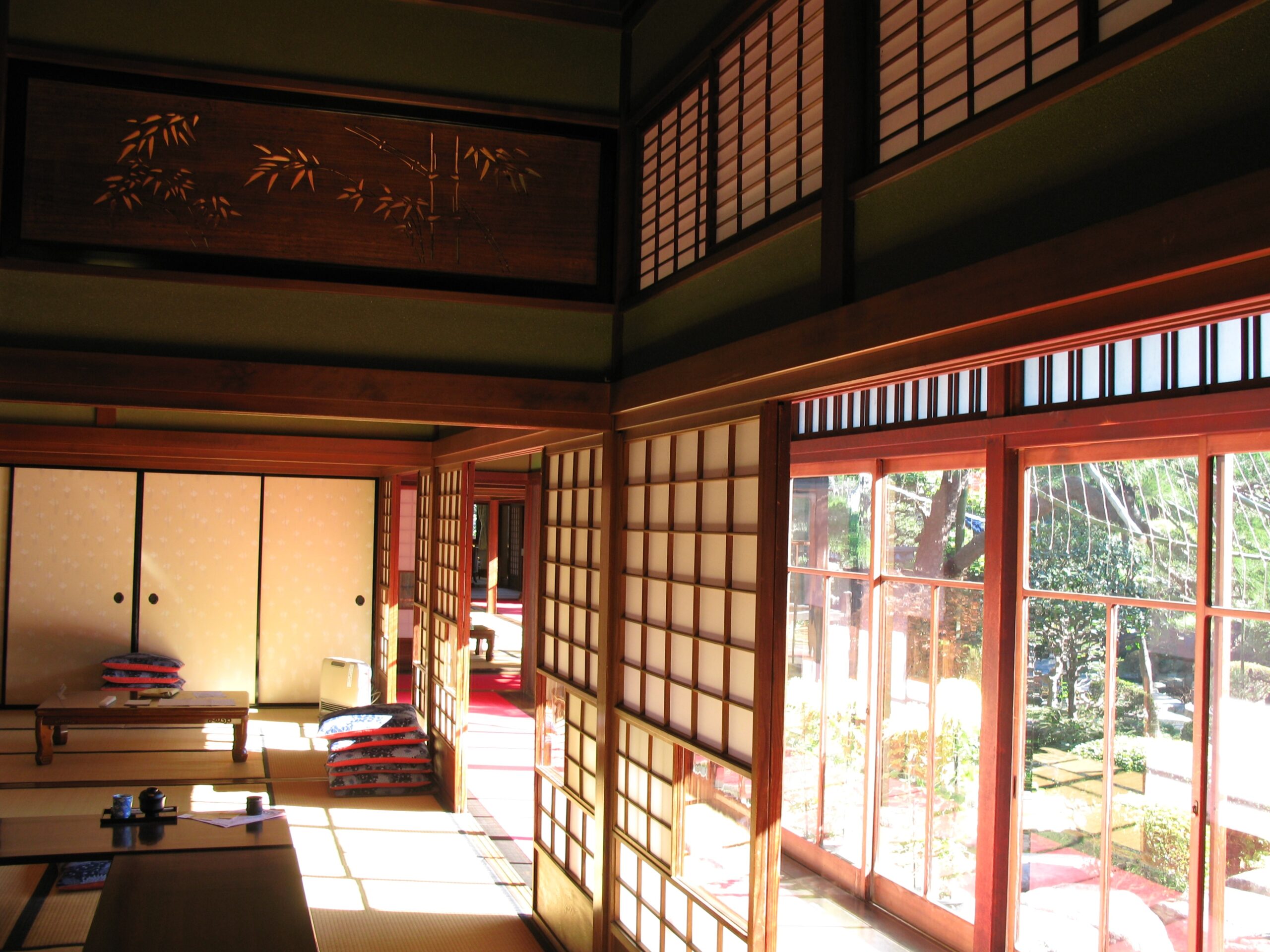
The traditional Japanese house, known as minka (民家), represents residential architecture developed over centuries to suit Japan’s climate and available materials. These structures typically feature wooden post-and-beam construction, raised floors, and flexible interior spaces defined by sliding doors rather than fixed walls.
A traditional Japanese home uses shoji (障子)—translucent paper screens on wooden frames—and fusuma (襖)—opaque sliding doors—as movable partitions between rooms. This allows residents to reconfigure spaces seasonally or for different functions. The tatami room (畳の間, tatami no ma), floored with woven rush mats in standardized sizes, serves as the architectural module for measuring room dimensions. One tatami mat measures approximately 1.62 square meters, and rooms are described by their mat count: a six-mat room, an eight-mat room.
The roof of a traditional Japanese house extends significantly beyond the walls, protecting wooden structures from rain while creating covered outdoor transition spaces called engawa (縁側). Tile roofs, particularly ceramic kawara tiles, became standard in urban areas after repeated fire disasters in Edo-period cities.
Kominka (古民家) specifically refers to old minka, typically structures built before World War II. According to data from the Ministry of Land, Infrastructure, Transport and Tourism, approximately 1.5 million kominka remain standing across Japan as of 2026, though many face demolition due to inheritance issues and maintenance costs. In Kyoto prefecture, local governments have established preservation incentives for machiya (町家)—the narrow wooden townhouses that once dominated merchant districts.
These traditional houses suit those who value Japanese culture and craftsmanship, accept higher maintenance requirements, and often seek rural or historic urban locations. Kominka renovation has gained attention in recent years, particularly among buyers seeking second homes or lifestyle businesses like guesthouses.
Modern Japanese house: contemporary detached residences
The modern Japanese house represents a significant departure from traditional design while retaining certain cultural preferences. Detached houses (一戸建て) built after 1980 typically use a combination of wood framing and steel reinforcement to meet Japan’s strict seismic performance standards (耐震性能, taishin seinou).
According to the Japan Housing Finance Agency, the average new detached house in Tokyo measured 99.5 square meters in floor area as of 2026, considerably smaller than single-family homes in most Western countries. This reflects land scarcity in urban areas—the average plot size in Tokyo’s 23 wards measures just 110 square meters.
Modern Japanese homes incorporate Western room layouts alongside traditional elements. A typical residence includes LDK space (living-dining-kitchen in one open plan), Western-style bedrooms with beds rather than futon, and at least one tatami room for guests or ceremonial occasions. Built-in storage has become standard, addressing the minimal square footage available.
Construction methods divide into two main categories. Custom-built homes (注文住宅, chuumon juutaku) involve hiring an architect and builder to design from scratch. Spec homes (分譲住宅, bunjou juutaku) are pre-designed houses built by developers on subdivided land parcels and sold upon completion or during construction.
The concept of kikaku juutaku (規格住宅), or standardized housing, has grown significantly since 2020. Major house manufacturers (ハウスメーカー, house maker) like Sekisui House, Daiwa House, and積水ハウス offer catalog-based designs with customization options, reducing costs through standardized components while maintaining quality control.
Pricing uses tsubo-tanka (坪単価), the cost per tsubo—a traditional unit equaling 3.31 square meters. According to Suumo’s 2026 data, average construction costs in Tokyo range from ¥800,000 to ¥1,200,000 per tsubo for standard builders, rising to ¥1,500,000 to ¥2,500,000 per tsubo for premium custom construction.
Modern detached houses suit families seeking more space and autonomy than apartment living provides, those willing to manage property maintenance directly, and buyers in suburban or regional areas where land costs make this option financially viable.
Mansion: the Japanese condominium apartment
The term “mansion” (マンション) in Japanese refers to what English speakers call a condominium or apartment building with individually owned units. This represents the dominant housing type in Tokyo and other major urban areas. According to the Real Estate Economic Institute, mansion units accounted for 68% of new housing supply in Tokyo’s 23 wards in 2026.
Mansion buildings typically use reinforced concrete construction (鉄筋コンクリート, tekkin konkuriito, abbreviated RC) or steel-frame reinforced concrete (鉄骨鉄筋コンクリート, SRC). This construction method provides superior earthquake resistance, sound insulation, and fire protection compared to wooden structures.
The average new mansion unit in central Tokyo measured 62.3 square meters in 2026, according to Tokyo Kantei data. Layouts follow the LDK system: 1LDK (one bedroom plus living-dining-kitchen), 2LDK (two bedrooms plus LDK), and so forth. Premium developments in areas like Shirokane (白金) or Hiroo (広尾) may include larger formats: 3LDK units exceeding 100 square meters, or rare 4LDK residences approaching 150 square meters.
Mansion ownership includes monthly management fees (管理費, kanrihi) and repair reserve funds (修繕積立金, shuuzen tsumitatekin). These typically range from ¥15,000 to ¥40,000 combined for a standard 70-square-meter unit, increasing with building age and amenity level. Luxury towers in Roppongi (六本木) or Azabu (麻布) may charge ¥100,000 or more monthly for units exceeding 200 square meters.
The mansion market divides into several sub-categories. Tower mansion (タワーマンション) refers to high-rise buildings exceeding 20 floors, concentrated in waterfront areas and major transit hubs. Vintage mansion describes older buildings from the 1970s-1990s, often in established neighborhoods with larger unit sizes than contemporary construction. Designer’s mansion features architectural distinction, often by notable firms.
Mansion residence suits urban professionals prioritizing location and convenience, those seeking lower maintenance responsibility than detached houses require, and buyers in central Tokyo where land costs make detached houses prohibitively expensive. According to Koukyuu’s market analysis, mansion units represent 89% of residential transactions above ¥300 million in Tokyo’s central five wards.
Apato: the rental apartment building
An apato (アパート) refers to a smaller rental apartment building, typically two or three stories, using wood or light steel frame construction. The distinction between apato and mansion involves both construction method and cultural perception—apato buildings generally offer more modest specifications and lower rents.
According to the Japan Property Management Association, the average apato unit measures 25 to 35 square meters, usually configured as a studio (ワンルーム, one room) or 1K (one room plus separate kitchen). Construction uses mokuzou (木造, wooden) or keiryou tekkin (軽量鉄骨, light steel frame) methods, providing adequate but minimal sound insulation between units.
Apato buildings rarely include elevators or significant shared amenities. Residents typically have individual entrance doors opening to exterior corridors or staircases rather than enclosed hallways. Monthly costs include only rent and utilities—no management fees or repair reserves as with mansion ownership.
This housing type suits students, young professionals, and those seeking affordable short-term residence. Apato concentrations appear in university districts and suburban areas throughout Tokyo, Osaka, and regional cities. The rental model means no property tax obligations or long-term maintenance concerns for residents.
Terrace house and row house: connected residences
Terrace houses (テラスハウス) and row houses (長屋, nagaya) represent attached single-family dwellings sharing side walls with neighboring units. Each residence includes its own entrance at ground level, typically with a small private yard or terrace space.
The modern terrace house evolved from the traditional nagaya, which housed merchant-class families in Edo-period cities. Contemporary versions use the same construction standards as detached houses—wooden or steel frame with proper seismic reinforcement—but reduce land costs by sharing lot boundaries.
According to architectural data from the Japan Institute of Architects, terrace house developments have increased 23% in Tokyo’s outer wards since 2023. These projects typically include 4 to 12 connected units, each measuring 70 to 100 square meters across two or three floors.
Terrace house ownership resembles detached house ownership in terms of maintenance responsibility and property tax, but with lower purchase prices due to reduced land costs. The shared wall construction requires coordination with neighbors for exterior repairs and renovations. Some developments establish homeowners’ associations to manage common elements like access roads or shared gardens.
This housing type suits small families or couples seeking a middle ground between apartment living and fully detached houses, those prioritizing outdoor space and ground-level access, and buyers in expensive urban areas where detached houses exceed budget constraints.
What Japanese houses look like inside
The interior of a Japanese house, whether traditional or modern, reflects specific cultural practices and spatial efficiency principles. Genkan (玄関), the entrance area, creates a distinct boundary between outside and inside. Residents and guests remove shoes here before stepping up to the main floor level, maintaining cleanliness and marking a psychological transition into private domestic space.
Storage solutions emphasize built-in elements rather than freestanding furniture. Oshiire (押入れ) closets in tatami rooms use deep shelving designed for stacking futon bedding during daytime. Western-style bedrooms include closets with hanging rods. Modern homes increasingly incorporate walk-in closets and pantry storage, addressing the limited square footage of urban residences.
Kitchens in contemporary Japanese homes follow compact, highly organized layouts. According to housing manufacturer Panasonic Homes, the average Tokyo kitchen measures 2.4 to 2.7 meters in length. Built-in appliances, pull-out storage, and vertical organization maximize utility within minimal space. Many apartments include combination washer-dryer units in bathroom areas or dedicated utility closets rather than separate laundry rooms.
Bathroom design separates bathing and toilet functions. The ofuro (お風呂) bathroom contains a deep soaking tub and shower area with waterproof flooring and walls, designed for washing before bathing. The toilet occupies a separate small room. This separation allows multiple family members to use facilities simultaneously and reflects Japanese bathing culture, which emphasizes the bath as a relaxation ritual rather than merely hygiene.
Sliding doors—both shoji and fusuma—continue to appear even in modern homes, allowing flexible space division. A dining area can connect to or separate from a living room depending on need. Guest rooms can close off or open to create larger gathering spaces.
How long Japanese houses last
Japanese residential structures have notably shorter lifespans than housing in many Western countries. According to research from Nomura Research Institute, the average Japanese house undergoes demolition after approximately 30 years, compared to 70-80 years in the United States or over 100 years in the United Kingdom.
This pattern reflects several factors. Rapid post-war construction used materials and methods that deteriorated relatively quickly. Cultural preferences favor new construction over renovation—the resale value of detached houses drops significantly after 20-25 years, with land value rather than structure value determining price. Tax depreciation schedules treat wooden structures as fully depreciated after 22 years and RC structures after 47 years, creating financial incentives for demolition and rebuilding.
However, this pattern has begun shifting. Stricter building codes implemented after the 1995 Kobe earthquake and 2011 Tohoku earthquake established higher seismic performance standards. Houses built after 2000 using modern techniques and materials should last 50-60 years with proper maintenance. The government’s long-term quality housing (長期優良住宅, chouki yuryou juutaku) certification program, introduced in 2009 and expanded in 2023, provides tax incentives for homes designed to last 75-100 years.
Mansion buildings generally last longer than detached houses due to RC construction. According to Tokyo Kantei, the average mansion building in Tokyo operates for 50-60 years before redevelopment, though some structures from the 1960s-1970s continue in use. Large-scale renovations (大規模修繕, daikibo shuuzen) occur approximately every 12-15 years to maintain building systems and exteriors.
What are Japanese style houses called
Japanese architectural terminology distinguishes between historical and contemporary forms. Minka (民家) serves as the general term for traditional folk houses, encompassing various regional styles. Kominka (古民家) specifically means old minka, typically pre-war structures.
Within traditional categories, several specific types exist. Machiya (町家) refers to the narrow wooden townhouses built in merchant districts of Kyoto, Kanazawa, and other historic cities. These typically measure 5-6 meters wide but extend 20-30 meters deep, with interior courtyards (tsuboniwa) providing light and ventilation. Nōka (農家) describes traditional farmhouses, often featuring large thatched roofs and open interior spaces for agricultural work.
Samurai residences (武家屋敷, buke yashiki) represented higher-status construction with more elaborate roof forms, larger rooms, and defensive features. Few authentic examples remain, though preserved districts in Kanazawa and Kakunodate allow visitors to experience these historical forms.
Contemporary terminology focuses on construction type and ownership structure rather than architectural style. Ikkodate (一戸建て) means detached house. Mansion (マンション) refers to condominium apartments. Apato (アパート) indicates rental apartments. Danchi (団地) describes large-scale public housing developments built primarily in the 1960s-1980s.
The term “Japanese-style” (和風, wafuu) applied to modern construction indicates incorporation of traditional elements—tatami rooms, shoji screens, or traditional roof forms—within otherwise contemporary design. Many modern Japanese homes blend Western and Japanese elements, described as wasei (和洋, Japanese-Western style).
Where types of Japanese houses are located
Housing type distribution follows clear geographic and economic patterns across Japan. Traditional houses concentrate in rural areas and historic preservation districts. According to the Ministry of Internal Affairs and Communications, approximately 78% of remaining kominka stand in towns and villages with populations under 50,000. Kyoto maintains the highest concentration of preserved machiya, with over 40,000 traditional townhouses still in residential or commercial use as of 2026.
Detached houses dominate suburban and regional areas where land costs allow. In Tokyo, detached house construction concentrates in outer wards like Setagaya (世田谷), Ota (大田), and Nerima (練馬), where average land prices range from ¥800,000 to ¥1,500,000 per square meter. In central areas like Minato ward (港区) or Shibuya (渋谷), detached houses become rare and expensive, with land exceeding ¥3,000,000 per square meter in prime locations.
Mansion buildings concentrate in urban areas, particularly along major train lines. Tokyo’s 23 wards contain approximately 1.8 million mansion units according to Tokyo Metropolitan Government data, representing 52% of all housing stock in central areas. The highest concentrations appear in Koto ward (江東区), where waterfront redevelopment created extensive tower mansion districts, and Minato ward, where luxury developments serve international and domestic affluent residents.
Apato buildings appear throughout urban and suburban areas, particularly surrounding universities and in working-class neighborhoods. These provide essential affordable housing in cities like Tokyo, Osaka, and Nagoya, where mansion ownership or detached house rental exceed many residents’ budgets.
Terrace house developments occupy a middle zone—too land-intensive for central Tokyo but appearing in inner suburbs like Meguro (目黒), Nakano (中野), and Suginami (杉並). Regional cities with lower land costs see more terrace house construction, offering urban convenience with house-like characteristics.
What are Japanese houses made of
Construction materials in Japanese housing have evolved significantly while maintaining certain consistent principles. Traditional Japanese houses used wood as the primary structural material, specifically Japanese cypress (hinoki), cedar (sugi), and zelkova (keyaki). These woods offer natural rot resistance, workability, and aesthetic qualities valued in Japanese carpentry. The post-and-beam framework allows walls to serve as non-structural elements, enabling the flexible interior spaces created by sliding doors and partitions.
Traditional roof construction used several materials depending on region and status. Ceramic tiles (kawara) became standard in urban areas and wealthy rural homes, providing fire resistance and durability. Thatched roofs (kayabuki) using miscanthus grass appeared in rural farmhouses, offering excellent insulation but requiring replacement every 20-30 years. Wooden shingles (kokera) covered some regional styles.
Modern detached houses continue to use wood framing as the primary method, but with engineered lumber, metal connectors, and integrated seismic reinforcement. According to the Japan Wood Products Information and Research Center, approximately 82% of new detached houses in 2026 used wood as the primary structural material. However, modern construction incorporates extensive non-wood elements: concrete foundations, steel reinforcement, synthetic insulation, and exterior cladding materials including metal siding, ceramic panels, or synthetic stucco.
Mansion buildings use reinforced concrete (RC) or steel-reinforced concrete (SRC) construction exclusively. These methods provide the structural integrity necessary for multi-story buildings in seismic zones. Concrete also offers superior fire resistance and sound insulation compared to wood construction—critical factors in dense urban environments.
Interior materials reflect a blend of traditional and contemporary preferences. Tatami mats continue to appear in many homes, using woven rush (igusa) over a compressed core. Fusuma sliding doors use wooden frames with paper or fabric covering. Modern homes incorporate vinyl flooring, engineered wood, and carpet alongside traditional materials. Built-in cabinetry and storage use plywood and particleboard with laminate or veneer finishes, maximizing durability and cost efficiency.
High-performance housing and ZEH standards
Japanese housing policy has shifted dramatically toward energy efficiency and environmental performance since 2020. The ZEH standard (ゼッチ, Net Zero Energy House) requires homes to produce as much energy as they consume annually through a combination of insulation, efficient systems, and solar power generation.
According to the Ministry of Economy, Trade and Industry, 28% of new detached houses completed in 2026 met ZEH standards, up from just 8% in 2020. The government targets 50% ZEH compliance by 2030 through subsidy programs and building code revisions. ZEH-compliant homes receive construction subsidies of ¥550,000 to ¥1,150,000 depending on specification level, plus preferential mortgage terms through the Japan Housing Finance Agency’s Flat 35 program.
ZEH standards require thick insulation, high-performance windows (typically triple-glazed), heat-recovery ventilation systems, and solar panels generating at least 10-15 kilowatts. These specifications increase construction costs by approximately ¥2,000,000 to ¥3,500,000 for a typical 100-square-meter house, but reduce annual energy costs by 60-80% according to data from the Institute for Building Environment and Energy Conservation.
Major house manufacturers now offer ZEH specifications as standard or easily-added options.積水ハウス (Sekisui House) reports that 87% of their detached house orders in 2026 specified ZEH-level performance. This represents a significant shift in buyer priorities—energy performance now ranks alongside earthquake resistance as a primary decision factor.
Seismic performance standards (耐震性能) have also strengthened progressively. Current building codes require structures to withstand shaking equivalent to the 1995 Kobe earthquake without collapse. Higher voluntary standards exist: Grade 2 seismic performance (耐震等級2) provides 1.25 times code minimum, while Grade 3 (耐震等級3) provides 1.5 times code minimum. Grade 3 structures should remain habitable after major earthquakes, while code-minimum buildings may require repairs despite avoiding collapse.
According to house manufacturer comparison data compiled by Suumo, premium builders like Mitsui Home and Sumitomo Forestry offer Grade 3 seismic performance as standard, while mid-tier builders typically provide Grade 2. Mansion buildings follow similar classifications, with luxury developments in Tokyo increasingly advertising Grade 2 or 3 certification as a premium feature.
Comparing costs and value across housing types
Purchase costs vary dramatically by housing type and location. According to the Real Estate Economic Institute, the average new mansion unit in Tokyo’s 23 wards cost ¥78,600,000 in 2026, while the average new detached house in the same area cost ¥67,300,000. However, these figures mask significant variation—central ward mansion units average ¥120,000,000 to ¥150,000,000, while outer ward detached houses may cost ¥45,000,000 to ¥60,000,000.
Terrace houses typically cost 70-80% of comparable detached houses due to shared land costs. Apato units, sold as investment properties, range from ¥15,000,000 to ¥35,000,000 depending on location and size. Kominka prices vary enormously based on condition and location—a deteriorated rural structure might sell for ¥3,000,000 to ¥8,000,000, while a renovated machiya in central Kyoto could exceed ¥100,000,000.
Ongoing costs differ substantially by type. Detached house owners pay property tax (固定資産税) averaging 1.4% of assessed value annually, plus all maintenance costs directly. Mansion owners pay similar property tax plus monthly management fees and repair reserves, but share maintenance costs across all unit owners. Apato renters pay only monthly rent and utilities, avoiding all ownership costs and long-term obligations.
Resale value patterns also vary. Mansion units in prime Tokyo locations maintain value relatively well—central ward properties depreciate approximately 10-15% over 10 years according to Tokyo Kantei data. Detached houses depreciate more rapidly, with structures losing most value after 20-25 years while land retains or appreciates in value. Traditional houses face challenging resale markets due to maintenance requirements and limited buyer pools, though well-renovated kominka in desirable locations can command premiums.
Choosing the right housing type
Housing selection in Japan depends on multiple factors: budget, location priorities, lifestyle preferences, and long-term plans. Families with children often prefer detached houses in suburban areas, gaining space and autonomy while accepting longer commutes. According to Suumo’s 2026 residential survey, 68% of families with two or more children choose detached houses when financially feasible.
Urban professionals typically select mansion apartments in central locations, prioritizing commute time and neighborhood amenities over space. Single residents and couples without children represent the primary mansion market in areas like Shibuya, Minato ward, and Chuo ward (中央区).
International buyers face additional considerations. Mansion ownership provides simpler management for those spending limited time in Japan—building management handles maintenance, security, and common area upkeep. Detached houses require more direct involvement or hiring property management services. According to Koukyuu’s client data, international buyers seeking Tokyo properties above ¥300 million choose mansion units in 89% of transactions, concentrating in neighborhoods like Azabu, Hiroo, and Aoyama (青山) where international communities and services cluster.
Traditional houses appeal to specific buyer segments: those seeking cultural immersion, buyers prioritizing character over convenience, and investors developing hospitality or retail concepts. The kominka market remains specialized, with limited financing options and requiring buyers comfortable managing renovation and ongoing maintenance.
—
The Japanese residential landscape offers distinct housing types serving different needs and preferences. Understanding these categories—from traditional minka to modern high-rise mansion apartments—allows informed decisions aligned with lifestyle priorities and practical requirements.
Koukyuu represents buyers seeking properties of lasting significance in Tokyo’s most distinguished addresses. For a private conversation about residence options in the ¥300 million and above market, reach our concierge team.